GoPro Max2
Insta360 X4 Air

GoPro Max2 Insta360 X4 Air

Overview

Welcome to our in-depth specs comparison between the GoPro Max2 and the Insta360 X4 Air — two compelling 360-degree action cameras vying for the attention of adventure filmmakers and content creators alike. In this head-to-head, we examine key battlegrounds including ruggedness and waterproofing, low-light imaging capability, portability, and connectivity features to help you decide which camera best suits your needs.

Common Features

  • Both cameras feature a touch screen.
  • Both cameras have an external memory slot.
  • Both cameras have a display.
  • Neither camera has any internal storage.
  • The maximum operating temperature is 40 °C on both cameras.
  • Neither camera has a secondary screen.
  • Neither camera has a flip-out screen.
  • Both cameras are compatible with Android.
  • Both cameras are compatible with iOS.
  • Both cameras support first-party live streaming.
  • Both cameras use USB version 3.
  • Both cameras have a USB Type-C connector.
  • Neither camera has an HDMI output.
  • Both cameras support Wi-Fi.
  • Neither camera supports aptX.
  • Both cameras have a removable and rechargeable battery.
  • Both cameras have a battery level indicator.
  • Both cameras feature a stereo microphone.
  • Neither camera has a microphone input or a 3.5 mm audio jack socket.
  • Both cameras shoot at 29 MP on the main camera.
  • Both cameras have an adjustable field of view.
  • Both cameras feature a dual-lens main camera.
  • Both cameras use a BSI CMOS sensor.
  • Both cameras support manual exposure and manual shutter speed.
  • Neither camera has a flash.
  • Both cameras record video at 3840 x 30 fps on the main camera.
  • Both cameras have a timelapse function.
  • Both cameras support phase-detection autofocus and continuous autofocus for video recording.
  • Both cameras support horizon leveling.
  • Both cameras have a 24p cinema mode.
  • Both cameras support AF tracking.
  • Neither camera has a video light.

Main Differences

  • The lowest operating temperature is -10 °C on GoPro Max2 and -20 °C on Insta360 X4 Air.
  • The waterproof depth rating is 5 m on GoPro Max2 and 15 m on Insta360 X4 Air.
  • The volume is 217.24 cm³ on GoPro Max2 and 193.69 cm³ on Insta360 X4 Air.
  • The weight is 195 g on GoPro Max2 and 165 g on Insta360 X4 Air.
  • The thickness is 48.7 mm on GoPro Max2 and 37 mm on Insta360 X4 Air.
  • The width is 64 mm on GoPro Max2 and 46 mm on Insta360 X4 Air.
  • The height is 69.7 mm on GoPro Max2 and 113.8 mm on Insta360 X4 Air.
  • The Bluetooth version is 5.3 on GoPro Max2 and 5.2 on Insta360 X4 Air.
  • GPS is available on GoPro Max2 but not on Insta360 X4 Air.
  • The battery capacity is 1960 mAh on GoPro Max2 and 2010 mAh on Insta360 X4 Air.
  • The wide aperture of the main camera is f/1.8 on GoPro Max2 and f/1.95 on Insta360 X4 Air.
  • The maximum ISO is 6400 on GoPro Max2 and 3200 on Insta360 X4 Air.
  • The field of view is 360° on GoPro Max2 and 170° on Insta360 X4 Air.
Specs Comparison
GoPro Max2

GoPro Max2

Insta360 X4 Air

Insta360 X4 Air

Design:
has a touch screen
has an external memory slot
Has a display
internal storage 0GB 0GB
maximum operating temperature 40 °C 40 °C
lowest potential operating temperature -10 °C -20 °C
Has a secondary screen
waterproof depth rating 5 m 15 m
Has a flip-out screen
volume 217.24096 cm³ 193.6876 cm³
weight 195 g 165 g
thickness 48.7 mm 37 mm
width 64 mm 46 mm
height 69.7 mm 113.8 mm

Both cameras share a similar feature baseline in terms of their display setup — each offers a touch screen, an external memory slot, and no internal storage, meaning neither gives you a buffer if you forget your microSD card. Neither has a flip-out or secondary screen, keeping the physical design relatively streamlined on both sides. Where things diverge meaningfully is in form factor and durability.

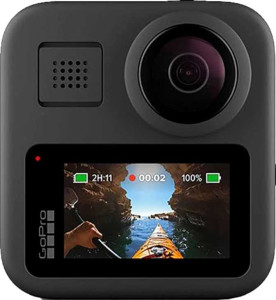
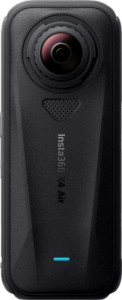
The GoPro Max2 is shaped more like a compact cube at 64 × 69.7 × 48.7 mm, while the Insta360 X4 Air takes a tall, slim profile at 46 × 113.8 × 37 mm — notably thinner and narrower but significantly taller. In practice, the Max2 feels more palm-sized and symmetrical, while the X4 Air is more pen-like or selfie-stick-friendly. The X4 Air also wins on weight at 165 g versus 195 g, a 30g difference that adds up during extended handheld shoots or when mounted on a helmet for long sessions. Its overall volume of 193.69 cm³ versus 217.24 cm³ confirms it is the more compact device overall.

The most decisive gap in this group, however, is environmental resilience. The X4 Air is rated waterproof to 15 m without a housing, compared to just 5 m for the Max2 — a threefold difference that matters enormously for divers, snorkelers, or anyone shooting in heavy rain or surf. The X4 Air also tolerates colder conditions, operating down to -20 °C versus -10 °C for the Max2, making it the better companion for winter sports or high-altitude use. On design and durability, the Insta360 X4 Air holds a clear edge, particularly for users who need rugged, weather-resistant performance.
Connectivity & Features:
release date September 2025 October 2025
Is compatible with Android
Is compatible with iOS
Bluetooth version 5.3 5.2
has first-party support for live streaming
USB version 3 3
Has USB Type-C
has an HDMI output
has GPS
supports Wi-Fi
Wi-Fi version Wi-Fi 6 (802.11ax), Wi-Fi 5 (802.11ac), Wi-Fi 4 (802.11n) Wi-Fi 4 (802.11n), Wi-Fi 5 (802.11ac), Wi-Fi 6 (802.11ax)
has aptX
has wireless charging
is DLNA-certified
supports a remote smartphone
has NFC

The connectivity foundation is nearly identical between these two cameras — both support USB 3 with Type-C, match on Wi-Fi standards (Wi-Fi 4, 5, and 6), offer smartphone remote control, live streaming, and are compatible with both Android and iOS. For most users, day-to-day file transfers and app-based control will feel essentially the same on either device.

Digging into the finer points, the GoPro Max2 edges ahead with Bluetooth 5.3 versus 5.2 on the X4 Air — a minor version gap that brings marginally improved connection stability and efficiency, though it is unlikely to be noticeable in typical use. More meaningfully, the Max2 includes built-in GPS, which the X4 Air entirely lacks. For adventure athletes, travel vloggers, or anyone who wants to geotag footage, log routes, or overlay speed and altitude data in post-production, this is a practical and significant omission on the X4 Air's part.

On connectivity, the GoPro Max2 has a clear edge. The GPS inclusion alone is a meaningful real-world differentiator — it is the kind of feature that cannot be added via a firmware update and directly expands what you can do with your footage without relying on a separate device.

Battery:
battery power 1960 mAh 2010 mAh
has a removable battery
has a rechargeable battery
has a battery level indicator

Battery specs are about as close as they get here. The Insta360 X4 Air carries a 2010 mAh cell versus 1960 mAh in the GoPro Max2 — a difference of just 50 mAh, which translates to no meaningful real-world distinction in shooting time. Both batteries are removable and rechargeable, meaning you can carry spares and hot-swap in the field rather than waiting for a full recharge cycle, which is the most practically important battery feature for action camera users.

The shared battery level indicator on both devices is a minor but welcome convenience, letting you gauge remaining charge at a glance without needing to open an app. Again, neither camera offers any differentiation here.

On battery, these two cameras are effectively tied. The 50 mAh gap is too small to factor into any purchasing decision, and every other battery-related feature is identical. Users should weigh battery life expectations against other spec groups rather than looking for an advantage here.

Audio:
has a stereo microphone
has a microphone input
has a socket for a 3.5 mm audio jack

Audio hardware is a complete mirror between these two cameras. Both the GoPro Max2 and the Insta360 X4 Air feature a built-in stereo microphone, and neither offers a microphone input or a 3.5 mm audio jack. That last point is worth flagging for users who rely on external microphones for interviews, vlogging, or any scenario where ambient noise is a problem — on both cameras, you are locked into the internal mics with no wired upgrade path.

The absence of any external audio input is a known trade-off in compact 360 action cameras, where the priority is waterproofing and miniaturization over audio versatility. Both products make the same call here, so neither gains or loses ground relative to the other.

This group is a complete tie. Audio capability is identical across every provided spec, and the shared limitation of no external microphone support applies equally to both. If advanced audio capture is a priority, neither camera holds an advantage based on these specs.

Optics:
megapixels (main camera) 29 MP 29 MP
has an adjustable field of view
wide aperture (main camera) 1.8f 1.95f
Has a dual-lens (or multi-lens) main camera
has a BSI sensor
has a CMOS sensor
maximum ISO 6400 ISO 3200 ISO
has manual exposure
has a flash
has manual shutter speed
has manual white balance

At the sensor and resolution level, these two cameras are well-matched. Both shoot at 29 MP with dual lenses, BSI CMOS sensors, and an adjustable field of view — the standard architecture for 360 cameras aiming to stitch two wide-angle hemispheres into a seamless spherical image. The manual controls on offer are also identical: exposure, shutter speed, and white balance are all adjustable on both, giving experienced shooters the same degree of creative control on either device.

The two meaningful differentiators here are aperture and maximum ISO. The GoPro Max2 has a slightly wider aperture at f/1.8 compared to f/1.95 on the Insta360 X4 Air. While the gap is modest, a wider aperture allows more light to hit the sensor in any given moment, which translates to an advantage in low-light or fast-moving scenes. More significantly, the Max2 supports a maximum ISO of 6400, double the X4 Air's ceiling of 3200 ISO. A higher ISO ceiling means the camera can push sensitivity further in dim conditions — useful for indoor events, dusk shooting, or any environment where light is limited and flash is not an option (neither camera has one).

On optics, the GoPro Max2 holds a clear edge. The combination of a wider aperture and a higher ISO ceiling gives it a tangible advantage in low-light scenarios, which is often where the limits of action cameras become most apparent. For users who shoot predominantly outdoors in good light, the gap narrows considerably — but for mixed or challenging lighting conditions, the Max2's optical specs provide more headroom.

Videography:
video recording (main camera) 3840 x 30 fps 3840 x 30 fps
field of view 360° 170°
Has timelapse function
Has phase-detection autofocus for videos
has continuous autofocus when recording movies
supports horizon leveling
has a 24p cinema mode
has AF tracking
has a video light
has invisible selfie stick support

From a video capability standpoint, these two cameras are remarkably aligned — both record at 3840 x 30 fps, support timelapse, phase-detection autofocus, continuous AF while recording, AF tracking, horizon leveling, a 24p cinema mode, and invisible selfie stick support. For a shooter evaluating feature breadth, the checklist is essentially identical.

The single but defining differentiator in this group is field of view. The GoPro Max2 captures a full 360° spherical field, while the Insta360 X4 Air tops out at 170° — a wide-angle perspective, but not a true 360. This is not a minor spec gap; it represents a fundamentally different type of camera. The Max2 can capture every direction simultaneously, enabling reframing in post, immersive VR-ready content, and the invisible selfie stick effect in its full spherical form. The X4 Air's 170° FOV is an ultrawide single-direction capture, which limits it to more traditional — if expansive — action camera framing.

On videography, the GoPro Max2 holds a decisive edge for any user whose intent is true 360 content creation. That said, users who prefer a fixed wide-angle perspective without the overhead of spherical editing workflows may find the X4 Air's approach more straightforward. The choice here is less about quality and more about the style of capture each shooter needs.

Comparison Summary & Verdict

After examining every specification, both cameras share a strong foundation: identical 29 MP sensors, dual-lens designs, USB 3 Type-C connectivity, Wi-Fi 6 support, and capable video recording at 3840x30fps. However, their differences reveal clearly distinct audiences. The GoPro Max2 stands out with its full 360° field of view, higher maximum ISO of 6400, built-in GPS, wider f/1.8 aperture, and a more compact footprint height-wise — making it the stronger choice for immersive spherical storytelling and low-light shooting. The Insta360 X4 Air, on the other hand, wins on ruggedness and portability, offering an impressive 15 m waterproof rating, a lower operating temperature down to -20 °C, a lighter 165 g body, and a slightly larger 2010 mAh battery. Choose the GoPro Max2 for creative 360° versatility and low-light performance; opt for the Insta360 X4 Air if durability, slimmer design, and harsh-environment resilience are your top priorities.

GoPro Max2
Buy GoPro Max2 if...

Buy the GoPro Max2 if you want a true 360° field of view, superior low-light performance with a maximum ISO of 6400 and a wider f/1.8 aperture, or need built-in GPS for location tracking.

Insta360 X4 Air
Buy Insta360 X4 Air if...

Buy the Insta360 X4 Air if you prioritize ruggedness with a 15 m waterproof rating, a lighter and slimmer body for everyday carry, or plan to shoot in colder environments down to -20 °C.