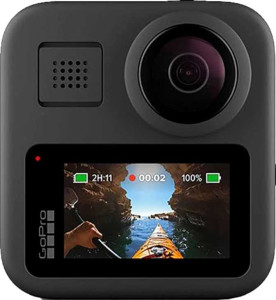
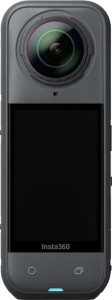
Both cameras share a solid baseline of design features: touch screens, external memory slots, accelerometers, and no flip-out or secondary displays. Their overall volumes are nearly identical — 217.2 cm³ vs 218.8 cm³ — and their weight difference of just 5 g is practically imperceptible in hand. Where they diverge sharply, however, is in form factor. The GoPro Max2 is built like a compact cube (64 × 69.7 × 48.7 mm), while the Insta360 X5 is a tall, slim wand (46 × 124.5 × 38.2 mm). For mounting on helmets or tight rigs, the Max2's squatter profile may be easier to manage; for handheld use on a selfie stick, the X5's slender grip feels more natural.
The X5 holds a meaningful edge in two durability specs. Its waterproof rating reaches 15 m depth versus the Max2's 5 m, making it genuinely suitable for recreational diving without a housing, while the Max2 is limited to snorkeling depth. The X5 also carries a full IP68 rating — covering both dust and water ingress — whereas the Max2's IPX8 rating leaves dust resistance untested. Additionally, the X5 operates down to -20 °C compared to the Max2's -10 °C, a real advantage for winter sports or high-altitude shooting.
The X5 also wins on usability with a noticeably larger 2.7″ touch screen versus the Max2's 1.82″ panel — a 48% larger viewing area that makes framing shots, reviewing footage, and navigating menus considerably easier in the field. On design and build, the Insta360 X5 has a clear overall advantage: it is tougher in harsh environments, functional in colder conditions, and more comfortable to interact with on screen, all while matching the Max2 in size and weight.