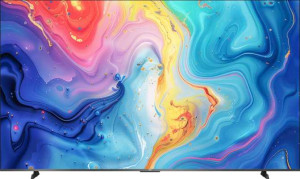
Haier H100S90FUX 100"
TCL 75C6KS 75"

Haier H100S90FUX 100" TCL 75C6KS 75"

Overview

When sizing up the Haier H100S90FUX 100″ against the TCL 75C6KS 75″, two distinct television philosophies come into focus. Both sets share a strong common foundation — 4K UHD resolution, comprehensive HDR format support, and a full smart TV platform — yet they diverge meaningfully on screen size and panel technology, refresh rate, wireless connectivity, and physical footprint. Read on to explore exactly where these two displays part ways and which one is best suited to your viewing space.

Common Features

  • Both products have a 4K (UHD) display resolution of 3840 x 2160 px.
  • Both products display 1070 million colors with a 10-bit bit depth.
  • HDR10 support is available on both products.
  • HDR10+ support is available on both products.
  • Dolby Vision support is available on both products.
  • HLG support is available on both products.
  • Both products use a QLED, LED-backlit, LCD display type as a base.
  • Both products have Bluetooth connectivity.
  • Both products use HDMI 2.1 and feature 4 HDMI ports.
  • Both products support Wi-Fi.
  • Both products have 2 USB ports and 1 RJ45 port.
  • Miracast support is available on both products.
  • Both products have a 3.5 mm audio jack socket.
  • Dolby Digital and Dolby Digital Plus support is available on both products.
  • Digital Out support is available on both products.
  • Both products have stereo speakers with Dolby Atmos and Dolby Audio.
  • SRS TheaterSound HD is not available on either product.
  • Dolby Virtual is not available on either product.
  • Both products support VESA mounting.
  • Chromecast built-in is available on both products.
  • AirPlay support is available on both products.
  • Both products have a built-in smart TV platform and are compatible with Google Assistant.
  • Siri/Apple HomeKit compatibility is not available on either product.
  • Remote smartphone control is supported on both products.
  • Neither product has a rechargeable remote control.
  • USB recording is supported on both products.
  • Both products have HDMI ARC and HDMI eARC support.

Main Differences

  • The Haier H100S90FUX 100″ uses a QLED, LED-backlit, LCD panel, while the TCL 75C6KS 75″ also includes Mini-LED backlight technology.
  • Screen size is 100″ on the Haier H100S90FUX 100″ and 74.5″ on the TCL 75C6KS 75″.
  • Pixel density is 44 ppi on the Haier H100S90FUX 100″ and 59 ppi on the TCL 75C6KS 75″.
  • Refresh rate is 144Hz on the Haier H100S90FUX 100″ and 120Hz on the TCL 75C6KS 75″.
  • Wi-Fi version support includes Wi-Fi 4, Wi-Fi 5, and Wi-Fi 6 on the Haier H100S90FUX 100″, while the TCL 75C6KS 75″ supports only Wi-Fi 4 and Wi-Fi 5.
  • Bluetooth version is 5.2 on the Haier H100S90FUX 100″ and 5.4 on the TCL 75C6KS 75″.
  • Width is 2225 mm on the Haier H100S90FUX 100″ and 1670 mm on the TCL 75C6KS 75″.
  • Height is 1278 mm on the Haier H100S90FUX 100″ and 960 mm on the TCL 75C6KS 75″.
  • Thickness is 95 mm on the Haier H100S90FUX 100″ and 56.7 mm on the TCL 75C6KS 75″.
  • Weight is 50600 g on the Haier H100S90FUX 100″ and 23500 g on the TCL 75C6KS 75″.
  • Volume is 270137.25 cm³ on the Haier H100S90FUX 100″ and 90901.44 cm³ on the TCL 75C6KS 75″.
Specs Comparison
Haier H100S90FUX 100"

Haier H100S90FUX 100"

TCL 75C6KS 75"

TCL 75C6KS 75"

Display:
display resolution 4K (UHD) 4K (UHD)
Display type QLED, LED-backlit, LCD QLED, LED-backlit, LCD, Mini-LED
screen size 100" 74.5"
resolution 3840 x 2160 px 3840 x 2160 px
pixel density 44 ppi 59 ppi
display colors 1070 million 1070 million
bit depth 10-bit 10-bit
refresh rate 144Hz 120Hz
supports HDR10
supports HDR10+
supports Dolby Vision
supports HLG
has anti-reflection coating
has an ambient light sensor
maximum horizontal viewing angle 178º 178º
maximum vertical viewing angle 178º 178º

Both the Haier H100S90FUX and the TCL 75C6KS share the same 4K (3840 x 2160) resolution and identical color output of 1.07 billion colors at 10-bit depth, meaning neither has an edge in raw color volume or color precision. Both also support the full suite of HDR formats — HDR10, HDR10+, Dolby Vision, and HLG — so content compatibility is evenly matched regardless of streaming platform or source. Viewing angles of 178º horizontally and vertically are identical, and both include anti-reflection coating and an ambient light sensor, making them equally well-equipped for varied lighting environments.

The most meaningful differentiators lie in screen size, pixel density, panel technology, and refresh rate. The Haier's 100″ screen dwarfs the TCL's 74.5″ panel, but that size advantage comes at a pixel density cost: 44 ppi versus the TCL's 59 ppi. In practice, this means the TCL will render finer detail and sharper edges at typical viewing distances, while the Haier's lower pixel density may become perceptible on very close-range viewing for a screen that large. The TCL also uses a Mini-LED backlighting layer on top of its QLED LCD panel — a technology that enables more precise local dimming zones, typically resulting in deeper blacks and better contrast compared to the Haier's conventional LED backlit QLED panel. On refresh rate, the Haier holds a 144Hz panel versus the TCL's 120Hz, giving it a tangible edge for fast-motion content and gaming responsiveness.

Overall, the two TVs trade advantages depending on priority. The TCL 75C6KS has the edge in display quality per inch — its higher pixel density and Mini-LED backlighting suggest sharper images and superior contrast control. The Haier H100S90FUX counters with a dramatically larger screen and a higher refresh rate, making it the stronger choice for immersive large-format viewing and motion-sensitive use cases. Users prioritizing picture fidelity and contrast in a standard living room setting will lean toward the TCL; those optimizing for sheer screen presence and smoother motion will favor the Haier.

Connectivity:
Has Bluetooth
HDMI version HDMI 2.1 HDMI 2.1
HDMI ports 4 4
supports Wi-Fi
Wi-Fi version Wi-Fi 4 (802.11n), Wi-Fi 5 (802.11ac), Wi-Fi 6 (802.11ax) Wi-Fi 4 (802.11n), Wi-Fi 5 (802.11ac)
Bluetooth version 5.2 5.4
USB ports 2 2
RJ45 ports 1 1
supports Miracast
has a socket for a 3.5 mm audio jack
has an external memory slot
has a VGA connector
has a DVI connector

The wired connectivity foundation of both TVs is essentially identical: 4 HDMI 2.1 ports, 2 USB ports, and a single RJ45 Ethernet port each. HDMI 2.1 is the current gold standard for home theater connections, supporting 4K at high refresh rates and features like eARC for premium audio passthrough — so neither TV is at a disadvantage when it comes to plugging in consoles, soundbars, or media players. Miracast and a 3.5mm audio jack are also shared, rounding out a port layout that is effectively a wash between the two.

The differences emerge in wireless connectivity. For Wi-Fi, the Haier H100S90FUX supports Wi-Fi 6 (802.11ax) in addition to Wi-Fi 4 and 5, while the TCL 75C6KS tops out at Wi-Fi 5 (802.11ac). Wi-Fi 6 brings meaningfully lower latency and better performance in congested network environments — a real advantage in households with many connected devices. On the Bluetooth side, the TCL counters with Bluetooth 5.4 versus the Haier's Bluetooth 5.2. Bluetooth 5.4 improves connection reliability and efficiency, which matters most when pairing wireless headphones or audio accessories.

Neither TV dominates connectivity outright — each holds one wireless edge over the other. However, Wi-Fi 6 support is the more broadly impactful advantage in modern home network setups, giving the Haier H100S90FUX a slight overall edge in this category. The TCL's newer Bluetooth version is a real but narrower benefit, most relevant to users who rely heavily on wireless audio peripherals.

Audio:
supports Dolby Digital
supports Digital Out
supports Dolby Digital Plus
has SRS TheaterSound HD
has stereo speakers
has Dolby Atmos
has Dolby Audio
supports Dolby Virtual
has a subwoofer
HDMI ARC / eARC HDMI ARC, HDMI eARC HDMI eARC, HDMI ARC

Across every audio specification provided, the Haier H100S90FUX and the TCL 75C6KS are a perfect match. Both support Dolby Digital, Dolby Digital Plus, Dolby Atmos, and Dolby Audio, cover Digital Out, include stereo speakers with a built-in subwoofer, and offer both HDMI ARC and eARC — the latter being the more capable standard, enabling lossless audio formats like Dolby TrueHD and DTS:X to pass through to a connected soundbar without compression.

The presence of a subwoofer in both units is worth noting for buyers who plan to use the TV's built-in speakers: it indicates a dedicated low-frequency driver rather than relying solely on small full-range drivers, which typically translates to more body and depth in the sound. Dolby Atmos support means both TVs can process and present object-based audio from streaming services that carry Atmos tracks, adding a sense of spatial dimension even through the built-in system.

This category is a clear tie. There is no differentiating audio feature between the two TVs based on the provided data — every supported format, output option, and hardware element is shared identically. The audio decision between these two products should rest entirely on other specification groups.

Design:
width 2225 mm 1670 mm
weight 50600 g 23500 g
thickness 95 mm 56.7 mm
height 1278 mm 960 mm
volume 270137.25 cm³ 90901.44 cm³
Supports VESA mount

The physical scale difference between these two TVs is substantial and has direct practical consequences. The Haier H100S90FUX spans 2225 mm wide and stands 1278 mm tall, while the TCL 75C6KS measures 1670 mm wide and 960 mm tall — making the Haier roughly a third larger in each linear dimension. This means the Haier demands a genuinely large wall or dedicated media room to be installed comfortably, whereas the TCL fits more naturally into a standard living room setup. Anyone considering the Haier should carefully measure their available wall space and viewing distance before purchasing.

Weight is where the gap becomes even more striking. At 50,600 g (approximately 50.6 kg), the Haier is more than twice as heavy as the TCL's 23,500 g (23.5 kg). That kind of mass has real installation implications — wall-mounting the Haier will require a heavy-duty bracket rated for its load and very likely a two-person installation, whereas the TCL is manageable with standard mounting hardware. The Haier is also noticeably thicker at 95 mm versus the TCL's slimmer 56.7 mm profile, which matters for wall-flush aesthetics. Both TVs support VESA mounting, so neither is restricted to stand use only.

For design and installation practicality, the TCL 75C6KS has a clear advantage — it is lighter, slimmer, and far easier to handle and mount. The Haier's dimensions are a deliberate trade-off for its 100″ screen and should be treated as a prerequisite rather than a flaw, but buyers must be fully prepared for the logistical demands that come with it.

Features:
release date September 2025 March 2025
has Chromecast built-in
has AirPlay
has built-in smart TV
compatible with Google Assistant
works with Siri/Apple HomeKit
supports a remote smartphone
has a rechargeable remote control
supports USB recording
standby power consumption 0.5W 0.5W
has a search browser
has a sleep timer
has a child lock
has voice commands

When it comes to smart features, these two TVs are identical in every measurable way the provided data captures. Both carry Chromecast built-in and AirPlay support, meaning users can cast content from Android and Apple devices alike without any additional hardware — a genuinely useful combination that covers the vast majority of smartphone ecosystems. Google Assistant voice control is present on both, enabling hands-free search, playback control, and smart home commands. Notably, neither TV supports Apple HomeKit or Siri, which is worth flagging for households deeply embedded in the Apple ecosystem.

Practical day-to-day features are also equally matched: both support USB recording for capturing live broadcast content to an external drive, offer smartphone remote control, include a sleep timer and child lock, and maintain a standby power draw of just 0.5W — a negligible idle consumption figure that is identical across both units.

This category is a complete tie. Every feature listed is shared between the Haier H100S90FUX and the TCL 75C6KS without exception. Buyers for whom smart platform breadth, voice control, or specific convenience features are deciding factors will find no differentiation here and should weigh other specification groups to guide their choice.

Comparison Summary & Verdict

Having examined every specification, each television caters to a distinct type of buyer. The Haier H100S90FUX 100″ is the clear choice for those who want an unrivalled sense of immersion, delivering a massive 100-inch screen paired with a 144Hz refresh rate and Wi-Fi 6 support — ideal for a dedicated home cinema room where scale is the top priority. The TCL 75C6KS 75″, by contrast, offers a more refined picture through its Mini-LED backlight technology and a higher pixel density of 59 ppi, producing a sharper image from typical seating distances, all within a substantially lighter and more compact body. Both share equally strong audio and smart features, including Dolby Atmos and a full suite of HDR formats, so the decision ultimately rests on whether you value sheer screen size and refresh rate or superior panel refinement and easier installation.

Haier H100S90FUX 100
Buy Haier H100S90FUX 100" if...

Buy the Haier H100S90FUX 100″ if you want maximum screen size with a 144Hz refresh rate and Wi-Fi 6 support for a dedicated, large-scale home cinema setup.

TCL 75C6KS 75
Buy TCL 75C6KS 75" if...

Buy the TCL 75C6KS 75″ if you prioritize a sharper, more refined image courtesy of its Mini-LED panel and higher pixel density, in a considerably lighter and more manageable form factor.