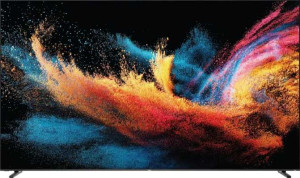
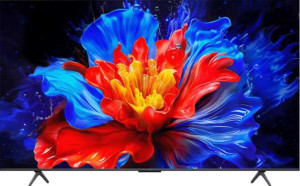
Both the Haier H75M92FUX and the TCL 85P8K share a strong display foundation: native 4K (3840 x 2160) resolution, a 144Hz refresh rate, 10-bit color depth rendering 1.07 billion colors, and full HDR format support including HDR10+, Dolby Vision, and HLG. Anti-reflection coatings and ambient light sensors are present on both, and viewing angles are identical at 178° horizontal and vertical. For everyday content consumption, both panels check the same fundamental boxes.
The most significant differentiator is brightness. The Haier's Mini-LED backlight enables a 1300 nits typical brightness rating, compared to the TCL's standard QLED panel at just 450 nits. In practice, this is a transformative gap: the Haier will render HDR highlights with far greater punch and pop, maintain picture quality in bright living rooms, and deliver more convincing local dimming contrast. Mini-LED backlighting also typically produces deeper blacks alongside those brighter highlights, a combination the TCL's conventional LED array cannot match. On pixel density, the Haier's 75″ screen yields 59 ppi versus the TCL's 52 ppi on its 84.6″ panel, meaning the Haier will appear slightly sharper at equivalent viewing distances. The Haier also supports AMD FreeSync Premium versus the TCL's base AMD FreeSync, offering better low-framerate compensation for gaming.
The Haier H75M92FUX holds a clear display advantage, driven overwhelmingly by its Mini-LED-powered brightness and the resulting HDR performance gap. The TCL 85P8K's only counterpoint is its larger physical screen size, which may matter for viewers prioritizing sheer screen real estate over picture quality. For anyone focused on image fidelity, HDR impact, or gaming performance, the Haier's display is the stronger choice based strictly on these specifications.