Harman Kardon Aura Studio 5
Harman Kardon Onyx Studio 9

Harman Kardon Aura Studio 5 Harman Kardon Onyx Studio 9

Overview

Welcome to our in-depth spec comparison between the Harman Kardon Aura Studio 5 and the Harman Kardon Onyx Studio 9. Both speakers share the same premium Harman Kardon DNA, yet they take noticeably different approaches when it comes to audio output power, physical footprint, and driver configuration. Whether you prioritize raw acoustic muscle or a more compact form factor, this side-by-side breakdown will help you navigate the key battlegrounds before making your decision.

Common Features

  • Neither product has a neodymium magnet.
  • Neither product offers water resistance.
  • Neither product includes a travel bag.
  • Neither product has a touch screen.
  • Both products have a detachable cable.
  • Neither product is a neckband speaker.
  • Neither product includes a remote control.
  • The highest frequency on both products reaches 20000 Hz.
  • Neither product has a noise-canceling microphone.
  • Neither product has magnetic shielding.
  • Neither product supports Bluetooth pairing using NFC.
  • Neither product has a 3.5 mm audio jack socket.
  • Neither product has an AUX input.
  • Neither product supports aptX Lossless, LDAC, aptX Adaptive, aptX HD, or aptX.
  • Both products can be used wirelessly.
  • Both products support remote smartphone control.
  • Neither product has fast pairing.
  • Neither product supports voice commands.
  • Both products have voice prompts.
  • Both products support pairing for stereo sound.

Main Differences

  • Volume is 16777.2384 cm³ on Harman Kardon Aura Studio 5 and 10808.85 cm³ on Harman Kardon Onyx Studio 9.
  • Driver count is 6 on Harman Kardon Aura Studio 5 and 3 on Harman Kardon Onyx Studio 9.
  • Driver unit size is 40 mm on Harman Kardon Aura Studio 5 and 20 mm on Harman Kardon Onyx Studio 9.
  • RGB lighting is present on Harman Kardon Aura Studio 5 but not available on Harman Kardon Onyx Studio 9.
  • Weight is 4200 g on Harman Kardon Aura Studio 5 and 3330 g on Harman Kardon Onyx Studio 9.
  • Height is 306.4 mm on Harman Kardon Aura Studio 5 and 287.5 mm on Harman Kardon Onyx Studio 9.
  • Width is 234 mm on Harman Kardon Aura Studio 5 and 289.2 mm on Harman Kardon Onyx Studio 9.
  • Thickness is 234 mm on Harman Kardon Aura Studio 5 and 130 mm on Harman Kardon Onyx Studio 9.
  • A subwoofer is included on Harman Kardon Aura Studio 5 but not available on Harman Kardon Onyx Studio 9.
  • Lowest frequency is 45 Hz on Harman Kardon Aura Studio 5 and 50 Hz on Harman Kardon Onyx Studio 9.
  • Audio output power is 4 x 40W on Harman Kardon Aura Studio 5 and 4 x 12.5W on Harman Kardon Onyx Studio 9.
  • Bluetooth version is 5.4 on Harman Kardon Aura Studio 5 and 5.3 on Harman Kardon Onyx Studio 9.
Specs Comparison
Harman Kardon Aura Studio 5

Harman Kardon Aura Studio 5

Harman Kardon Onyx Studio 9

Harman Kardon Onyx Studio 9

Design:
volume 16777.2384 cm³ 10808.85 cm³
drivers count 6 3
driver unit size 40 mm 20 mm
has a neodymium magnet
water resistance None None
travel bag is included
has a touch screen
has RGB lighting
has a detachable cable
is a neckband speaker
has a remote control
weight 4200 g 3330 g
height 306.4 mm 287.5 mm
width 234 mm 289.2 mm
thickness 234 mm 130 mm

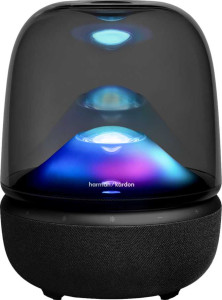
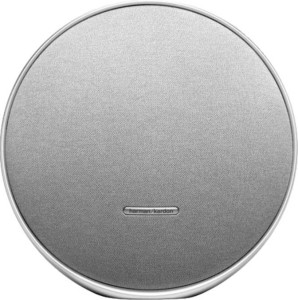
The two speakers take fundamentally different physical approaches. The Aura Studio 5 is a substantially larger, near-spherical unit — its width and thickness are both 234 mm, suggesting its signature globe shape — while the Onyx Studio 9 is a wider but far flatter design at 289.2 mm wide and only 130 mm thick. This translates to a meaningful volume difference: the Aura Studio 5 displaces roughly 16,777 cm³ versus the Onyx Studio 9's 10,809 cm³, making the Aura around 55% bulkier overall. The weight gap reinforces this — 4,200 g versus 3,330 g — so the Aura Studio 5 is considerably less portable and demands a more permanent shelf placement, whereas the Onyx Studio 9's slimmer profile makes it easier to reposition or store.

Internally, the driver configuration is a significant differentiator. The Aura Studio 5 houses 6 drivers at 40 mm each, which represents both more drivers and larger individual transducers compared to the Onyx Studio 9's 3 drivers at 20 mm. Larger, more numerous drivers generally move more air and can reproduce a wider dynamic range with greater low-frequency authority — a clear structural advantage for the Aura Studio 5 on paper. Neither unit uses neodymium magnets, so that efficiency advantage is absent from both. Both share a detachable cable and offer no water resistance, making them equally suited (and equally limited) as indoor, stationary speakers.

On aesthetics, only the Aura Studio 5 includes RGB lighting, which adds a visual dimension that the Onyx Studio 9 entirely lacks. Overall, the Aura Studio 5 holds the design edge for raw acoustic potential — its larger enclosure volume and superior driver count and size point to a more commanding sound-projection capability — while the Onyx Studio 9 wins on physical practicality, being noticeably lighter and far more compact in depth, making it the more versatile fit for tighter spaces.
Sound quality:
has a subwoofer
highest frequency 20000 Hz 20000 Hz
lowest frequency 45 Hz 50 Hz
audio output power 4 x 40W 4 x 12.5W
has a noise-canceling microphone
has a magnetic shielding

Power output is where these two speakers diverge most sharply. The Aura Studio 5 delivers 4 × 40W — a combined 160W — compared to the Onyx Studio 9's 4 × 12.5W, totaling just 50W. That is more than a 3× amplification advantage, which in practice means the Aura Studio 5 can fill significantly larger rooms, sustain higher volume levels without distortion, and maintain dynamic headroom on complex, transient-rich material like orchestral music or live recordings. The Onyx Studio 9's output is respectable for a compact speaker in a small-to-medium room, but it simply cannot compete at scale.

Bass extension reinforces this gap further. The Aura Studio 5 includes a dedicated subwoofer and reaches down to 45 Hz, while the Onyx Studio 9 has no subwoofer and bottoms out at 50 Hz. Although 5 Hz may seem marginal in isolation, the presence of a subwoofer means the Aura Studio 5 is engineered to reproduce those low frequencies with far greater authority and physical presence — the kind of visceral low-end impact that a subwoofer-less design structurally cannot replicate. Both speakers share an identical 20,000 Hz high-frequency ceiling, so treble reproduction is on equal footing.

Across every meaningful sound quality metric in this data set, the Aura Studio 5 holds a decisive advantage — substantially more power, a lower frequency floor, and a dedicated subwoofer all point to a richer, louder, and more full-range listening experience. The Onyx Studio 9 is not without merit for casual, near-field listening, but users prioritizing audio performance at volume or in larger spaces should clearly favor the Aura Studio 5.

Connectivity:
Bluetooth version 5.4 5.3
supports Bluetooth pairing using NFC
has a socket for a 3.5 mm audio jack
has an AUX input
has aptX Lossless
has LDAC
has aptX Adaptive
has aptX HD
has aptX
has aptX Low Latency
has AAC
has AirPlay
has Chromecast built-in
has Auracast
has Bluetooth LE Audio
maximum Bluetooth range 10 m 10 m
supports Wi-Fi
Has USB Type-C
has a 3.5mm male connector
has an external memory slot
is DLNA-certified
supports Ethernet
has a microphone input

Connectivity is the most evenly matched category between these two speakers. Both rely exclusively on Bluetooth as their wireless transport — no Wi-Fi, no AirPlay, no Chromecast — and share an identical 10 m maximum range. The only measurable distinction is the Bluetooth version: the Aura Studio 5 uses Bluetooth 5.4 while the Onyx Studio 9 runs Bluetooth 5.3. In practice, the gap between these two revisions is negligible for everyday use; both offer comparable stability, range, and energy efficiency well beyond what most listening environments will test.

Neither speaker supports any high-resolution audio codec — aptX, aptX HD, LDAC, and AAC are all absent from both — which caps streaming quality at standard SBC levels regardless of the source device. Both do, however, support Auracast, Bluetooth's broadcast audio standard that allows a single source to stream simultaneously to multiple receivers. This is a genuinely useful shared feature for scenarios like multi-room listening or public audio sharing. Both also include USB Type-C, though with no other wired audio input options (no AUX, no 3.5 mm jack), physical connectivity is limited to that single port.

Given how closely matched these two speakers are across every connectivity dimension, this category is effectively a tie. The marginal Bluetooth version advantage of the Aura Studio 5 carries no meaningful real-world weight, and the absence of advanced codecs, Wi-Fi, and wired audio inputs applies equally to both. Buyers with a strong preference for wired listening or network streaming will find neither option satisfying.

Features:
release date November 2025 January 2025
Can be used wirelessly
supports a remote smartphone
has fast pairing
has voice commands
Has a radio
Has voice prompts
has a mute function
works as a power bank

When it comes to features, the Aura Studio 5 and Onyx Studio 9 are in complete lockstep — every single spec in this group is identical. Both support wireless playback and remote smartphone control, meaning users can adjust playback from their phone without interacting with the speaker directly, a convenient baseline expectation for modern Bluetooth speakers. Both also offer voice prompts, which provide audible feedback for actions like pairing and power status — a small but practical usability touch that reduces guesswork during setup.

Notably absent from both are fast pairing, voice command support, and the ability to function as a power bank. None of these omissions favor one over the other, but they do define the ceiling of what either speaker offers in terms of smart or convenience features. These are straightforward, no-frills audio devices from a feature standpoint — capable and functional, but not designed to serve as smart home hubs or multi-purpose gadgets.

This category is an unambiguous tie. There is no differentiator here whatsoever, and the purchase decision for Features should carry no weight in either direction. Buyers seeking advanced smart features will find both equally limited; those content with reliable wireless streaming and basic smartphone integration will find both equally adequate.

Miscellaneous:
supports pairing for stereo sound

This group contains a single shared specification: both the Aura Studio 5 and the Onyx Studio 9 support stereo pairing, meaning two units of the same model can be linked together to create a dedicated left/right stereo configuration. For listeners who own two speakers or plan to purchase a pair, this unlocks a meaningfully wider soundstage than any single unit can produce on its own — a genuine upgrade over mono playback for music and home theater use.

With only one data point in this group, and both products sharing it equally, this is a straightforward tie. Neither speaker holds any advantage here, and the decision between the two should rest entirely on the differentiators found in other specification groups.

Comparison Summary & Verdict

After examining every specification, these two Harman Kardon speakers clearly target different listeners. The Aura Studio 5 is the more powerful proposition, delivering 4 x 40W of audio output, six drivers sized at 40 mm, a dedicated subwoofer, and a lower frequency floor of 45 Hz — making it the stronger choice for room-filling, bass-heavy sound. It also adds RGB lighting and the latest Bluetooth 5.4. The Onyx Studio 9, by contrast, is lighter at 3330 g, noticeably slimmer at 130 mm thick, and more compact overall, making it easier to place and move around. Both speakers share wireless playback, remote smartphone support, voice prompts, a detachable cable, and stereo-pairing capability. Choose based on whether acoustic power and features or portability and size matter more to you.

Harman Kardon Aura Studio 5
Buy Harman Kardon Aura Studio 5 if...

Buy the Harman Kardon Aura Studio 5 if you want maximum audio power, deeper bass extension, and RGB lighting, and do not mind a larger, heavier form factor.

Harman Kardon Onyx Studio 9
Buy Harman Kardon Onyx Studio 9 if...

Buy the Harman Kardon Onyx Studio 9 if you prefer a lighter, more compact speaker that is significantly slimmer and easier to fit into tighter spaces.