Harman Kardon Onyx Studio 9
JBL Charge 6

Harman Kardon Onyx Studio 9 JBL Charge 6

Overview

Welcome to our in-depth specification comparison between the Harman Kardon Onyx Studio 9 and the JBL Charge 6. These two Bluetooth speakers come from renowned audio brands, yet take strikingly different approaches to design, portability, and endurance. From their physical dimensions and water resistance to battery life and connectivity features, this comparison explores the key areas that set them apart and help you decide which one truly fits your lifestyle.

Common Features

  • Neither product includes a travel bag.
  • Neither product has a touch screen.
  • Neither product has RGB lighting.
  • Both products have a detachable cable.
  • Neither product is a neckband speaker.
  • Neither product has a remote control.
  • Both products share the same highest frequency of 20000 Hz.
  • Neither product has a noise-canceling microphone.
  • Both products have the same battery power of 4722 mAh.
  • Both products have a rechargeable battery.
  • Neither product has a removable battery.
  • Neither product supports wireless charging.
  • Neither product supports Bluetooth pairing using NFC.
  • Neither product has a 3.5 mm audio jack socket.
  • Neither product has an AUX input.
  • Neither product supports aptX Lossless, LDAC, aptX Adaptive, aptX HD, or aptX.
  • Both products can be used wirelessly.
  • Both products support remote smartphone control.
  • Neither product supports fast pairing.
  • Neither product has voice commands.
  • Neither product has a radio.
  • Both products have voice prompts.
  • Neither product has a mute function.
  • Both products support pairing for stereo sound.

Main Differences

  • Volume is 10808.85 cm³ on Harman Kardon Onyx Studio 9 and 2118.4592 cm³ on JBL Charge 6.
  • Driver count is 3 on Harman Kardon Onyx Studio 9 and 2 on JBL Charge 6.
  • A neodymium magnet is present on JBL Charge 6 but not on Harman Kardon Onyx Studio 9.
  • Water resistance is None on Harman Kardon Onyx Studio 9 and Waterproof on JBL Charge 6.
  • Weight is 3330 g on Harman Kardon Onyx Studio 9 and 960 g on JBL Charge 6.
  • Height is 287.5 mm on Harman Kardon Onyx Studio 9 and 98.5 mm on JBL Charge 6.
  • Width is 289.2 mm on Harman Kardon Onyx Studio 9 and 228.8 mm on JBL Charge 6.
  • Thickness is 130 mm on Harman Kardon Onyx Studio 9 and 94 mm on JBL Charge 6.
  • Lowest frequency is 50 Hz on Harman Kardon Onyx Studio 9 and 56 Hz on JBL Charge 6.
  • Audio output power is 4 x 12.5W on Harman Kardon Onyx Studio 9 and 2 x 22.5W on JBL Charge 6.
  • A passive radiator is present on JBL Charge 6 but not on Harman Kardon Onyx Studio 9.
  • Battery life is 8 hours on Harman Kardon Onyx Studio 9 and 28 hours on JBL Charge 6.
  • Charge time is 4 hours on Harman Kardon Onyx Studio 9 and 3 hours on JBL Charge 6.
  • A battery level indicator is present on JBL Charge 6 but not on Harman Kardon Onyx Studio 9.
  • Bluetooth version is 5.3 on Harman Kardon Onyx Studio 9 and 5.4 on JBL Charge 6.
  • Power bank functionality is available on JBL Charge 6 but not on Harman Kardon Onyx Studio 9.
Specs Comparison
Harman Kardon Onyx Studio 9

Harman Kardon Onyx Studio 9

JBL Charge 6

JBL Charge 6

Design:
volume 10808.85 cm³ 2118.4592 cm³
drivers count 3 2
has a neodymium magnet
water resistance None Waterproof
travel bag is included
has a touch screen
has RGB lighting
has a detachable cable
is a neckband speaker
has a remote control
weight 3330 g 960 g
height 287.5 mm 98.5 mm
width 289.2 mm 228.8 mm
thickness 130 mm 94 mm

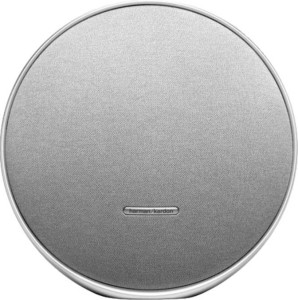
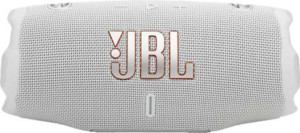
The most defining difference in this category is sheer physical scale. The Harman Kardon Onyx Studio 9 is a substantial home speaker, weighing 3330 g and occupying over 10,800 cm³ of space — roughly five times the volume of the JBL Charge 6, which comes in at 960 g and just over 2,100 cm³. In practice, the Onyx Studio 9 is a stay-at-home device: it sits on a shelf or tabletop and is not designed to move around. The Charge 6, by contrast, is genuinely portable — light enough to slip into a bag and carry all day without a second thought.

Beyond size and weight, the design philosophies diverge in a critical practical area: durability. The JBL Charge 6 carries a waterproof rating, making it suitable for outdoor use, poolside sessions, or unpredictable weather. The Onyx Studio 9 has no water resistance whatsoever, which means even a light splash is a real risk — a significant limitation for any speaker you might consider moving between rooms or environments. The Charge 6 also uses a neodymium magnet in its driver assembly, which delivers stronger magnetic force in a lighter and more compact form factor, helping explain how JBL engineered meaningful performance into such a small enclosure. Both speakers share a detachable cable, which is a minor convenience for storage and replacement.

In terms of design edge, the JBL Charge 6 wins clearly for portability and resilience — its waterproofing, low weight, and compact form make it a far more versatile product. The Onyx Studio 9 is purpose-built for stationary, indoor use, where its larger cabinet and three-driver configuration are given room to breathe, but it concedes almost every practical design advantage to the Charge 6 outside of that context.
Sound quality:
highest frequency 20000 Hz 20000 Hz
lowest frequency 50 Hz 56 Hz
audio output power 4 x 12.5W 2 x 22.5W
Has a passive radiator
has a noise-canceling microphone

Both speakers share an identical frequency ceiling of 20,000 Hz, so treble reproduction is theoretically on equal footing. The more telling number is at the low end: the Onyx Studio 9 reaches down to 50 Hz versus 56 Hz for the Charge 6. That 6 Hz gap is modest in absolute terms, but in the bass register it represents a meaningful slice of low-end extension — kick drums, bass guitars, and cinematic rumble all live in that range. For a stationary home speaker with a larger cabinet, this advantage is expected and reinforces the Onyx Studio 9's positioning as a room-filling device.

The total output figures are identical on paper — both deliver 90W combined — but the amplifier architectures differ. The Onyx Studio 9 spreads that power across 4 channels at 12.5W each, while the Charge 6 concentrates it into 2 channels at 22.5W each. More channels typically allow for better stereo separation and dedicated driver control, which can contribute to a wider, more layered soundstage. However, the Charge 6 counters with a meaningful hardware advantage: a passive radiator, which uses acoustic physics rather than additional amplification to reinforce low-frequency output. In a compact enclosure, this is a well-established technique for punching well above a speaker's physical size in the bass department — a direct answer to its smaller cabinet.

Weighing these factors against each other, the sound quality comparison is genuinely close. The Onyx Studio 9 holds a slight edge in raw bass extension and multi-driver staging, advantages that are natural given its size. But the Charge 6's passive radiator largely neutralizes the size penalty in the low end, making it a surprisingly competitive performer for its form factor. Neither product includes a noise-canceling microphone, so call quality is a non-factor here. For pure acoustic output relative to expectations, the Charge 6 earns a slight engineering edge — getting near-equivalent performance from a far smaller, portable package is the harder design problem to solve.

Power:
battery power 4722 mAh 4722 mAh
Battery life 8 hours 28 hours
charge time 4 hours 3 hours
has a battery level indicator
has a rechargeable battery
has a removable battery
has wireless charging

Perhaps the most striking finding in this group is that both speakers share an identical 4722 mAh battery — yet their real-world endurance couldn't be further apart. The Charge 6 delivers up to 28 hours of playback from that cell, while the Onyx Studio 9 manages just 8 hours. Same fuel tank, roughly 3.5 times the range. The explanation lies in power draw: the Onyx Studio 9's larger, multi-driver amplifier system consumes significantly more energy per hour of operation, burning through the shared capacity far faster. In practical terms, 8 hours is enough for a long evening at home — but it means the Onyx will need a nightly recharge, whereas the Charge 6 could comfortably run for multiple days of moderate use between charges.

Charging efficiency also favors the Charge 6, which replenishes fully in 3 hours compared to 4 hours for the Onyx Studio 9 — a smaller gap, but meaningful if you need a quick top-up before heading out. The Charge 6 also includes a battery level indicator, letting users monitor remaining power at a glance, while the Onyx Studio 9 omits this feature entirely, leaving the user to guess or wait for a low-battery warning. Neither speaker supports wireless charging or a removable battery, so both are on equal footing there.

The JBL Charge 6 wins this category decisively. Extracting 28 hours of playback from the same capacity cell that gives the Onyx Studio 9 only 8 hours is a significant efficiency advantage — and when paired with a faster charge time and a battery indicator, it makes for a substantially more practical power package overall.

Connectivity:
Bluetooth version 5.3 5.4
supports Bluetooth pairing using NFC
has a socket for a 3.5 mm audio jack
has an AUX input
has aptX Lossless
has LDAC
has aptX Adaptive
has aptX HD
has aptX
has aptX Low Latency
has AAC
has AirPlay
has Chromecast built-in
has Auracast
has Bluetooth LE Audio
maximum Bluetooth range 10 m 10 m
supports Wi-Fi
Has USB Type-C
has a 3.5mm male connector
has an external memory slot
is DLNA-certified
supports Ethernet
has a microphone input

Connectivity is the most uniform category in this comparison — the two speakers are nearly identical across the board. Both rely exclusively on Bluetooth with a 10 m maximum range, both include USB-C for charging and data, both support Auracast broadcast audio, and both conspicuously omit wired audio input, Wi-Fi, NFC pairing, and every advanced Bluetooth codec including AAC, aptX, and LDAC. For users who stream from a phone or tablet, the absence of any high-resolution codec means audio is transmitted via the standard SBC baseline — functional, but not audiophile-grade regardless of which speaker you choose.

The only measurable difference in this group is the Bluetooth version: the Charge 6 runs Bluetooth 5.4 against the Onyx Studio 9's 5.3. In real-world use, this gap is marginal — both versions offer low-energy operation, solid stability, and comparable range. Bluetooth 5.4 introduced refinements to LE Audio and connection reliability, but given that neither speaker implements Bluetooth LE Audio, the practical benefit of that newer version is limited in this context.

This category is effectively a tie. The Charge 6 holds a technically newer Bluetooth version, but the functional connectivity experience — range, inputs, codec support, pairing options — is indistinguishable between the two. Buyers prioritizing wired fallback, multiroom streaming, or hi-res wireless audio will find both speakers equally limited.

Features:
release date January 2025 March 2025
Can be used wirelessly
supports a remote smartphone
has fast pairing
has voice commands
Has a radio
Has voice prompts
has a mute function
works as a power bank

Across most of the features in this group, the two speakers are evenly matched. Both operate wirelessly, support smartphone remote control, deliver voice prompts for status feedback, and skip fast pairing and voice assistant integration alike. For everyday use, the experience offered by each is functionally identical on these fronts.

The single feature that separates them is significant for a portable device: the JBL Charge 6 can function as a power bank, using its internal battery to charge other devices via USB. On a long day outdoors — exactly the kind of use case the Charge 6 is built for — this means it can top up a phone or earbuds without needing a separate battery pack. The Onyx Studio 9 offers no such capability, which is unsurprising given its home-use positioning, but it does mean users are carrying a large battery with no secondary utility.

The Charge 6 takes this category. The baseline features are identical, but the power bank function is a genuinely practical addition that adds real-world value for a portable speaker — and it costs the competition nothing to note, since the Onyx Studio 9 simply doesn't offer it.

Miscellaneous:
supports pairing for stereo sound

This group contains a single data point, and both speakers share it equally: both the Harman Kardon Onyx Studio 9 and the JBL Charge 6 support stereo pairing, meaning two units of the same model can be wirelessly linked to split audio into dedicated left and right channels. For listeners who already own or plan to own two of the same speaker, this unlocks a noticeably wider soundstage compared to a single-unit setup.

This is a tie — there is no differentiator to analyze here. Both products offer the feature on equal terms, and the provided data contains no further detail to distinguish how each implementation behaves in practice.

Comparison Summary & Verdict

After examining every specification, it is clear that these two speakers serve quite different audiences. The Harman Kardon Onyx Studio 9 stands out with its 3-driver configuration and larger cabinet, which may appeal to those who prioritize a more powerful home listening experience and a premium aesthetic. However, the JBL Charge 6 counters with a dramatically superior 28-hour battery life, full waterproof protection, a passive radiator for deeper bass, a battery level indicator, and even power bank functionality for charging other devices on the go. It also charges faster and uses the latest Bluetooth 5.4. If you need a capable, durable, and versatile portable companion for outdoor adventures, the JBL Charge 6 is the stronger choice. If you prefer a larger, bold-looking speaker for indoor use and are less concerned with portability or weather resistance, the Harman Kardon Onyx Studio 9 is worth considering.

Harman Kardon Onyx Studio 9
Buy Harman Kardon Onyx Studio 9 if...

Buy the Harman Kardon Onyx Studio 9 if you want a large, statement home speaker with a 3-driver setup and prioritize bold design over portability and outdoor durability.

JBL Charge 6
Buy JBL Charge 6 if...

Buy the JBL Charge 6 if you need a portable, waterproof speaker with an exceptional 28-hour battery life and the added bonus of being able to charge your other devices on the go.