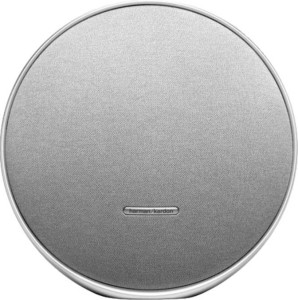
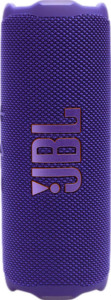
The most defining design difference between these two speakers is sheer scale. The Harman Kardon Onyx Studio 9 occupies a volume of 10,808 cm³ and weighs 3,330 g, making it a substantial home speaker meant to stay in one place. The JBL Flip 7, by contrast, comes in at just 906 cm³ and 560 g — roughly 12× smaller and 6× lighter. In practice, this means the Flip 7 can slip into a bag or backpack with ease, while the Onyx Studio 9 demands a dedicated shelf or table and is not a realistic carry-everywhere option.
Portability aside, water resistance is a critical functional gap. The Flip 7 is rated waterproof, making it suitable for outdoor use, poolside listening, or unpredictable weather. The Onyx Studio 9 has no water resistance at all, which effectively confines it to dry, indoor environments. For any scenario where exposure to moisture is even a possibility, this is a decisive disadvantage for the Onyx. On driver count, the Onyx carries 3 drivers versus the Flip 7's 2, which aligns with its larger cabinet and home-use positioning — more internal space allows for a dedicated driver configuration that a compact enclosure simply cannot accommodate.
Both speakers share a detachable cable and lack extras like RGB lighting, a touch screen, or a bundled travel bag, so those elements do not differentiate them. Overall, the JBL Flip 7 holds a clear design edge for portability and outdoor versatility, while the Onyx Studio 9's larger form factor is a deliberate trade-off aimed at a stationary, indoor listening context rather than a flaw in execution.