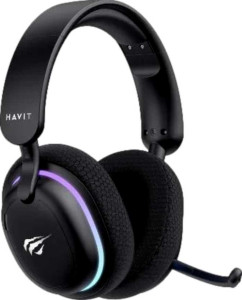
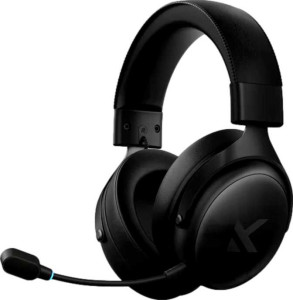
Havit Gamenote Fuxi-H7
MCHOSE V9 Pro

Havit Gamenote Fuxi-H7 MCHOSE V9 Pro

Overview

Welcome to our in-depth specification comparison between the Havit Gamenote Fuxi-H7 and the MCHOSE V9 Pro, two wireless gaming headsets that share a solid foundation but take noticeably different paths in key areas. From battery endurance to driver size and microphone flexibility, each headset brings its own set of trade-offs worth examining closely before making a purchase decision.

Common Features

  • Both headsets use an over-ear fit.
  • Both products have a detachable cable.
  • Neither product can be folded.
  • Neither product has an open-back design.
  • Both products have stereo speakers.
  • Both products cover a frequency range from 20 Hz to 20000 Hz.
  • Active noise cancellation (ANC) is not available on either product.
  • Both products offer virtual surround sound.
  • Both products have an impedance of 32 Ohms.
  • Both products feature a neodymium magnet.
  • Both products provide passive noise reduction.
  • Both products have 2 drivers.
  • Both products include a noise-canceling microphone.
  • A mute function is available on both products.
  • Both products have 1 microphone.
  • Both products have a rechargeable battery.
  • Neither product has a removable battery.
  • Both products can be used wirelessly.
  • Both products have a USB Type-C connector.
  • A control panel placed on the device is present on both products.
  • Both products can be used as a headset.
  • A vibration function is not available on either product.
  • Neither product has an in-line control panel.

Main Differences

  • Weight is 247 g on Havit Gamenote Fuxi-H7 and 272 g on MCHOSE V9 Pro.
  • RGB lighting is present on Havit Gamenote Fuxi-H7 but not available on MCHOSE V9 Pro.
  • Driver unit size is 40 mm on Havit Gamenote Fuxi-H7 and 53 mm on MCHOSE V9 Pro.
  • Sound pressure level is 110 dB/mW on Havit Gamenote Fuxi-H7 and 113 dB/mW on MCHOSE V9 Pro.
  • The microphone is removable on MCHOSE V9 Pro but not removable on Havit Gamenote Fuxi-H7.
  • Battery life is 18 hours on Havit Gamenote Fuxi-H7 and 250 hours on MCHOSE V9 Pro.
  • Battery power is 750 mAh on Havit Gamenote Fuxi-H7 and 2000 mAh on MCHOSE V9 Pro.
  • Havit Gamenote Fuxi-H7 supports USB, 3.5mm, 2.4GHz wireless, and Bluetooth connectivity, while MCHOSE V9 Pro supports USB, 2.4GHz wireless, and Bluetooth.
  • Havit Gamenote Fuxi-H7 is compatible with PlayStation, PC, Nintendo Switch, and Xbox, while MCHOSE V9 Pro is compatible with PlayStation, PC, and Nintendo Switch.
Specs Comparison
Havit Gamenote Fuxi-H7

Havit Gamenote Fuxi-H7

MCHOSE V9 Pro

MCHOSE V9 Pro

Design:
Fit Over-ear Over-ear
has a detachable cable
weight 247 g 272 g
has RGB lighting
can be folded
has an open-back design
has stereo speakers

Both the Havit Gamenote Fuxi-H7 and the MCHOSE V9 Pro share the same fundamental design blueprint: over-ear, closed-back headsets with detachable cables and stereo speakers. The detachable cable is a meaningful shared advantage, as it extends the product's lifespan by allowing cable replacement rather than discarding the entire headset after wear and tear. Neither model folds, which limits portability but is typical for desktop-oriented gaming headsets where structural rigidity and driver size take priority.

The most practical design differentiator is weight. The Fuxi-H7 comes in at 247 g versus the V9 Pro's 272 g — a 25 g difference that may seem minor on paper but becomes noticeable during extended gaming sessions. Lighter headsets reduce fatigue on the neck and ears over time, giving the Fuxi-H7 a tangible ergonomic edge for marathon use. The other notable distinction is aesthetics: the Fuxi-H7 includes RGB lighting, while the V9 Pro omits it entirely. For users who value a cohesive lit gaming setup, this matters; for those who prefer a cleaner, more understated look, the V9 Pro's absence of RGB is a non-issue.

On design alone, the Fuxi-H7 holds a clear edge: it is meaningfully lighter for better long-session comfort and adds RGB for users who want it, without sacrificing any of the shared structural features the V9 Pro offers.

Sound quality:
lowest frequency 20 Hz 20 Hz
highest frequency 20000 Hz 20000 Hz
has active noise cancellation (ANC)
Surround sound Virtual Virtual
driver unit size 40 mm 53 mm
sound pressure level 110 dB/mW 113 dB/mW
impedance 32 Ohms 32 Ohms
has a neodymium magnet
has passive noise reduction
drivers count 2 2

The two headsets share a great deal of common ground in audio engineering: identical 20 Hz–20,000 Hz frequency ranges, matching 32 Ohm impedance, dual neodymium-magnet drivers, passive noise reduction, and virtual surround sound. The 32 Ohm impedance means both will drive easily from a PC, console controller, or phone without needing an external amplifier — a practical plus for plug-and-play gaming setups.

Where the specs diverge is in driver size and output level. The V9 Pro uses significantly larger 53 mm drivers compared to the Fuxi-H7's 40 mm units. Larger drivers move more air, which generally translates to fuller low-end reproduction and a more expansive soundstage — particularly relevant for cinematic or immersive gaming audio. Reinforcing this, the V9 Pro also registers a higher sound pressure level of 113 dB/mW versus 110 dB/mW, meaning it can produce louder output from the same input signal. While a 3 dB gap is modest in absolute terms, it is a perceptible difference in perceived loudness and headroom.

On sound quality specs, the V9 Pro holds a clear edge. Its larger drivers and higher SPL suggest it is tuned for more powerful, room-filling audio output, which is an advantage for users who prioritize impact and immersion. The Fuxi-H7 remains entirely competent, but its driver configuration positions it as the more modest performer of the two.

Microphone:
has a noise-canceling microphone
has a removable microphone
has a mute function
number of microphones 1 1

For the core microphone feature set, these two headsets are nearly identical: both offer a single noise-canceling microphone with a mute function — a combination that covers the essentials for clear in-game communication and quick silencing during calls or streams. The noise-canceling mic on both models is designed to filter out background interference, which is a meaningful quality-of-life feature for anyone gaming in a noisy environment.

The one functional split between them is microphone removability. The V9 Pro ships with a detachable microphone, while the Fuxi-H7's mic is fixed in place. This distinction has real practical consequences: a removable mic allows the headset to double as a cleaner, more discreet pair of headphones for casual listening or commuting, without an arm jutting out. It also means that if the mic is damaged, it can be replaced independently rather than compromising the entire unit.

In this category, the V9 Pro has a clear advantage purely through its removable microphone. The added flexibility in usage scenarios and the practical durability benefit it provides make it the more versatile option for users who want their headset to serve multiple roles beyond gaming.

Power:
Battery life 18 hours 250 hours
battery power 750 mAh 2000 mAh
has a rechargeable battery
has a removable battery

Battery performance is where the gap between these two headsets becomes impossible to ignore. The V9 Pro is equipped with a 2000 mAh battery rated for 250 hours of use, while the Fuxi-H7 carries a 750 mAh cell delivering just 18 hours of runtime. That is not a incremental difference — it is a fundamentally different category of endurance. The Fuxi-H7 will need recharging multiple times a week for a typical gamer, whereas the V9 Pro could theoretically go weeks between charges under moderate daily use.

Both headsets share a non-removable rechargeable battery, so neither offers the option to hot-swap cells for instant runtime extension. This makes the rated battery life the only meaningful variable, and on that front the V9 Pro's advantage is overwhelming. For users who frequently forget to charge peripherals or want a headset that can travel and sit unused for extended periods without being completely drained on return, the V9 Pro's capacity is a substantial practical benefit.

The V9 Pro wins this category decisively. Its battery capacity and rated life so far exceed the Fuxi-H7's that there is no meaningful counterargument — for any user who values charging convenience and long-term unplugged reliability, the V9 Pro is the clear choice on power alone.

Connectivity:
connectivity USB, 3.5mm, 2.4GHz wireless, Bluetooth USB, 2.4GHz wireless, Bluetooth
compatibility PlayStation, PC, Nintendo Switch, Xbox PlayStation, PC, Nintendo Switch
Can be used wirelessly
Has USB Type-C

Connectivity is an area where both headsets cover the modern multi-platform essentials well: USB, 2.4GHz wireless, Bluetooth, and USB Type-C charging are shared across both models. The dual wireless options — 2.4GHz for low-latency gaming and Bluetooth for casual device pairing — give both headsets genuine flexibility for switching between a PC setup and a mobile device without re-cabling.

Two meaningful differences emerge on closer inspection. First, the Fuxi-H7 includes a 3.5mm analog connection that the V9 Pro lacks entirely. This matters in scenarios where wireless isn't an option — plugging directly into a controller, a flight entertainment system, or any device without USB — giving the Fuxi-H7 a fallback the V9 Pro simply cannot match. Second, the Fuxi-H7 explicitly lists Xbox compatibility alongside PlayStation, PC, and Nintendo Switch, while the V9 Pro's compatibility stops at three platforms. For Xbox users, this is a concrete functional gap.

In this category, the Fuxi-H7 has a clear edge. Its additional 3.5mm input broadens compatibility with devices and scenarios outside the standard gaming setup, and its explicit Xbox support makes it the more universally compatible headset of the two — a decisive advantage for multi-platform households.

Features:
release date January 2025 March 2025
control panel placed on a device
can be used as a headset
has a vibration function
Has an in-line control panel

Across every feature spec in this category, the Havit Gamenote Fuxi-H7 and the MCHOSE V9 Pro are in complete lockstep. Both place their controls directly on the earcup, both function as full headsets with microphone support, and neither includes a vibration motor or an in-line cable remote. There is no differentiator to analyze here — the feature sets are identical.

It is worth noting what is absent from both: no vibration function keeps the design focused on audio fidelity over gimmickry, and the lack of an in-line control panel means users manage everything from the headset itself. For on-ear controls, this is the more common and generally preferred layout for gaming headsets, as it avoids a dangling remote on the cable and keeps adjustments intuitive during play.

This category is a complete tie. Neither headset offers a feature advantage over the other, and users should treat this group as a non-factor when deciding between the two.

Comparison Summary & Verdict

After examining all the specifications, both headsets deliver a strong shared baseline: over-ear fit, virtual surround sound, 32 Ohm impedance, and multi-device wireless connectivity. However, their differences reveal distinct target audiences. The Havit Gamenote Fuxi-H7 stands out with its lighter 247 g build, RGB lighting, and broader platform compatibility including Xbox, making it a compelling pick for console and PC gamers who value aesthetics and versatility. The MCHOSE V9 Pro, on the other hand, makes a strong case with its larger 53 mm drivers, higher sound pressure level, a removable microphone, and a massive 250-hour battery life backed by a 2000 mAh cell, making it ideal for users who prioritize audio performance and extended use without frequent recharging.

Havit Gamenote Fuxi-H7
Buy Havit Gamenote Fuxi-H7 if...

Buy the Havit Gamenote Fuxi-H7 if you want a lighter headset with RGB lighting and broader platform compatibility that includes Xbox alongside PlayStation, PC, and Nintendo Switch.

MCHOSE V9 Pro
Buy MCHOSE V9 Pro if...

Buy the MCHOSE V9 Pro if you prioritize longer battery life, larger drivers for potentially richer sound, and the flexibility of a removable microphone.