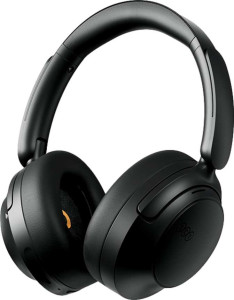
Haylou S40
QCY H3S

Haylou S40 QCY H3S

Overview

Welcome to our in-depth spec comparison between the Haylou S40 and the QCY H3S, two over-ear headphones that share a strong foundation but diverge in meaningful ways. Both deliver active noise cancellation, LDAC support, and Bluetooth 6, yet key differences in battery capacity, connectivity options, and microphone count make each headset better suited to a different type of listener. Read on to find out which one earns a place on your ears.

Common Features

  • Both headphones have an over-ear fit.
  • Neither headphone offers water resistance.
  • Both headphones can be folded.
  • Neither headphone is designed for kids.
  • Neither headphone has an open-back design.
  • Both headphones feature stereo speakers.
  • Both headphones support active noise cancellation (ANC).
  • Both headphones have a lowest frequency of 20 Hz and a highest frequency of 20000 Hz.
  • Both headphones use a 40 mm driver unit size.
  • Both headphones support spatial audio.
  • Both headphones have passive noise reduction.
  • Both headphones charge via USB Type-C.
  • Both headphones have a battery level indicator.
  • Neither headphone supports wireless charging.
  • Neither headphone has a solar power battery.
  • Both headphones have a rechargeable, non-removable battery.
  • Both headphones use Bluetooth version 6.
  • LDAC support is available on both headphones.
  • aptX Adaptive, aptX, LDHC, Bluetooth LE Audio, aptX Low Latency, and aptX HD are not supported on either headphone.
  • Both headphones have a noise-canceling microphone.
  • Ambient sound mode is available on both headphones.
  • Neither headphone has in/on-ear detection.
  • Neither headphone has a mute function.
  • Both headphones support multipoint connection with up to 2 devices.
  • Both headphones have a control panel placed on the device.
  • Both headphones can be used as a headset.
  • Neither headphone has an in-line control panel.

Main Differences

  • Weight is 280 g on the Haylou S40 and 240 g on the QCY H3S.
  • A detachable cable is available on the Haylou S40 but not on the QCY H3S.
  • A tangle-free cable is included with the Haylou S40 but not with the QCY H3S.
  • Battery life is 90 hours on the Haylou S40 and 102 hours on the QCY H3S.
  • Battery power is 650 mAh on the Haylou S40 and 750 mAh on the QCY H3S.
  • The Haylou S40 supports both wireless and wired connectivity, while the QCY H3S supports wireless only.
  • Audio latency is 80 ms on the Haylou S40 and 58 ms on the QCY H3S.
  • Maximum Bluetooth range is 20 m on the Haylou S40 and 10 m on the QCY H3S.
  • The Haylou S40 has 11 microphones, while the QCY H3S has 7 microphones.
Specs Comparison
Haylou S40

Haylou S40

QCY H3S

QCY H3S

Design:
Fit Over-ear Over-ear
weight 280 g 240 g
has a detachable cable
water resistance None None
can be folded
is designed for kids
has a tangle free cable
has an open-back design
has stereo speakers

Both the Haylou S40 and QCY H3S share the same fundamental design DNA: over-ear, closed-back headphones with foldable builds and stereo speakers. The foldable form factor is a meaningful shared win for portability, making either a reasonable travel companion. Neither offers any water resistance, so both should be kept away from rain or heavy sweat.

The most practical divergence is weight: the QCY H3S comes in at 240 g versus the Haylou S40's 280 g — a 40 g difference that may seem minor on paper but translates to noticeably less fatigue during extended listening sessions. For daily commuters or long work-from-home stretches, the lighter H3S has a tangible comfort edge.

On the cable side, the Haylou S40 counters with a detachable, tangle-free cable, while the QCY H3S has neither. A detachable cable is a significant practical advantage: it means the headphone survives a cable failure without becoming a paperweight, and it opens the door to using aftermarket or balanced cables. Overall, the H3S edges ahead on wearability comfort, but the S40 wins on long-term durability and cable flexibility — making the better choice dependent on whether you prioritize all-day fit or serviceability.

Sound quality:
has active noise cancellation (ANC)
lowest frequency 20 Hz 20 Hz
highest frequency 20000 Hz 20000 Hz
driver unit size 40 mm 40 mm
supports spatial audio
has passive noise reduction

Across every sound quality specification provided, the Haylou S40 and QCY H3S are a perfect mirror of each other. Both deploy a 40 mm dynamic driver — a size well-regarded in over-ear headphones for delivering a balanced mix of bass body and midrange clarity without the diminishing returns of oversized drivers. Their shared frequency range of 20 Hz to 20,000 Hz covers the full extent of human hearing, which is standard but confirms neither cuts corners on paper.

More meaningfully, both headphones combine active noise cancellation with passive noise reduction — a layered approach that typically outperforms ANC alone. The closed-back over-ear design physically blocks ambient sound, letting the ANC circuitry handle what leaks through rather than working overtime. Spatial audio support on both adds a modern dimension for immersive listening with compatible sources, though real-world quality of that feature depends heavily on implementation, which the specs alone cannot reveal.

With no differentiating data point anywhere in this category, the sound quality group is a dead tie. A buyer cannot use these specs to favor one over the other — the decision will need to rest on the design and connectivity differences covered in other groups.

Power:
Battery life 90 hours 102 hours
Has USB Type-C
has a battery level indicator
has wireless charging
battery power 650 mAh 750 mAh
Has a solar power battery
has a rechargeable battery
has a removable battery

Battery life is where the QCY H3S pulls ahead in a concrete, measurable way. Its 750 mAh cell delivers a rated 102 hours of playback, compared to the Haylou S40's 650 mAh and 90 hours. That 12-hour gap is not trivial — it represents roughly an extra day and a half of moderate daily use before needing to reach for a cable. For travelers, remote workers, or anyone who charges infrequently, the H3S has a genuine endurance advantage.

Everything else in this category is shared ground. Both headphones charge via USB-C, include a battery level indicator, and lack wireless charging — none of which surprise at this tier. The absence of wireless charging is a minor convenience trade-off but not a real-world dealbreaker for most over-ear headphone users given the exceptional wired runtimes both offer.

The QCY H3S takes a clear edge here. Its larger battery translates directly into fewer charging interruptions, and when combined with its lighter weight noted in the Design group, it positions itself as the stronger pick for endurance-focused listeners.

Connectivity:
connectivity Wireless & wired Wireless
Bluetooth version 6 6
has aptX Adaptive
has aptX
has LDAC
has LDHC
has Bluetooth LE Audio
has aptX Low Latency
has aptX HD
has aptX Lossless
has AAC
has Auracast
audio latency 80 ms 58 ms
maximum Bluetooth range 20 m 10 m
has fast pairing
supports Bluetooth pairing using NFC

Sharing Bluetooth 6, LDAC, and AAC support, both headphones arrive well-equipped for high-quality wireless audio. LDAC in particular is the standout codec here — capable of transmitting up to three times the data of standard SBC — making either headphone a solid match for hi-res streaming on compatible Android devices. Neither supports aptX variants or LE Audio, so codec parity is complete.

The meaningful splits come down to three variables. First, connectivity type: the Haylou S40 supports both wireless and wired use, while the QCY H3S is wireless-only. A wired fallback matters when battery dies mid-flight or when connecting to devices without Bluetooth. Second, Bluetooth range: the S40 reaches up to 20 m versus the H3S's 10 m — a real advantage for users who leave their source device in another room. Third, audio latency tilts the other way: the H3S posts a notably lower 58 ms versus the S40's 80 ms, which makes it the more responsive choice for casual video watching or gaming where lip-sync matters.

Neither product dominates cleanly — the result depends on use case. The Haylou S40 wins for versatility, offering wired fallback and double the wireless range. The QCY H3S counters with lower latency for video and gaming scenarios. Users who prioritize flexibility and range should lean toward the S40; those who primarily watch content wirelessly will appreciate the H3S's tighter latency.

Features:
release date August 2025 October 2025
has a noise-canceling microphone
has ambient sound mode
has in/on-ear detection
number of microphones 11 7
has a mute function
multipoint count 2 2
control panel placed on a device
can be used as a headset
Has an in-line control panel

For day-to-day usability, the two headphones are largely cut from the same cloth: both offer ambient sound mode, noise-canceling microphones, on-device controls, 2-device multipoint pairing, and headset functionality. Multipoint is worth highlighting — the ability to stay connected to two sources simultaneously is a genuine quality-of-life feature for anyone juggling a laptop and a phone throughout the workday.

The standout differentiator in this group is microphone count. The Haylou S40 packs 11 microphones compared to the QCY H3S's 7. More microphones generally enable more sophisticated beamforming and wind-noise rejection algorithms, which can translate to cleaner call audio in noisy environments. For users who take frequent calls or rely on voice assistants, this is a spec worth paying attention to — though the practical gap depends on the quality of the underlying processing, not just the raw count.

The Haylou S40 holds the edge here on paper, primarily due to its denser microphone array. All other features in this group are evenly matched, so the S40's advantage is narrow but real for call-heavy or voice-centric users.

Comparison Summary & Verdict

After examining the full spec sheet, both the Haylou S40 and the QCY H3S prove to be capable over-ear headphones with a shared commitment to ANC, LDAC, and Bluetooth 6. However, their differences reveal distinct identities. The QCY H3S wins on endurance with a 102-hour battery life and a 750 mAh cell, and its lower 58 ms audio latency makes it the stronger pick for media consumption. The Haylou S40, on the other hand, stands out with wired and wireless connectivity, a detachable tangle-free cable, an impressive 11-microphone array, and a longer 20 m Bluetooth range, making it the more versatile choice for calls and studio-style use. Choose the QCY H3S for all-day wireless listening; choose the Haylou S40 if flexibility and call quality are your top priorities.

Haylou S40
Buy Haylou S40 if...

Buy the Haylou S40 if you need wired and wireless connectivity with a detachable cable, a longer Bluetooth range of 20 m, and a superior 11-microphone setup for clearer calls.

QCY H3S
Buy QCY H3S if...

Buy the QCY H3S if you prioritize a longer battery life of 102 hours, a lighter 240 g build, and lower audio latency of 58 ms for everyday wireless listening.