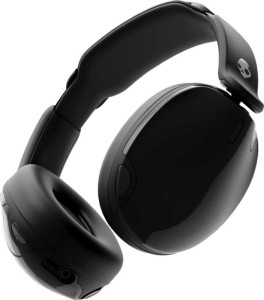
Haylou S40
Skullcandy Hesh 540

Haylou S40 Skullcandy Hesh 540

Overview

When it comes to premium over-ear headphones, the Haylou S40 and the Skullcandy Hesh 540 both bring strong credentials to the table. This comparison digs into the key battlegrounds that matter most to headphone buyers: battery endurance, audio codec support, Bluetooth connectivity, and everyday usability features. Whether you prioritize marathon listening sessions or a more travel-ready, feature-rich experience, read on to find out which headphone is the right fit for you.

Common Features

  • Both headphones have an over-ear fit.
  • Both headphones have a detachable cable.
  • Neither headphone offers water resistance.
  • Both headphones can be folded.
  • Neither headphone is designed for kids.
  • Both headphones have a tangle-free cable.
  • Neither headphone has an open-back design.
  • Both headphones have stereo speakers.
  • Both headphones support active noise cancellation (ANC).
  • Both headphones share a lowest frequency of 20 Hz and a highest frequency of 20000 Hz.
  • Both headphones have a 40 mm driver unit size.
  • Both headphones support spatial audio.
  • Neither headphone has a neodymium magnet.
  • Both headphones offer passive noise reduction.
  • Both headphones charge via USB Type-C.
  • Both headphones have a battery level indicator.
  • Neither headphone supports wireless charging.
  • Neither headphone has a solar power battery.
  • Both headphones have a rechargeable battery that is not removable.
  • Both headphones support wireless and wired connectivity.
  • Neither headphone supports aptX Adaptive, aptX, LDHC, Bluetooth LE Audio, aptX Low Latency, aptX HD, or aptX Lossless.
  • Both headphones have a noise-canceling microphone.
  • Both headphones have an ambient sound mode.
  • Both headphones support multipoint connection with up to 2 devices.
  • Both headphones can be used as a headset.
  • Neither headphone has an in-line control panel.

Main Differences

  • A travel bag is included with the Skullcandy Hesh 540 but not with the Haylou S40.
  • Impedance is 32 Ohms on the Haylou S40 and 36 Ohms on the Skullcandy Hesh 540.
  • Sound pressure level is 97 dB/mW on the Haylou S40 and 119.4 dB/mW on the Skullcandy Hesh 540.
  • Battery life is 90 hours on the Haylou S40 and 65 hours on the Skullcandy Hesh 540.
  • Bluetooth version is 6 on the Haylou S40 and 5.3 on the Skullcandy Hesh 540.
  • LDAC support is present on the Haylou S40 but not available on the Skullcandy Hesh 540.
  • AAC support is present on the Haylou S40 but not available on the Skullcandy Hesh 540.
  • Audio latency is 80 ms on the Haylou S40 and 50 ms on the Skullcandy Hesh 540.
  • Maximum Bluetooth range is 20 m on the Haylou S40 and 10 m on the Skullcandy Hesh 540.
  • Fast pairing is available on the Skullcandy Hesh 540 but not on the Haylou S40.
  • In/on-ear detection is present on the Skullcandy Hesh 540 but not available on the Haylou S40.
  • The number of microphones is 11 on the Haylou S40 and 4 on the Skullcandy Hesh 540.
  • The control panel is placed on the device on the Haylou S40 but not on the Skullcandy Hesh 540.
Specs Comparison
Haylou S40

Haylou S40

Skullcandy Hesh 540

Skullcandy Hesh 540

Design:
Fit Over-ear Over-ear
has a detachable cable
water resistance None None
can be folded
is designed for kids
has a tangle free cable
travel bag is included
has an open-back design
has stereo speakers

The Haylou S40 and Skullcandy Hesh 540 share a remarkably similar design profile: both are over-ear, closed-back headphones that fold for compact storage, feature a detachable, tangle-free cable, and carry no water resistance rating. For users comparing on form factor alone, these two headphones are essentially cut from the same cloth — portability-minded over-ear cans built for everyday use rather than outdoor or sport scenarios.

The only meaningful differentiator in this category is that the Hesh 540 includes a travel bag, while the S40 does not. This is a small but practical advantage: a dedicated carrying case protects the headphones during transit and keeps cables organized, which matters more given that both models rely on a detachable cable that could otherwise be misplaced.

Overall, the Skullcandy Hesh 540 holds a slight edge in design purely due to the bundled travel bag — a tangible accessory that adds day-one value. The Haylou S40 matches it on every other design point, so buyers who already own a case or prioritize price-to-feature ratio may find the omission negligible.

Sound quality:
has active noise cancellation (ANC)
lowest frequency 20 Hz 20 Hz
highest frequency 20000 Hz 20000 Hz
driver unit size 40 mm 40 mm
impedance 32 Ohms 36 Ohms
supports spatial audio
sound pressure level 97 dB/mW 119.4 dB/mW
has a neodymium magnet
has passive noise reduction

At first glance, the sound quality specs of the Haylou S40 and Skullcandy Hesh 540 look nearly identical: both deliver the full 20 Hz–20,000 Hz audible frequency range, use a 40 mm driver, and share the same feature set — ANC, passive noise reduction, and spatial audio support. For most users, these similarities mean both headphones are targeting the same listening experience on paper.

The standout difference, however, is the sound pressure level: the Hesh 540 is rated at 119.4 dB/mW compared to the S40's 97 dB/mW. That gap of over 22 dB is substantial — in practical terms, it means the Hesh 540 can reach significantly higher volume levels from the same power input. This matters for users who listen in loud environments or simply prefer headroom to spare without the driver straining. The slight difference in impedance (36 Ohms vs 32 Ohms for the S40) is minor and unlikely to affect everyday use with standard devices.

On sound quality specs, the Skullcandy Hesh 540 holds a clear advantage thanks to its considerably higher sensitivity rating. While both headphones share the same core feature parity, the Hesh 540's SPL headroom gives it a measurable edge for listeners who prioritize maximum loudness potential or need strong output in noisy surroundings.

Power:
Battery life 90 hours 65 hours
Has USB Type-C
has a battery level indicator
has wireless charging
Has a solar power battery
has a rechargeable battery
has a removable battery

Battery life is where these two headphones genuinely diverge. The Haylou S40 is rated at an impressive 90 hours, while the Skullcandy Hesh 540 comes in at 65 hours — still excellent by any standard, but trailing by a full 25 hours. To put that in perspective, even the Hesh 540's 65 hours comfortably covers most users for one to two weeks of daily commuting without a recharge; the S40's 90 hours pushes that window considerably further, making it especially appealing for frequent travelers or anyone who dislikes keeping track of charging routines.

Beyond battery life, both headphones are evenly matched: USB Type-C charging, a battery level indicator, and a sealed non-removable rechargeable battery are shared across the board. The absence of wireless charging on both means a cable is always required, but USB-C ensures broad compatibility with modern chargers.

The Haylou S40 wins this category outright on the strength of its significantly longer battery life. For users who prioritize going as long as possible between charges, that 25-hour gap is a concrete, real-world advantage that is hard to overlook.

Connectivity:
connectivity Wireless & wired Wireless & wired
Bluetooth version 6 5.3
has aptX Adaptive
has aptX
has LDAC
has LDHC
has Bluetooth LE Audio
has aptX Low Latency
has aptX HD
has aptX Lossless
has AAC
has Auracast
audio latency 80 ms 50 ms
maximum Bluetooth range 20 m 10 m
has fast pairing
supports Bluetooth pairing using NFC

Connectivity is one of the more nuanced battlegrounds between these two headphones. The Haylou S40 runs on Bluetooth 6 — a newer standard than the Hesh 540's Bluetooth 5.3 — which translates to improved connection stability and efficiency. More consequentially, the S40 supports LDAC and AAC, while the Hesh 540 supports neither. LDAC in particular is significant: it transmits audio at up to three times the bitrate of standard SBC, making it the preferred codec for users streaming high-resolution audio from compatible Android devices. The S40 also doubles the wireless range, rated at 20 m versus the Hesh 540's 10 m — a practical advantage in larger spaces or when the source device is not close at hand.

The Skullcandy Hesh 540 counters with two meaningful advantages of its own. Its 50 ms audio latency undercuts the S40's 80 ms, which matters for video watching or casual gaming where lip-sync accuracy is noticeable. It also offers fast pairing, streamlining the initial connection experience — a small but appreciated convenience that the S40 lacks.

Weighing the tradeoffs, the Haylou S40 holds the stronger overall advantage in this category. Superior codec support — especially LDAC — and double the Bluetooth range are substantial wins for audio quality and everyday usability. The Hesh 540's lower latency and fast pairing are genuine perks, but they serve a narrower set of use cases by comparison.

Features:
release date August 2025 June 2025
has a noise-canceling microphone
has ambient sound mode
has in/on-ear detection
number of microphones 11 4
multipoint count 2 2
control panel placed on a device
can be used as a headset
Has an in-line control panel

Both headphones cover the essential feature bases comfortably — noise-canceling microphones, ambient sound mode, 2-device multipoint connectivity, and headset capability are shared across the board. Where things get interesting is in the details that separate a capable headphone from a well-thought-out one.

The most striking difference is the microphone count: the Haylou S40 packs 11 microphones compared to the Hesh 540's 4. More microphones generally allow for more sophisticated beamforming and noise isolation algorithms, which can meaningfully improve call clarity in noisy environments. On the flip side, the Skullcandy Hesh 540 includes in/on-ear detection — a convenience feature that automatically pauses playback when the headphones are removed and resumes when worn again, something the S40 lacks entirely. The Hesh 540 also notably omits an on-device control panel, relying instead on other interaction methods, whereas the S40 provides physical controls directly on the earcup for straightforward, tactile operation.

This category does not have a single clear winner — it depends on priorities. The S40 is the stronger pick for call-heavy users, given its substantial microphone array and on-device controls. The Hesh 540 appeals more to music listeners who will appreciate the seamless convenience of ear detection. Neither advantage is trivial, making this a genuine split decision.

Comparison Summary & Verdict

After examining all the evidence, both the Haylou S40 and the Skullcandy Hesh 540 are capable over-ear headphones that share a strong foundation — including ANC, ambient sound mode, spatial audio, and dual-device multipoint support. However, their differences reveal distinct personalities. The Haylou S40 stands out with its exceptional 90-hour battery life, broader codec support via LDAC and AAC, a newer Bluetooth 6 chip, and a longer wireless range of 20 m, making it the stronger choice for audiophiles and heavy daily users. The Skullcandy Hesh 540, on the other hand, wins with a higher sound pressure level of 119.4 dB/mW, lower audio latency of 50 ms, fast pairing, in/on-ear detection, and an included travel bag, making it a compelling pick for commuters and users who value convenience and out-of-box usability.

Haylou S40
Buy Haylou S40 if...

Buy the Haylou S40 if you want an exceptionally long battery life of 90 hours, superior codec support with LDAC and AAC, and a wider Bluetooth range for audiophile-grade wireless listening.

Skullcandy Hesh 540
Buy Skullcandy Hesh 540 if...

Buy the Skullcandy Hesh 540 if you value a louder sound output, lower audio latency, fast pairing, in/on-ear detection, and the added convenience of an included travel bag.