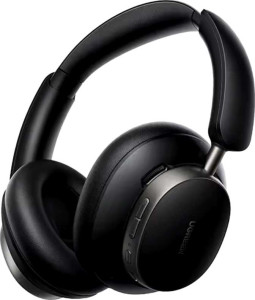
Haylou S40
Ugreen Studio Pro

Haylou S40 Ugreen Studio Pro

Overview

Welcome to our in-depth comparison of the Haylou S40 and the Ugreen Studio Pro, two feature-rich over-ear wireless headphones that share a surprising amount of common ground. Both models support ANC, LDAC, spatial audio, and multipoint connectivity — but the real story lies in their key differences, particularly around battery performance, audio range, microphone count, and Bluetooth range. Read on to see how each headphone stands out and which one is the right fit for you.

Common Features

  • Both the Haylou S40 and Ugreen Studio Pro use an over-ear fit.
  • Both headphones come with a detachable cable.
  • Neither the Haylou S40 nor the Ugreen Studio Pro offers water resistance.
  • Both the Haylou S40 and Ugreen Studio Pro can be folded.
  • Neither product is designed for kids.
  • Both headphones feature a tangle-free cable.
  • Neither the Haylou S40 nor the Ugreen Studio Pro has an open-back design.
  • Both products have stereo speakers.
  • Active noise cancellation (ANC) is available on both the Haylou S40 and Ugreen Studio Pro.
  • Both headphones share a lowest frequency of 20 Hz.
  • Both the Haylou S40 and Ugreen Studio Pro use a 40 mm driver unit.
  • Spatial audio support is available on both products.
  • Neither the Haylou S40 nor the Ugreen Studio Pro uses a neodymium magnet.
  • Passive noise reduction is present on both headphones.
  • Both products charge via USB Type-C.
  • A battery level indicator is included on both the Haylou S40 and Ugreen Studio Pro.
  • Neither product supports wireless charging.
  • Neither the Haylou S40 nor the Ugreen Studio Pro has a solar power battery.
  • Both headphones have a rechargeable, non-removable battery.
  • Both products support wireless and wired connectivity.
  • Both the Haylou S40 and Ugreen Studio Pro use Bluetooth version 6.
  • aptX Adaptive support is not available on either product.
  • aptX support is not available on either product.
  • LDAC support is available on both the Haylou S40 and Ugreen Studio Pro.
  • LDHC support is not available on either product.
  • Bluetooth LE Audio is not supported by either headphone.
  • aptX Low Latency is not supported on either product.
  • Both products feature a noise-canceling microphone.
  • Ambient sound mode is available on both the Haylou S40 and Ugreen Studio Pro.
  • Neither headphone has in/on-ear detection.
  • A mute function is not available on either product.
  • Both headphones support multipoint connection with up to 2 devices.
  • Both the Haylou S40 and Ugreen Studio Pro have a control panel placed on the device.
  • Both products can be used as a headset.
  • Neither headphone has an in-line control panel.

Main Differences

  • Weight is 280 g on the Haylou S40 and 315 g on the Ugreen Studio Pro.
  • The highest frequency reaches 20000 Hz on the Haylou S40 and 40000 Hz on the Ugreen Studio Pro.
  • Battery life is 90 hours on the Haylou S40 and 120 hours on the Ugreen Studio Pro.
  • Charge time is 2.5 hours on the Haylou S40 and 1.5 hours on the Ugreen Studio Pro.
  • Battery power is 650 mAh on the Haylou S40 and 820 mAh on the Ugreen Studio Pro.
  • Audio latency is 80 ms on the Haylou S40 and 60 ms on the Ugreen Studio Pro.
  • Maximum Bluetooth range is 20 m on the Haylou S40 and 15 m on the Ugreen Studio Pro.
  • The number of microphones is 11 on the Haylou S40 and 4 on the Ugreen Studio Pro.
Specs Comparison
Haylou S40

Haylou S40

Ugreen Studio Pro

Ugreen Studio Pro

Design:
Fit Over-ear Over-ear
weight 280 g 315 g
has a detachable cable
water resistance None None
can be folded
is designed for kids
has a tangle free cable
has an open-back design
has stereo speakers

From a design standpoint, the Haylou S40 and Ugreen Studio Pro share an almost identical feature profile: both are over-ear, closed-back headphones that fold for portability, come with a detachable and tangle-free cable, and offer no water resistance. For most users evaluating design priorities, these shared traits mean day-to-day usability is largely equivalent between the two models.

The one meaningful differentiator in this category is weight. The S40 comes in at 280 g versus the Studio Pro's 315 g — a difference of 35 grams. While this gap may sound small on paper, it becomes more noticeable during extended listening sessions, where additional weight translates directly into greater fatigue on the neck and headband pressure on the skull. For users who wear their headphones for hours at a stretch, the lighter S40 offers a tangible ergonomic advantage.

Overall, the Haylou S40 holds a design edge in this comparison, strictly due to its lower weight. Every other design attribute examined here is identical, making weight the single deciding factor for users who prioritize long-term wearing comfort.

Sound quality:
has active noise cancellation (ANC)
lowest frequency 20 Hz 20 Hz
highest frequency 20000 Hz 40000 Hz
driver unit size 40 mm 40 mm
supports spatial audio
has a neodymium magnet
has passive noise reduction

At the core of both headphones' sound profiles lies an identical foundation: 40 mm drivers, a shared low-end floor of 20 Hz, active noise cancellation, passive noise reduction, and spatial audio support. For the vast majority of listening scenarios, this common ground means neither headphone has a structural advantage in terms of noise isolation capability or driver architecture.

Where the two models diverge is at the top of the frequency range. The S40 cuts off at the standard 20,000 Hz ceiling of human hearing, while the Studio Pro extends to 40,000 Hz — squarely in hi-res audio territory. In practice, humans cannot directly perceive frequencies above roughly 20 kHz, so this difference is less about audible content and more about headroom: a wider frequency ceiling can reduce phase distortion in the upper registers and may result in a marginally cleaner, more accurate reproduction of the highest audible frequencies, particularly for critical listeners or audiophiles playing high-resolution audio files.

The Ugreen Studio Pro holds a technical edge in this category on the basis of its extended high-frequency response. While the real-world audibility of that advantage is debatable, it is the sole differentiating data point here, and for users who prioritize hi-res audio fidelity or work in audio production, it is a meaningful one.

Power:
Battery life 90 hours 120 hours
charge time 2.5 hours 1.5 hours
Has USB Type-C
has a battery level indicator
has wireless charging
battery power 650 mAh 820 mAh
Has a solar power battery
has a rechargeable battery
has a removable battery

Battery performance is where the Ugreen Studio Pro pulls ahead most decisively. Its 820 mAh cell delivers a rated 120 hours of playback, compared to the S40's 650 mAh battery and 90-hour claim. That 30-hour gap is substantial — for a typical listener putting in 3–4 hours a day, the Studio Pro could go nearly two additional weeks before needing a charge. This makes it particularly compelling for frequent travelers or users who dislike keeping track of charging routines.

The charging speed gap reinforces this advantage. The Studio Pro replenishes fully in just 1.5 hours, while the S40 requires 2.5 hours — an entire hour longer. Both use USB Type-C, which is the modern standard, so cable compatibility is a non-issue for either. Neither model supports wireless charging, keeping that variable off the table.

Across every meaningful power metric, the Ugreen Studio Pro holds a clear edge: it carries more capacity, lasts longer on a charge, and refuels faster. For users who prioritize set-it-and-forget-it battery convenience, this category is not particularly close.

Connectivity:
connectivity Wireless & wired Wireless & wired
Bluetooth version 6 6
has aptX Adaptive
has aptX
has LDAC
has LDHC
has Bluetooth LE Audio
has aptX Low Latency
has aptX HD
has aptX Lossless
has AAC
has Auracast
audio latency 80 ms 60 ms
maximum Bluetooth range 20 m 15 m
has fast pairing
supports Bluetooth pairing using NFC

Connectivity-wise, the Haylou S40 and Ugreen Studio Pro are built on the same backbone: both run Bluetooth 6, support both wireless and wired connections, and share an identical codec lineup — LDAC for high-quality wireless audio and AAC for Apple ecosystem compatibility. Neither supports aptX variants, LE Audio, or Auracast, so users dependent on those specific codecs will find both headphones equally unsuitable.

The two meaningful differentiators here pull in opposite directions. The Studio Pro achieves a lower audio latency of 60 ms versus the S40's 80 ms, which matters most for video content consumption and casual gaming — the tighter the latency, the less noticeable any lip-sync drift. The S40, however, offers a longer maximum Bluetooth range of 20 m compared to the Studio Pro's 15 m, giving users more freedom to move away from their source device without dropouts.

This group ultimately comes down to use-case priority. For users who watch video or game wirelessly, the Studio Pro's latency advantage is the more practically impactful edge. For those who frequently leave their phone in one room while moving around, the S40's extended range is the deciding factor. Neither product dominates outright — the two headphones trade blows on the only two specs that differ.

Features:
release date August 2025 May 2025
has a noise-canceling microphone
has ambient sound mode
has in/on-ear detection
number of microphones 11 4
has a mute function
multipoint count 2 2
control panel placed on a device
can be used as a headset
Has an in-line control panel

Much of the feature set here is a wash: both headphones offer ambient sound mode, on-device controls, noise-canceling microphones, dual-device multipoint pairing, and headset functionality. For call quality and everyday usability, these shared capabilities put both models on equal footing across the board.

The one standout differentiator is the microphone count. The Haylou S40 deploys an unusually high 11 microphones, compared to the Studio Pro's more conventional 4. A larger microphone array generally enables more sophisticated beamforming — the process of isolating the speaker's voice while suppressing surrounding noise — which can translate to cleaner call quality and more effective ANC processing. Whether the S40's implementation fully capitalizes on that hardware advantage cannot be determined from specs alone, but the raw array size does represent a significant architectural difference, particularly for users who prioritize voice call clarity or use their headphones in loud environments.

On the strength of its substantially larger microphone array, the Haylou S40 holds the edge in this category. All other features are identical, making the 11-microphone configuration the sole — but notable — differentiator for call-centric or noise-cancellation-focused users.

Comparison Summary & Verdict

After a thorough comparison, both the Haylou S40 and the Ugreen Studio Pro prove to be capable over-ear headphones with strong shared foundations — including ANC, LDAC support, spatial audio, and multipoint pairing. However, their differences are meaningful. The Ugreen Studio Pro pulls ahead with a longer 120-hour battery life, faster 1.5-hour charge time, a wider frequency range up to 40000 Hz, and lower 60 ms audio latency, making it the stronger choice for audiophiles and power users. The Haylou S40, on the other hand, is notably lighter at 280 g, offers a greater Bluetooth range of 20 m, and comes equipped with an impressive 11-microphone array, giving it a clear edge for calls, voice clarity, and on-the-go use. Your ideal pick depends entirely on what you value most.

Haylou S40
Buy Haylou S40 if...

Buy the Haylou S40 if you prioritize a lighter headphone with a longer Bluetooth range and a superior 11-microphone setup for clearer calls and voice performance.

Ugreen Studio Pro
Buy Ugreen Studio Pro if...

Buy the Ugreen Studio Pro if you want a longer-lasting battery, faster charging, lower audio latency, and a wider frequency range for a richer listening experience.