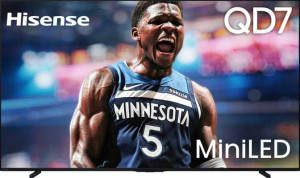
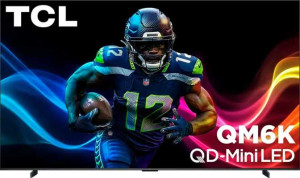
At a foundational level, these two televisions are remarkably close. Both the Hisense 100QD7QF and the TCL 98QM6K share the same core panel technology — QLED Mini-LED LCD — and deliver identical resolution (3840 x 2160), color depth (10-bit, 1.07 billion colors), and refresh rate (144Hz). Their HDR format support is also perfectly matched, covering HDR10, HDR10+, Dolby Vision, and HLG, which means neither has an advantage in compatibility with streaming services or physical media. Viewing angles of 178° horizontally and vertically on both sets indicate wide off-axis usability, and both include anti-reflection coating and an ambient light sensor for automatic brightness adaptation.
The most tangible hardware difference is screen size: the Hisense measures 99.5″ versus the TCL's 97.5″ — a 2-inch gap that translates to a slightly larger image and marginally more screen real estate, though at typical living-room distances this difference is unlikely to be perceptible. Pixel density is nearly identical at 44 ppi versus 45 ppi, so sharpness in day-to-day viewing is effectively equivalent.
The one spec where the TCL earns a meaningful edge is adaptive sync: it supports AMD FreeSync Premium Pro in addition to the standard FreeSync and FreeSync Premium tiers that the Hisense also offers. FreeSync Premium Pro adds low-framerate compensation and mandates HDR support within the variable refresh rate window, which matters for gamers connecting a compatible GPU or console and wanting tear-free, HDR gaming simultaneously. For non-gamers this distinction is irrelevant, but for a display-focused gaming setup the TCL 98QM6K holds a clear, if narrow, advantage in this group.