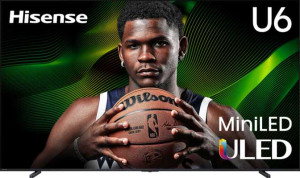
Hisense 100U65QF 100"
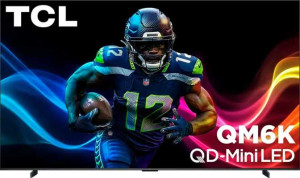
TCL 98QM6K 98"

Hisense 100U65QF 100" TCL 98QM6K 98"

Overview

Welcome to our in-depth specification comparison between the Hisense 100U65QF 100″ and the TCL 98QM6K 98″ — two commanding large-screen televisions battling it out in the premium segment. Both sets share a strong foundation of 4K Mini-LED technology, 144Hz refresh rates, and comprehensive HDR support, yet they diverge in meaningful ways across display technology, connectivity, and overall physical design. Read on to discover which of these giants best fits your living room and viewing needs.

Common Features

  • Both products have a 4K (UHD) display resolution of 3840 x 2160 px.
  • Both products display 1070 million colors at a 10-bit depth.
  • Both products have a 144Hz refresh rate.
  • HDR10 support is available on both products.
  • HDR10+ support is available on both products.
  • Dolby Vision support is available on both products.
  • Both products use a Mini-LED, LED-backlit LCD panel.
  • Bluetooth connectivity is available on both products.
  • Both products have HDMI 2.1 ports, with 4 HDMI ports each.
  • Wi-Fi support is available on both products.
  • Both products have 2 USB ports and 1 RJ45 port.
  • Miracast support is available on both products.
  • Neither product has an external memory slot.
  • Dolby Digital and Dolby Digital Plus support is available on both products.
  • Digital Out support is available on both products.
  • Both products have stereo speakers with Dolby Atmos and Dolby Audio.
  • SRS TheaterSound HD is not available on either product.
  • Dolby Virtual support is not available on either product.
  • Both products support VESA mounting and share the same operating temperature range of 5 °C to 35 °C.
  • AirPlay is available on both products.
  • Both products have a built-in smart TV platform and are compatible with Google Assistant.
  • Neither product works with Siri or Apple HomeKit.
  • Both products support remote smartphone control and USB recording.
  • Neither product has a rechargeable remote control.
  • Both products have a standby power consumption of 0.5W.

Main Differences

  • The display type is LED-backlit, LCD, Mini-LED on Hisense 100U65QF 100″ and QLED, LED-backlit, LCD, Mini-LED on TCL 98QM6K 98″.
  • The screen size is 99.5″ on Hisense 100U65QF 100″ and 97.5″ on TCL 98QM6K 98″.
  • The pixel density is 44 ppi on Hisense 100U65QF 100″ and 45 ppi on TCL 98QM6K 98″.
  • Adaptive synchronization includes AMD FreeSync and AMD FreeSync Premium on Hisense 100U65QF 100″, while TCL 98QM6K 98″ also adds AMD FreeSync Premium Pro.
  • Wi-Fi 6 (802.11ax) support is available on Hisense 100U65QF 100″ but not on TCL 98QM6K 98″, which only supports Wi-Fi 4 and Wi-Fi 5.
  • The Bluetooth version is 5.2 on Hisense 100U65QF 100″ and 5.4 on TCL 98QM6K 98″.
  • A 3.5mm audio jack is present on Hisense 100U65QF 100″ but not available on TCL 98QM6K 98″.
  • The width is 2230.1 mm on Hisense 100U65QF 100″ and 2180.1 mm on TCL 98QM6K 98″.
  • The weight is 63503 g on Hisense 100U65QF 100″ and 53302 g on TCL 98QM6K 98″.
  • The thickness is 81.3 mm on Hisense 100U65QF 100″ and 64 mm on TCL 98QM6K 98″.
  • The height is 1282.7 mm on Hisense 100U65QF 100″ and 1246.9 mm on TCL 98QM6K 98″.
  • The volume is 232562.655651 cm³ on Hisense 100U65QF 100″ and 173975.46816 cm³ on TCL 98QM6K 98″.
  • Alexa compatibility is present on Hisense 100U65QF 100″ but not available on TCL 98QM6K 98″.
Specs Comparison
Hisense 100U65QF 100"

Hisense 100U65QF 100"

TCL 98QM6K 98"

TCL 98QM6K 98"

Display:
display resolution 4K (UHD) 4K (UHD)
Display type LED-backlit, LCD, Mini-LED QLED, LED-backlit, LCD, Mini-LED
screen size 99.5" 97.5"
resolution 3840 x 2160 px 3840 x 2160 px
pixel density 44 ppi 45 ppi
display colors 1070 million 1070 million
bit depth 10-bit 10-bit
refresh rate 144Hz 144Hz
supports HDR10
supports HDR10+
supports Dolby Vision
supports HLG
Adaptive synchronization AMD FreeSync, AMD FreeSync Premium AMD FreeSync, AMD FreeSync Premium, AMD FreeSync Premium Pro
has anti-reflection coating
has an ambient light sensor
maximum horizontal viewing angle 178º 178º
maximum vertical viewing angle 178º 178º

Both the Hisense 100U65QF and the TCL 98QM6K share a strong display foundation: native 4K (3840 x 2160) resolution, a 10-bit panel capable of rendering 1.07 billion colors, a 144Hz refresh rate, and a Mini-LED backlighting architecture. They also match on HDR format support — covering HDR10, HDR10+, Dolby Vision, and HLG — and both offer full 178° horizontal and vertical viewing angles, anti-reflection coating, and an ambient light sensor. For most buyers, these shared traits represent the bulk of the day-to-day display experience.

The most meaningful hardware distinction lies in the TCL's panel technology: it adds a QLED (Quantum Dot) layer on top of the Mini-LED backlight. In practice, quantum dots expand the color gamut and improve color volume at high brightness levels, which can make HDR content appear more vivid and saturated compared to a standard LCD-based Mini-LED panel like the one in the Hisense. On the gaming side, the TCL also supports AMD FreeSync Premium Pro, a superset of the FreeSync Premium standard both TVs share — adding Low Framerate Compensation (LFC) for smoother visuals during frame rate dips below the sync range. The Hisense counters with a marginally larger physical screen at 99.5″ versus the TCL's 97.5″, a real but modest two-inch difference at this size class.

Overall, the TCL 98QM6K holds a display edge based strictly on these specs. The QLED layer is a tangible technology advantage for color performance in HDR, and FreeSync Premium Pro offers a more complete variable refresh rate implementation for gamers. The Hisense's slightly larger screen is the only spec-based counterpoint, but it does not offset the panel technology gap. Buyers prioritizing color richness and gaming smoothness should favor the TCL; those who want the absolute largest screen footprint may lean toward the Hisense.
Connectivity:
Has Bluetooth
HDMI version HDMI 2.1 HDMI 2.1
HDMI ports 4 4
supports Wi-Fi
Wi-Fi version Wi-Fi 4 (802.11n), Wi-Fi 5 (802.11ac), Wi-Fi 6 (802.11ax) Wi-Fi 4 (802.11n), Wi-Fi 5 (802.11ac)
Bluetooth version 5.2 5.4
USB ports 2 2
RJ45 ports 1 1
supports Miracast
has a socket for a 3.5 mm audio jack
has an external memory slot
has a VGA connector
has a DVI connector

The connectivity skeletons of these two TVs are nearly identical — both offer 4x HDMI 2.1 ports, 2x USB, a single RJ45 Ethernet port, Wi-Fi, Bluetooth, and Miracast support. HDMI 2.1 is the key standard for modern home theater setups, enabling 4K at 120Hz and eARC for high-quality audio passthrough, so having it across all four ports on both units is a genuine strength they share equally.

The differences, while fewer, carry real-world weight. On wireless, the Hisense 100U65QF supports Wi-Fi 6 (802.11ax) in addition to the older Wi-Fi 4 and 5 standards that the TCL 98QM6K tops out at. Wi-Fi 6 delivers notably better performance in congested network environments — a common scenario in households with many connected devices — offering lower latency and more stable throughput. Conversely, the TCL counters with a newer Bluetooth 5.4 versus the Hisense's Bluetooth 5.2; Bluetooth 5.4 introduces improved connection reliability and reduced power consumption, which benefits wireless audio accessories and peripherals. The other split: the Hisense includes a 3.5mm headphone jack, which the TCL omits — a meaningful convenience for anyone wanting to plug in wired headphones directly.

Connectivity here is a genuine trade-off rather than a clear sweep for either side. The Hisense edges ahead for households prioritizing network performance and wired headphone use, while the TCL holds a marginal lead in Bluetooth modernity. Given that Wi-Fi 6 has broader day-to-day impact than a Bluetooth point revision, the Hisense 100U65QF holds a slight overall connectivity advantage, primarily driven by its superior wireless networking capability.

Audio:
supports Dolby Digital
supports Digital Out
supports Dolby Digital Plus
has SRS TheaterSound HD
has stereo speakers
has Dolby Atmos
has Dolby Audio
supports Dolby Virtual
has a subwoofer
has DTS:X
HDMI ARC / eARC HDMI ARC, HDMI eARC HDMI ARC, HDMI eARC

Across every single audio specification provided, the Hisense 100U65QF and the TCL 98QM6K are a perfect match. Both ship with built-in stereo speakers, a dedicated subwoofer, and support for the most important audio formats in the market today — including Dolby Atmos, Dolby Audio, Dolby Digital Plus, and DTS:X. The presence of both HDMI ARC and eARC on each TV is also worth highlighting: eARC in particular allows uncompressed, high-bitrate audio formats to be sent to a soundbar or AV receiver over a single HDMI cable, which is the preferred setup for anyone looking to expand beyond the built-in speakers.

This is a straightforward complete tie. There is not a single audio specification in this group where one TV differentiates itself from the other. Buyers should treat audio hardware as a non-factor in the decision between these two models and focus their attention on the differences identified in other specification groups.

Design:
width 2230.1 mm 2180.1 mm
weight 63503 g 53302 g
thickness 81.3 mm 64 mm
height 1282.7 mm 1246.9 mm
volume 232562.655651 cm³ 173975.46816 cm³
Supports VESA mount
maximum operating temperature 35 °C 35 °C
lowest potential operating temperature 5 °C 5 °C

At this screen size class, physical dimensions and weight are not abstract numbers — they have direct consequences for installation, wall reinforcement, and how many people are needed to safely move and mount the TV. The Hisense 100U65QF is the larger and heavier of the two by a meaningful margin: it weighs 63,503 g (roughly 63.5 kg) compared to the TCL 98QM6K's 53,302 g (53.3 kg), a difference of over 10 kilograms. That gap is significant enough that it could be the deciding factor between a two-person install and one requiring professional mounting assistance, particularly for wall installations where bracket load ratings must be respected.

The physical footprint tells a similar story. The Hisense is wider, taller, and notably thicker — 81.3 mm deep versus the TCL's 64 mm — resulting in a total volume roughly 34% larger than the TCL. The slimmer profile of the TCL will sit more flush against a wall and generally present a more streamlined aesthetic in the room. Width and height differences (~50 mm and ~36 mm respectively) are less dramatic visually but still relevant when measuring cabinet clearances or planning a tight installation. Both TVs support VESA mounting and share identical operating temperature ranges, so those factors are a wash.

For design and installation practicality, the TCL 98QM6K holds a clear advantage. Its substantially lower weight and slimmer chassis make it easier to handle, mount, and integrate into a living space — advantages that are especially pronounced given the sheer scale of near-100-inch televisions. The Hisense's extra size stems partly from its larger screen, but buyers should factor in the logistical and structural implications of that additional mass before committing.

Features:
release date April 2025 March 2025
has AirPlay
has built-in smart TV
compatible with Google Assistant
works with Alexa
works with Siri/Apple HomeKit
supports a remote smartphone
has a rechargeable remote control
supports USB recording
standby power consumption 0.5W 0.5W
has a search browser
has a sleep timer
has a child lock
warranty period 1 years 1 years
has voice commands

Feature parity between these two TVs is high across the smart platform essentials. Both carry built-in smart TV functionality, AirPlay support, Google Assistant compatibility, smartphone remote control, USB recording, and voice commands — a well-rounded baseline that covers the needs of most households regardless of their ecosystem preferences. Standby power consumption is an identical 0.5W on both, and warranty coverage matches at 1 year each.

The only functional differentiator in this group is Amazon Alexa compatibility, which the Hisense 100U65QF supports and the TCL 98QM6K does not. For users already embedded in the Amazon ecosystem — with Alexa-enabled speakers, smart home devices, or routines — this is a genuine convenience advantage, enabling voice control of the TV through existing Alexa hardware without any workarounds. Neither TV supports Siri or Apple HomeKit, so that is not a factor either way.

The Hisense 100U65QF holds a narrow edge in this group purely on the basis of its Alexa support. It is a single differentiator, but one that carries practical weight for Amazon ecosystem households. For users who do not use Alexa, the two TVs are effectively tied on features.

Comparison Summary & Verdict

After reviewing every specification, both televisions deliver an impressive shared platform: 4K 144Hz Mini-LED panels, full HDR10, HDR10+, and Dolby Vision support, four HDMI 2.1 ports, and smart TV features including AirPlay and Google Assistant. The Hisense 100U65QF 100″ edges ahead with its slightly larger 99.5″ screen, Wi-Fi 6 support, a 3.5mm audio jack, and Alexa compatibility, making it the stronger choice for smart home enthusiasts who want maximum connectivity options. The TCL 98QM6K 98″, on the other hand, benefits from a QLED panel, a notably slimmer and lighter build, Bluetooth 5.4, and AMD FreeSync Premium Pro, making it the preferred option for gamers and those who value a sleeker physical footprint alongside enhanced color technology.

Hisense 100U65QF 100
Buy Hisense 100U65QF 100" if...

Buy the Hisense 100U65QF 100″ if you want the largest possible screen, Wi-Fi 6 connectivity, a 3.5mm audio jack, and Alexa smart home integration built in.

TCL 98QM6K 98
Buy TCL 98QM6K 98" if...

Buy the TCL 98QM6K 98″ if you prioritize a QLED display, a slimmer and significantly lighter design, Bluetooth 5.4, and AMD FreeSync Premium Pro for an enhanced gaming experience.