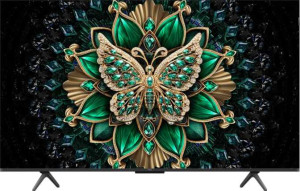
Both the Hisense 100U75QG and the TCL 98C6K share the same fundamental display architecture: QLED Mini-LED LCD panels with a native 4K (3840 x 2160) resolution, 10-bit color depth, and 1.07 billion colors. They also match on HDR support — covering HDR10, HDR10+, Dolby Vision, and HLG — as well as identical 178° viewing angles in both directions, anti-reflection coating, and an ambient light sensor. For everyday HDR viewing and content compatibility, these two televisions are effectively on equal footing.
Where they diverge is in screen size and refresh rate. The Hisense measures 99.5″ versus the TCL's 97.5″, a 2-inch difference that is barely perceptible at typical viewing distances and carries no meaningful real-world impact. The more relevant gap is the refresh rate: the Hisense runs at 165Hz while the TCL tops out at 144Hz. In practice, both far exceed the 120Hz threshold needed for smooth high-frame-rate gaming and sports content, but the Hisense's higher ceiling gives it a slight edge for enthusiast gamers who can actually feed the panel with compatible high-framerate signals — particularly relevant given both TVs share the same AMD FreeSync Premium Pro adaptive sync support.
Overall, the Hisense 100U75QG holds a narrow display edge, driven primarily by its higher 165Hz refresh rate. The pixel density difference (44 vs. 45 ppi) is statistically negligible and imperceptible at normal sitting distances for screens this size. If gaming performance is a priority, the Hisense is the stronger choice; for pure cinematic or broadcast viewing, the two panels are essentially equivalent.