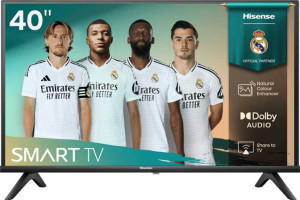
Hisense 40A4Q 40"
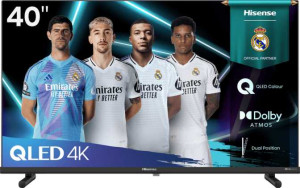
Hisense 40A5Q 40"

Hisense 40A4Q 40" Hisense 40A5Q 40"

Overview

Welcome to our detailed spec comparison between the Hisense 40A4Q 40″ and the Hisense 40A5Q 40″. These two 40-inch Full HD smart TVs share the same physical footprint and core resolution, yet they diverge in some meaningful ways. From display technology and HDR support to connectivity options and audio capabilities, this head-to-head breakdown will help you understand exactly what sets these two models apart before you make your decision.

Common Features

  • Both TVs have a 40″ screen size.
  • Both TVs offer 1080p Full HD resolution at 1920 x 1080 px.
  • Both TVs have a pixel density of 55 ppi.
  • Both TVs display 1670 million colors with an 8-bit bit depth.
  • Both TVs have a contrast ratio of 5000:1.
  • Both TVs have a 60Hz refresh rate.
  • Bluetooth is not available on either TV.
  • Both TVs have 2 HDMI ports.
  • Both TVs support Wi-Fi 4 (802.11n).
  • Both TVs have 1 RJ45 port.
  • Miracast is supported on both TVs.
  • Both TVs have a 3.5mm audio jack socket.
  • External memory slot is not available on either TV.
  • Both TVs support Dolby Digital, Dolby Digital Plus, and Dolby Audio.
  • Digital Out is supported on both TVs.
  • SRS TheaterSound HD is not available on either TV.
  • Both TVs have stereo speakers and no subwoofer.
  • Dolby Virtual support is not available on either TV.
  • Both TVs share the same physical dimensions: 900mm wide, 515mm tall, 85mm thick, and weigh 5500g.
  • Both TVs support VESA mounting.
  • Both TVs have built-in smart TV functionality.
  • Apple HomeKit and Siri are not supported on either TV.
  • Both TVs support remote control via smartphone.
  • Neither TV has a rechargeable remote control.
  • Both TVs have a standby power consumption of 0.5W.
  • Both TVs include a search browser, sleep timer, and child lock.

Main Differences

  • The Hisense 40A4Q 40″ uses LED-backlit LCD display technology, while the Hisense 40A5Q 40″ uses QLED LED-backlit LCD technology.
  • Typical brightness is 200 nits on the Hisense 40A4Q 40″ and 230 nits on the Hisense 40A5Q 40″.
  • HDR10 support is present on the Hisense 40A5Q 40″ but not available on the Hisense 40A4Q 40″.
  • HLG support is present on the Hisense 40A5Q 40″ but not available on the Hisense 40A4Q 40″.
  • HDMI version is 1.4 on the Hisense 40A4Q 40″ and 2.0 on the Hisense 40A5Q 40″.
  • The Hisense 40A4Q 40″ has 1 USB port, while the Hisense 40A5Q 40″ has 2 USB ports.
  • DVB standards supported are DVB-T, DVB-T2, DVB-C, DVB-S, and DVB-S2 on the Hisense 40A4Q 40″, compared to only DVB-T, DVB-T2, and DVB-C on the Hisense 40A5Q 40″.
  • Audio output power is 2 x 7W on the Hisense 40A4Q 40″ and 2 x 8W on the Hisense 40A5Q 40″.
  • Dolby Atmos support is present on the Hisense 40A5Q 40″ but not available on the Hisense 40A4Q 40″.
  • AirPlay support is present on the Hisense 40A5Q 40″ but not available on the Hisense 40A4Q 40″.
  • USB recording is supported on the Hisense 40A4Q 40″ but not available on the Hisense 40A5Q 40″.
Specs Comparison
Hisense 40A4Q 40"

Hisense 40A4Q 40"

Hisense 40A5Q 40"

Hisense 40A5Q 40"

Display:
display resolution 1080p (Full HD) 1080p (Full HD)
Display type LED-backlit, LCD QLED, LED-backlit, LCD
screen size 40" 40"
resolution 1920 x 1080 px 1920 x 1080 px
pixel density 55 ppi 55 ppi
display colors 1670 million 1670 million
bit depth 8-bit 8-bit
brightness (typical) 200 nits 230 nits
contrast ratio 5000:1 5000:1
refresh rate 60Hz 60Hz
supports HDR10
supports HDR10+
supports Dolby Vision
supports HLG
Adaptive synchronization None None
response time 9.5 ms 9.5 ms
has anti-reflection coating
has an ambient light sensor
maximum horizontal viewing angle 178º 178º
maximum vertical viewing angle 178º 178º

At their core, both the Hisense 40A4Q and Hisense 40A5Q share the same foundational display DNA: a 1920 x 1080 (Full HD) resolution at 55 ppi on a 40″ panel, with identical contrast ratios of 5000:1, a 60Hz refresh rate, 9.5 ms response time, and wide 178° viewing angles in both directions. For everyday TV viewing at this screen size, these shared specs mean both sets will look comparably sharp and handle motion similarly.

The meaningful differences emerge in two areas. First, the A5Q uses QLED panel technology — a quantum-dot enhancement layer over the standard LED-backlit LCD found in the A4Q. This directly correlates with the A5Q's higher typical brightness of 230 nits versus the A4Q's 200 nits, a 15% advantage that translates to a punchier, more visible image in moderately lit rooms. Second, and arguably more impactful, the A5Q supports HDR10 and HLG, while the A4Q supports neither HDR format. HDR10 enables compatible streaming content and Blu-rays to deliver a wider range of light and shadow, and HLG is the broadcast HDR standard — meaning the A5Q can actually decode and render HDR signals where the A4Q simply cannot.

The A5Q has a clear display advantage. The QLED panel, brighter output, and HDR10/HLG support collectively make it the more capable screen, particularly for users who stream HDR content or watch HDR broadcasts. The A4Q is not a bad display for its class, but it lacks the tools to take advantage of higher-quality video signals that are increasingly common.
Connectivity:
Has Bluetooth
HDMI version HDMI 1.4 HDMI 2.0
HDMI ports 2 2
supports Wi-Fi
Wi-Fi version Wi-Fi 4 (802.11n) Wi-Fi 4 (802.11n)
USB ports 1 2
RJ45 ports 1 1
supports Miracast
has a socket for a 3.5 mm audio jack
has an external memory slot
has a VGA connector
DVB standards DVB-T, DVB-T2, DVB-C, DVB-S, DVB-S2 DVB-T, DVB-T2, DVB-C
has a DVI connector

Both TVs share a reasonable connectivity baseline: dual HDMI ports, a single RJ45 ethernet port, Wi-Fi 4 (802.11n), Miracast screen mirroring, and a 3.5 mm audio jack — solid but unspectacular for this price tier. Neither offers Bluetooth, which rules out wireless headphones or speakers on both models without a third-party adapter.

Two differences are worth attention. The A5Q steps up to HDMI 2.0 versus the A4Q's HDMI 1.4 — a practically significant gap, since HDMI 2.0 supports 4K at 60Hz and, more relevantly here, properly handles the HDR10 signals that the A5Q's display can decode. The A4Q's HDMI 1.4 ports are bandwidth-limited and cannot pass HDR metadata correctly, which actually compounds the display disadvantage noted earlier. Additionally, the A5Q provides 2 USB ports compared to the A4Q's single USB port, giving more flexibility for simultaneous use of a USB drive and a peripheral like a keyboard or mouse. On the other hand, the A4Q's tuner supports a broader DVB standard set — including DVB-S and DVB-S2 (satellite) — while the A5Q is limited to DVB-T/T2 and DVB-C (terrestrial and cable only). For users without satellite reception this is irrelevant, but it is a real limitation for those who rely on it.

Overall, the A5Q has the connectivity edge for most users: its HDMI 2.0 ports and extra USB slot are broadly useful upgrades. The A4Q's satellite tuner support is a niche but genuine advantage for a specific subset of buyers — worth checking before deciding.

Audio:
supports Dolby Digital
audio output power 2 x 7W 2 x 8W
supports Digital Out
supports Dolby Digital Plus
has SRS TheaterSound HD
has stereo speakers
has Dolby Atmos
has Dolby Audio
supports Dolby Virtual
has a subwoofer
has DTS:X

The audio profiles of these two TVs are closely matched: both run stereo speaker setups with no subwoofer, support Dolby Digital, Dolby Digital Plus, Dolby Audio, DTS:X, and offer a digital output for external sound systems. For a 40″ set in this class, that is a respectable codec foundation covering the most common streaming and disc-based audio formats.

The two points of divergence are output power and one key format. The A5Q delivers 2 x 8W versus the A4Q's 2 x 7W — a modest but real difference that contributes to slightly higher maximum volume headroom and a marginally fuller sound at the same volume level. More meaningfully, the A5Q adds Dolby Atmos support, which the A4Q lacks. In practice, the TV's stereo speakers cannot reproduce true Atmos spatial audio on their own, but Atmos support matters for pass-through: when connected to an Atmos-capable soundbar or AV receiver via HDMI or digital out, the A5Q can relay the Atmos bitstream intact, preserving the full audio experience that the source material was mastered with. The A4Q would downmix that same signal.

The A5Q holds the audio edge, primarily due to Dolby Atmos pass-through capability — a forward-looking advantage for anyone pairing the TV with an external sound system. The extra watt per channel is a minor bonus. For users relying solely on the built-in speakers, the gap is smaller, but the A5Q still nudges ahead on raw output power.

Design:
width 900 mm 900 mm
weight 5500 g 5500 g
thickness 85 mm 85 mm
height 515 mm 515 mm
volume 39397.5 cm³ 39397.5 cm³
Supports VESA mount
maximum operating temperature 35 °C 35 °C
lowest potential operating temperature 5 °C 5 °C

Across every design and physical specification provided, the Hisense 40A4Q and 40A5Q are identical: same dimensions (900 x 515 x 85 mm), same 5500 g weight, same volume, identical VESA mount support, and the same operating temperature range of 5–35 °C. There is no differentiator here whatsoever.

This is a complete tie. Buyers making a decision based on installation requirements, wall-mount compatibility, furniture fit, or portability will find no reason to choose one over the other from this data alone.

Features:
release date April 2025 April 2025
has AirPlay
has built-in smart TV
works with Siri/Apple HomeKit
supports a remote smartphone
has a rechargeable remote control
supports USB recording
standby power consumption 0.5W 0.5W
has a search browser
has a sleep timer
has a child lock
warranty period 3 years 3 years

Feature-wise, these two TVs share a solid common ground: both are smart TVs with smartphone remote support, a search browser, sleep timer, child lock, identical 0.5W standby consumption, and a matching 3-year warranty. Neither offers a rechargeable remote or Apple HomeKit integration.

The two features where they diverge cut in opposite directions. The A5Q gains AirPlay support — a meaningful addition for households invested in Apple devices, enabling direct wireless streaming from iPhones, iPads, and Macs without needing a separate dongle or app workaround. The A4Q, meanwhile, supports USB recording, which allows users to record live broadcast content directly to an attached USB drive — a feature the A5Q omits entirely. For cord-cutters or users who rely on over-the-air and cable broadcasts, USB recording is a genuinely practical capability that removes the need for a separate PVR device.

Neither product has a clean overall win in this group — it comes down squarely to use case. The A5Q is the better fit for Apple ecosystem users, while the A4Q is more practical for users who want to record live TV. Buyers who use neither AirPlay nor USB recording will find both sets functionally equivalent here.

Comparison Summary & Verdict

Both the Hisense 40A4Q 40″ and the Hisense 40A5Q 40″ are competent 40-inch Full HD smart TVs that share identical dimensions, the same contrast ratio, and a broadly similar feature set. However, the differences are meaningful. The Hisense 40A5Q 40″ steps ahead with its QLED panel, higher brightness, HDR10 and HLG support, Dolby Atmos, AirPlay, an extra USB port, and HDMI 2.0 — making it the stronger pick for viewers who want a richer, more connected viewing experience. On the other hand, the Hisense 40A4Q 40″ holds its own for users who need DVB-S and DVB-S2 satellite tuner support or rely on USB recording functionality, features entirely absent on the A5Q. Choose the A4Q for satellite and recording flexibility; choose the A5Q for a more premium picture and modern connectivity.

Hisense 40A4Q 40
Buy Hisense 40A4Q 40" if...

Buy the Hisense 40A4Q 40″ if you need satellite tuner support (DVB-S/DVB-S2) or rely on USB recording to save broadcast content directly from your TV.

Hisense 40A5Q 40
Buy Hisense 40A5Q 40" if...

Buy the Hisense 40A5Q 40″ if you want a superior picture experience with QLED technology, HDR10, Dolby Atmos, AirPlay support, and more versatile HDMI 2.0 connectivity.