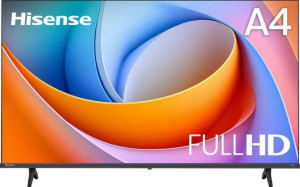
Both the Hisense 40A4Q and the Hisense 43A4NF share the same foundational display technology: LED-backlit LCD panels with 1920×1080 Full HD resolution, 8-bit color depth rendering 1.67 billion colors, a 60Hz refresh rate, and identical 178º viewing angles on both axes. Neither TV supports any HDR format — not HDR10, HDR10+, Dolby Vision, or HLG — and neither offers adaptive sync. In practical terms, both deliver a standard SDR picture with no dynamic range enhancement, which limits their performance with modern HDR-mastered content.
The most meaningful differentiator between these two displays is the ambient light sensor found on the 43A4NF but absent on the 40A4Q. In a real-world living room, this allows the 43A4NF to automatically adjust screen brightness based on the lighting conditions in the room — a genuinely useful feature for comfort and power efficiency. The A4Q, lacking this, requires manual brightness adjustment. Beyond that, the slightly larger 42.5″ panel of the 43A4NF versus the 40″ of the A4Q results in a marginally lower pixel density (52 ppi vs 55 ppi), though at typical viewing distances this difference is imperceptible to most viewers.
Overall, the displays are nearly identical in technical capability. However, the 43A4NF holds a slight edge due to its ambient light sensor, which adds a layer of practical convenience absent on the A4Q. The A4Q's fractionally higher pixel density is a negligible real-world advantage. If automatic brightness adaptation matters to you, the 43A4NF is the more practical choice; otherwise, the two panels are functionally equivalent for everyday SDR viewing.