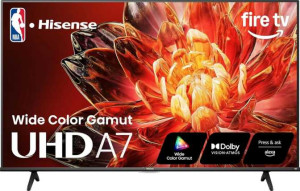
The most fundamental divide between these two sets is resolution. The Hisense 40A4Q offers 1080p Full HD at 55 ppi, while the Hisense 43A7NF delivers 4K UHD (3840 x 2160) at 104 ppi — nearly double the pixel density. In practice, on a screen just a few inches larger, that difference is clearly perceptible at normal viewing distances: the 43A7NF will render finer detail in supported content, with noticeably sharper edges and textures.
The HDR story further separates the two. The 40A4Q supports no HDR formats whatsoever, meaning it cannot render the expanded contrast and color range that modern streaming content increasingly relies on. The 43A7NF, by contrast, supports HDR10, HDR10+, Dolby Vision, and HLG — the full suite of current standards. This is a significant real-world gap: content mastered in Dolby Vision or HDR10+ will display in its intended form only on the 43A7NF. Interestingly, despite the 40A4Q claiming 1.67 billion colors versus the 43A7NF′s 1.07 billion, the 43A7NF′s 10-bit panel (vs. 8-bit) means it handles gradients and color transitions more smoothly, with far less banding — the raw color count figure is less meaningful than bit depth in practice.
Both panels share the same LED-backlit LCD technology, 60Hz refresh rate, 178° viewing angles, and anti-reflection coating. The 43A7NF adds an ambient light sensor, which the 40A4Q lacks. Overall, the 43A7NF holds a clear and decisive advantage in this group: higher resolution, full HDR support, superior bit depth, and a more adaptive display experience — making it the stronger choice for picture quality by a wide margin.