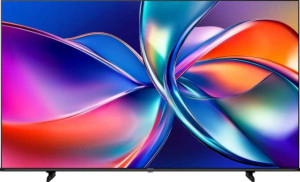
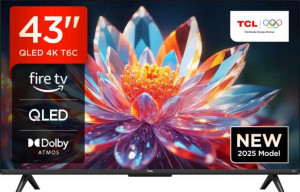
At the panel fundamentals level, the Hisense 43E7Q and TCL 43T6C-UK share an identical foundation: both are QLED LED-backlit LCD panels running at 4K (3840 x 2160) resolution with a 102 ppi pixel density, 10-bit color depth, and 1.07 billion colors. Viewing angles, anti-reflection coating, and ambient light sensor support are also matched at 178º on both axes, meaning neither TV has an edge in panel geometry or everyday ergonomics.
Where the two diverge meaningfully is in brightness, contrast, and motion handling. The TCL edges ahead on raw image quality metrics: its 350 nits of typical brightness versus the Hisense's 275 nits means noticeably more pop in HDR highlights and better visibility in bright rooms. The TCL's 6000:1 contrast ratio versus the Hisense's 4000:1 translates to deeper perceived blacks and more separation between shadow detail — a tangible difference in dark scene content. Most significantly, the TCL's 120Hz refresh rate doubles the Hisense's 60Hz, resulting in smoother motion in fast-paced sports or gaming, and unlocking compatibility with higher frame-rate sources.
On HDR format support, the dynamic shifts slightly: the Hisense supports HDR10+ while the TCL does not, though both cover HDR10, Dolby Vision, and HLG. HDR10+ is a dynamic metadata format that can improve scene-by-scene tone mapping, but its real-world advantage depends heavily on available content. Overall, the TCL 43T6C-UK holds a clear display advantage — its superior brightness, higher contrast ratio, and 120Hz panel make it the stronger performer for most viewing scenarios, with the Hisense's HDR10+ support being a minor consolation for a specific content library.