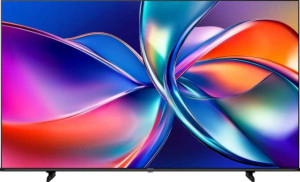
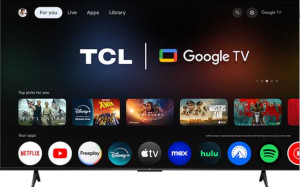
Both the Hisense 43E7Q and the TCL 50Q51K share the same core display technology — QLED, LED-backlit LCD panels — and are virtually identical across most specifications: both output 4K (3840 x 2160) resolution at 60Hz, offer 10-bit color depth capable of rendering 1.07 billion colors, and support every major HDR format including HDR10, HDR10+, Dolby Vision, and HLG. Both also feature anti-reflection coatings, ambient light sensors, and wide 178º viewing angles in both axes — meaning neither has an edge in color accuracy, HDR versatility, or off-angle usability.
The one meaningful differentiator is physical: the TCL ships with a 49.5″ panel versus the Hisense's 43″, but because both resolve to the same 4K pixel grid, the larger screen actually spreads those pixels over more surface area. This results in a noticeably lower pixel density — 89 ppi on the TCL versus 102 ppi on the Hisense. In practice, that gap matters most at closer viewing distances; if you sit within roughly 5–6 feet, the Hisense will appear slightly sharper. At typical living-room distances of 8 feet or more, the difference becomes negligible to the human eye.
For the display group, the conclusion hinges entirely on your priority: the TCL 50Q51K offers a larger, more immersive canvas with no sacrifice in HDR or color capability, making it the better pick for distance viewing or larger rooms. The Hisense 43E7Q has the edge in raw pixel density, suiting closer seating arrangements or smaller spaces where sharpness is more perceptible. In terms of feature parity, these two screens are essentially tied — size and viewing distance are the deciding factors.