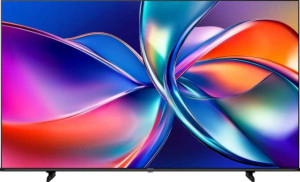
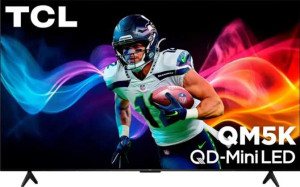
Both the Hisense 43E7Q and the TCL 50QM5K share a strong common foundation: 4K (3840 x 2160) resolution, a QLED LED-backlit LCD panel, 10-bit color depth rendering 1.07 billion colors, and full support for every major HDR format — HDR10, HDR10+, Dolby Vision, and HLG. Both also include an anti-reflection coating and an ambient light sensor, along with wide 178° viewing angles in both axes. Given these similarities, the meaningful differences come down to panel technology, brightness, and refresh rate.
The TCL 50QM5K pulls ahead decisively in two critical areas. First, its 500 nits of typical brightness nearly doubles the Hisense's 275 nits, which translates directly into more impactful HDR highlights and much better visibility in bright rooms. This is reinforced by the TCL's inclusion of Mini-LED backlighting — a significant panel upgrade over standard LED that enables finer local dimming zones, delivering deeper blacks and higher contrast alongside that extra luminance. Second, the TCL's 144Hz refresh rate versus the Hisense's 60Hz is a substantial gap: smoother motion in fast-paced sports and action content, and a major advantage for anyone who might connect a gaming console or PC, where high frame rates are directly usable.
The one area where the Hisense holds a measurable edge is pixel density — 102 ppi versus 89 ppi — a natural consequence of fitting the same 4K resolution into a smaller 43″ screen. In practice, this means slightly sharper fine detail at close viewing distances, though at typical TV seating distances the difference is rarely perceptible. Overall, the TCL 50QM5K has a clear display advantage: its Mini-LED panel, significantly higher brightness, and much higher refresh rate make it the stronger performer for both cinematic HDR content and motion-heavy use cases, at the cost of a larger physical footprint.