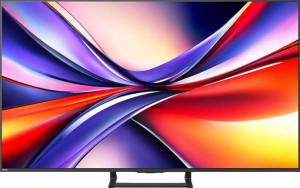
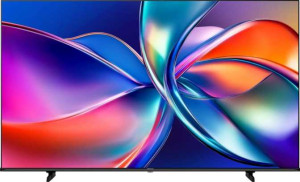
Both the Hisense 50A7Q and Hisense 50E7Q share the same fundamental display foundation: a 50″ QLED, LED-backlit LCD panel with a 4K (3840 x 2160) resolution, 88 ppi pixel density, 10-bit color depth rendering 1.07 billion colors, a 60Hz refresh rate, and an 8ms response time. HDR support is identical across both — HDR10, HDR10+, Dolby Vision, and HLG are all present — as are anti-reflection coating, an ambient light sensor, and wide 178° viewing angles in both directions. For the vast majority of display characteristics, these two TVs are effectively the same panel.
The only meaningful differences lie in brightness and contrast ratio. The A7Q edges ahead with a higher typical brightness of 400 nits versus the E7Q′s 330 nits — a roughly 21% advantage. In practice, this makes the A7Q better suited for brighter rooms or daytime viewing, where extra luminance helps maintain image punch and HDR highlights. The E7Q, however, counters with a marginally superior contrast ratio of 4000:1 compared to the A7Q′s 3800:1. A higher contrast ratio means deeper perceived blacks relative to peak whites, which benefits dark room viewing and shadow detail in dimly lit scenes.
The two specs point in opposite directions for different use cases, making this a genuine trade-off. If your viewing environment is well-lit, the A7Q′s brightness advantage is the more practically impactful spec. If you primarily watch in a darkened room and prioritize depth and black levels, the E7Q′s contrast edge — though modest — is the relevant differentiator. Neither product has a clear overall display advantage; the better choice depends entirely on your viewing conditions.