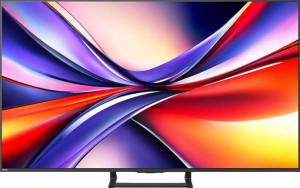
Hisense 50A7Q 50"
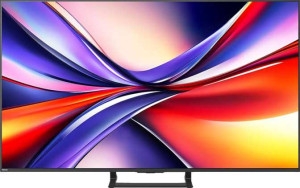
Hisense 55A7Q 55"

Hisense 50A7Q 50" Hisense 55A7Q 55"

Overview

Choosing between the Hisense 50A7Q 50″ and the Hisense 55A7Q 55″ means deciding how much screen real estate you truly need — because in almost every other respect, these two QLED 4K televisions are remarkably alike. Both share the same panel technology, refresh rate, brightness, and a rich feature set including Dolby Atmos, AirPlay, and smart assistant support. The key battlegrounds come down to screen size and pixel density, physical footprint, and power consumption, making this a fascinating comparison for anyone trying to match a TV to a specific room and budget.

Common Features

  • Both TVs share a 4K (UHD) display resolution of 3840 x 2160 px.
  • Both TVs use a QLED, LED-backlit, LCD display type.
  • Both TVs display 1070 million colors with a 10-bit bit depth.
  • Both TVs have a typical brightness of 400 nits.
  • Both TVs have a contrast ratio of 3800:1.
  • Both TVs have a refresh rate of 60Hz.
  • Both TVs have a thickness of 78 mm.
  • Both TVs support VESA mounting.
  • Both TVs have an operating temperature range of 5 °C to 35 °C.
  • Both TVs include 3 HDMI 2.1 ports and 2 USB ports.
  • Both TVs include 1 RJ45 port.
  • Both TVs support Wi-Fi 4 (802.11n) and Wi-Fi 5 (802.11ac).
  • Both TVs feature Bluetooth 5.
  • Both TVs support Dolby Digital, Dolby Digital Plus, Dolby Audio, and Dolby Atmos.
  • SRS TheaterSound HD is not available on either TV.
  • Dolby Virtual support is not available on either TV.
  • Both TVs have stereo speakers and support Digital Out.
  • AirPlay is available on both TVs.
  • Both TVs are compatible with Google Assistant and work with Alexa.
  • Siri and Apple HomeKit are not supported on either TV.
  • Both TVs support USB recording and remote smartphone control.
  • Neither TV has a rechargeable remote control.
  • Both TVs have a built-in smart TV platform.

Main Differences

  • Screen size is 50″ on Hisense 50A7Q 50″ and 55″ on Hisense 55A7Q 55″.
  • Pixel density is 88 ppi on Hisense 50A7Q 50″ and 80 ppi on Hisense 55A7Q 55″.
  • Width is 1111 mm on Hisense 50A7Q 50″ and 1226 mm on Hisense 55A7Q 55″.
  • Height is 647 mm on Hisense 50A7Q 50″ and 711 mm on Hisense 55A7Q 55″.
  • Weight is 13000 g on Hisense 50A7Q 50″ and 14800 g on Hisense 55A7Q 55″.
  • Volume is 56067.726 cm³ on Hisense 50A7Q 50″ and 67991.508 cm³ on Hisense 55A7Q 55″.
  • Operating power consumption is 150W on Hisense 50A7Q 50″ and 180W on Hisense 55A7Q 55″.
Specs Comparison
Hisense 50A7Q 50"

Hisense 50A7Q 50"

Hisense 55A7Q 55"

Hisense 55A7Q 55"

Display:
display resolution 4K (UHD) 4K (UHD)
Display type QLED, LED-backlit, LCD QLED, LED-backlit, LCD
screen size 50" 55"
resolution 3840 x 2160 px 3840 x 2160 px
pixel density 88 ppi 80 ppi
display colors 1070 million 1070 million
bit depth 10-bit 10-bit
brightness (typical) 400 nits 400 nits
contrast ratio 3800:1 3800:1
refresh rate 60Hz 60Hz
supports HDR10
supports HDR10+
supports Dolby Vision
supports HLG
response time 8 ms 8 ms
has anti-reflection coating
has an ambient light sensor
maximum horizontal viewing angle 178º 178º
maximum vertical viewing angle 178º 178º

Both the Hisense 50A7Q and Hisense 55A7Q share the same core display technology: a QLED, LED-backlit LCD panel with a 3840 x 2160 (4K UHD) resolution, 10-bit color depth, and 1.07 billion colors. They also match on brightness (400 nits), contrast ratio (3800:1), refresh rate (60Hz), and response time (8ms). HDR support is identical across both, covering HDR10, HDR10+, Dolby Vision, and HLG — a comprehensive suite that ensures compatibility with virtually all streaming and disc-based HDR content. Both panels also feature anti-reflection coating and an ambient light sensor, adding real-world usability in varied lighting conditions.

The only measurable display difference between the two models is a consequence of their size: the 50-inch model achieves a pixel density of 88 ppi, while the 55-inch model drops slightly to 80 ppi. In practice, this difference is negligible at typical viewing distances for TVs in these size categories — most viewers sitting 6–10 feet away will not perceive any sharpness difference. Both retain the same physical resolution, so no detail is actually lost on the larger screen.

For the display group, these two TVs are effectively tied. The 55A7Q offers a larger canvas without sacrificing any panel quality or feature parity. If screen real estate is the priority, the 55-inch has the edge simply by virtue of its size — but buyers should not expect any qualitative display advantage from either model over the other.
Connectivity:
Has Bluetooth
HDMI version HDMI 2.1 HDMI 2.1
HDMI ports 3 3
supports Wi-Fi
Wi-Fi version Wi-Fi 4 (802.11n), Wi-Fi 5 (802.11ac) Wi-Fi 4 (802.11n), Wi-Fi 5 (802.11ac)
Bluetooth version 5 5
USB ports 2 2
RJ45 ports 1 1
supports Miracast
has a socket for a 3.5 mm audio jack
has an external memory slot
has a VGA connector
DVB standards DVB-T, DVB-T2, DVB-C, DVB-S, DVB-S2 DVB-T, DVB-T2, DVB-C, DVB-S, DVB-S2
has a DVI connector

Connectivity is one area where these two models are completely interchangeable — every single spec is identical. Both TVs offer 3 HDMI 2.1 ports, which is a meaningful inclusion: HDMI 2.1 supports higher bandwidth than the older 2.0 standard, making these ports future-ready for 4K@120Hz sources and advanced gaming consoles, even if the panels themselves are capped at 60Hz. Pair that with 2 USB ports and a dedicated RJ45 ethernet port, and the physical connection options are well-rounded for a mid-range TV.

On the wireless side, both support Wi-Fi 5 (802.11ac) and Bluetooth 5.0. Wi-Fi 5 brings solid throughput and stability for 4K streaming, while Bluetooth 5.0 enables reliable low-latency connections to wireless headphones, soundbars, or remotes. Miracast support adds screen mirroring from compatible Android and Windows devices without needing additional hardware. The inclusion of a 3.5mm audio jack is a practical bonus for users who want to connect headphones directly.

Since the connectivity specs are a perfect mirror across both models, this group results in a clear tie. Neither the 50A7Q nor the 55A7Q holds any advantage here — the choice between them should rest entirely on other factors such as size or price.

Audio:
supports Dolby Digital
supports Digital Out
supports Dolby Digital Plus
has SRS TheaterSound HD
has stereo speakers
has Dolby Atmos
has Dolby Audio
supports Dolby Virtual
has a subwoofer
has DTS:X
HDMI ARC / eARC HDMI ARC, HDMI eARC HDMI ARC, HDMI eARC

Audio capabilities are another area where the 50A7Q and 55A7Q are spec-for-spec identical. What stands out is how capable the shared audio profile actually is for mid-range televisions: both units include a built-in subwoofer alongside stereo speakers, which meaningfully deepens bass reproduction compared to TVs that rely solely on slim full-range drivers. Real-world impact is noticeable — dialogue stays clear while action scenes and music carry more weight without requiring an external soundbar.

On the format side, support for Dolby Atmos and DTS:X covers the two dominant object-based surround standards, ensuring that Atmos-encoded streaming content from Netflix or Disney+ is processed natively rather than downmixed. Critically, both TVs include HDMI eARC alongside standard ARC — eARC carries significantly more audio bandwidth than its predecessor, meaning users who connect a high-end soundbar or AV receiver can pass through lossless Dolby TrueHD and DTS-HD Master Audio from the TV rather than being limited to compressed formats.

With no differences whatsoever across every audio specification, this group is an unambiguous tie. Buyers get the same well-equipped audio package regardless of which screen size they choose.

Design:
width 1111 mm 1226 mm
weight 13000 g 14800 g
thickness 78 mm 78 mm
height 647 mm 711 mm
volume 56067.726 cm³ 67991.508 cm³
Supports VESA mount
maximum operating temperature 35 °C 35 °C
lowest potential operating temperature 5 °C 5 °C

As expected from a 5-inch screen size difference, the physical dimensions diverge in a predictable but practically significant way. The 55A7Q is noticeably larger — 1226 mm wide and 711 mm tall versus 1111 mm wide and 647 mm tall for the 50A7Q — which translates to roughly 10% more width and height. Before purchasing, buyers should carefully measure their intended placement, whether that is a TV stand or wall mount, since the 55-inch footprint is meaningfully bigger and may not fit comfortably in tighter spaces or smaller rooms.

The weight gap is also worth noting. At 14.8 kg, the 55A7Q is about 1.8 kg heavier than the 50A7Q's 13 kg. For wall mounting in particular, this difference matters — the mounting surface, bracket, and stud configuration all need to account for the additional load. Solo installation becomes more challenging at the higher weight, and a sturdier mount may be required. One reassuring constant: both models share an identical 78 mm thickness, so depth-related clearance concerns are the same regardless of which size is chosen.

Both TVs support VESA mounting and share the same operating temperature range, so neither holds a structural or environmental advantage. The edge here goes to the 50A7Q purely on manageability — it is lighter, more compact, and easier to install or reposition, making it the more practical choice for constrained spaces or single-person setups.

Features:
release date April 2025 April 2025
has AirPlay
has built-in smart TV
compatible with Google Assistant
works with Alexa
works with Siri/Apple HomeKit
supports a remote smartphone
has a rechargeable remote control
supports USB recording
operating power consumption 150W 180W
standby power consumption 0.5W 0.5W
has a search browser
has a sleep timer
has a child lock
warranty period 3 years 3 years
has voice commands
EU energy label E E

The smart feature set is essentially a carbon copy across both models. AirPlay, Google Assistant, and Alexa integration are all present, covering the major voice and ecosystem platforms — the notable absence being Apple HomeKit/Siri, which may matter to users deeply embedded in the Apple ecosystem. USB recording support is a practical inclusion that lets users record live broadcasts directly to an external drive, a feature not always guaranteed at this price tier. Both carry a solid 3-year warranty, which offers above-average peace of mind compared to the more common 1-2 year coverage seen elsewhere in the mid-range segment.

The one measurable difference in this group is power consumption. The 55A7Q draws 180W during operation versus 150W for the 50A7Q — a 30W gap that is a direct consequence of powering a larger panel and backlighting array. For a TV running 4-5 hours daily, this translates to a modest but real difference in electricity costs over time. Standby consumption is identical at 0.5W for both, and both share the same EU energy label E rating, meaning the efficiency class is equivalent despite the wattage gap.

Overall, the 50A7Q holds a narrow edge in this group solely due to its lower operating power draw. For feature parity, ecosystem support, and long-term ownership considerations like warranty, the two TVs are indistinguishable — the 50-inch simply costs less to run day to day.

Comparison Summary & Verdict

After examining every specification, the choice between the Hisense 50A7Q 50″ and the Hisense 55A7Q 55″ is essentially a question of space and priorities. The Hisense 50A7Q 50″ delivers a higher pixel density of 88 ppi, meaning images may appear slightly sharper up close, and its more compact dimensions — lighter at 13 kg and drawing only 150W — make it the better fit for smaller rooms or wall setups where size and energy efficiency matter. The Hisense 55A7Q 55″, on the other hand, offers a more immersive 55-inch viewing experience that suits larger living spaces and those who sit further from the screen, where the slightly lower 80 ppi pixel density becomes imperceptible. Both models are equally matched on audio, connectivity, and smart features, so neither compromises on capability.

Hisense 50A7Q 50
Buy Hisense 50A7Q 50" if...

Buy the Hisense 50A7Q 50″ if you have a smaller room, want a more compact and lighter TV, or prefer higher pixel density and lower power consumption.

Hisense 55A7Q 55
Buy Hisense 55A7Q 55" if...

Buy the Hisense 55A7Q 55″ if you want a larger, more immersive screen for a spacious living room and viewing distance is not a concern.