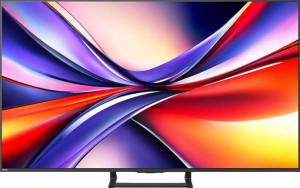
Hisense 50A7Q 50"
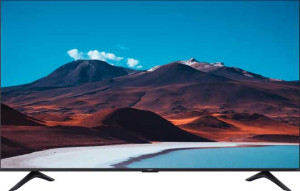
Xiaomi TV F 2026 50"

Hisense 50A7Q 50" Xiaomi TV F 2026 50"

Overview

Welcome to our in-depth spec comparison between the Hisense 50A7Q 50″ and the Xiaomi TV F 2026 50″ — two 50-inch 4K QLED televisions competing in the same screen-size category. While they share a strong common foundation in display technology and smart connectivity, key battlegrounds emerge around HDR and audio capabilities, physical design, energy consumption, and long-term value. Read on to discover which TV best suits your needs.

Common Features

  • Both TVs have a 50″ screen size.
  • Both TVs feature a 4K UHD resolution of 3840 x 2160 px.
  • Both TVs use a QLED, LED-backlit, LCD display type.
  • Both TVs have a pixel density of 88 ppi.
  • Both TVs display 1070 million colors with a 10-bit bit depth.
  • Both TVs have a 60Hz refresh rate.
  • Both TVs support Bluetooth 5.
  • Both TVs support Wi-Fi 4 (802.11n) and Wi-Fi 5 (802.11ac).
  • Both TVs include 3 HDMI 2.1 ports and 1 RJ45 port.
  • Both TVs support Miracast.
  • Both TVs feature stereo speakers and Dolby Audio.
  • Both TVs support DTS:X.
  • Both TVs include HDMI ARC and HDMI eARC.
  • Digital audio output is available on both TVs.
  • SRS TheaterSound HD is not available on either TV.
  • Dolby Virtual is not supported on either TV.
  • Both TVs share a width of 1111 mm.
  • Both TVs support VESA mounting.
  • AirPlay is available on both TVs.
  • Both TVs have a built-in smart TV platform and are compatible with Google Assistant and Alexa.
  • Siri and Apple HomeKit are not supported on either TV.
  • Both TVs support remote smartphone control.
  • Neither TV has a rechargeable remote control.
  • Both TVs support USB recording.

Main Differences

  • HDR10+ support is present on the Hisense 50A7Q 50″ but not available on the Xiaomi TV F 2026 50″.
  • Dolby Vision support is present on the Hisense 50A7Q 50″ but not available on the Xiaomi TV F 2026 50″.
  • The Hisense 50A7Q 50″ has 2 USB ports while the Xiaomi TV F 2026 50″ has only 1.
  • Dolby Atmos support is present on the Hisense 50A7Q 50″ but not available on the Xiaomi TV F 2026 50″.
  • The Hisense 50A7Q 50″ includes a built-in subwoofer, whereas the Xiaomi TV F 2026 50″ does not.
  • The Hisense 50A7Q 50″ weighs 13000 g while the Xiaomi TV F 2026 50″ is considerably lighter at 7400 g.
  • The Hisense 50A7Q 50″ is 78 mm thick while the Xiaomi TV F 2026 50″ is slimmer at 73 mm.
  • The Hisense 50A7Q 50″ stands 647 mm tall while the Xiaomi TV F 2026 50″ is slightly shorter at 643 mm.
  • The volume of the Hisense 50A7Q 50″ is 56067.726 cm³ compared to 52149.229 cm³ for the Xiaomi TV F 2026 50″.
  • The maximum operating temperature is 35 °C on the Hisense 50A7Q 50″ and 40 °C on the Xiaomi TV F 2026 50″.
  • The lowest potential operating temperature is 5 °C on the Hisense 50A7Q 50″ and 0 °C on the Xiaomi TV F 2026 50″.
  • Operating power consumption is 150W on the Hisense 50A7Q 50″ and 75W on the Xiaomi TV F 2026 50″.
  • The warranty period is 3 years on the Hisense 50A7Q 50″ and 1 year on the Xiaomi TV F 2026 50″.
Specs Comparison
Hisense 50A7Q 50"

Hisense 50A7Q 50"

Xiaomi TV F 2026 50"

Xiaomi TV F 2026 50"

Display:
display resolution 4K (UHD) 4K (UHD)
Display type QLED, LED-backlit, LCD QLED, LED-backlit, LCD
screen size 50" 50"
resolution 3840 x 2160 px 3840 x 2160 px
pixel density 88 ppi 88 ppi
display colors 1070 million 1070 million
bit depth 10-bit 10-bit
refresh rate 60Hz 60Hz
supports HDR10
supports HDR10+
supports Dolby Vision
supports HLG
has anti-reflection coating
has an ambient light sensor
maximum horizontal viewing angle 178º 178º
maximum vertical viewing angle 178º 178º

Both the Hisense 50A7Q and the Xiaomi TV F 2026 share an identical panel foundation: a QLED, LED-backlit LCD at 50″, delivering 3840 x 2160 px at 88 ppi, with a 10-bit color pipeline capable of rendering over a billion shades. The 60Hz refresh rate, 178° viewing angles in both axes, anti-reflection coating, and ambient light sensor are also perfectly matched — meaning neither TV has a structural or ergonomic advantage in day-to-day viewing conditions.

The only meaningful split between these two displays lies in HDR format support. Both handle HDR10 and HLG, but the Hisense adds HDR10+ and Dolby Vision — the two dynamic metadata standards that adapt tone-mapping scene by scene rather than applying a fixed curve to the entire film. Dolby Vision in particular is the dominant premium HDR format on streaming platforms like Netflix and Apple TV+, and its absence on the Xiaomi means that compatible content will either fall back to standard HDR10 or not trigger HDR at all, depending on the source.

For users who primarily watch HDR content from major streaming services, the Hisense 50A7Q holds a clear edge purely on the strength of its broader HDR ecosystem. If your viewing habits lean toward SDR, gaming at 60Hz, or sources that don't leverage dynamic metadata, the Xiaomi is effectively identical — but you would be leaving measurable picture quality on the table in a growing number of scenarios.

Connectivity:
Has Bluetooth
HDMI version HDMI 2.1 HDMI 2.1
HDMI ports 3 3
supports Wi-Fi
Wi-Fi version Wi-Fi 4 (802.11n), Wi-Fi 5 (802.11ac) Wi-Fi 4 (802.11n), Wi-Fi 5 (802.11ac)
Bluetooth version 5 5
USB ports 2 1
RJ45 ports 1 1
supports Miracast
has a socket for a 3.5 mm audio jack
has an external memory slot
has a VGA connector
DVB standards DVB-T, DVB-T2, DVB-C, DVB-S, DVB-S2 DVB-T, DVB-T2, DVB-C, DVB-S, DVB-S2
has a DVI connector

The connectivity blueprints of these two TVs are remarkably similar. Both arrive with three HDMI 2.1 ports, a wired RJ45 input, Wi-Fi 5, Bluetooth 5, Miracast screen mirroring, and a 3.5mm audio jack — a well-rounded set that covers the vast majority of living room setups. HDMI 2.1 is worth noting here: at this price tier it ensures headroom for 4K@120Hz passthrough from next-gen consoles, even though the panels themselves are capped at 60Hz natively.

The single differentiator in this group is USB port count. The Hisense 50A7Q provides 2 USB ports versus the Xiaomi's 1. In practice this matters if you routinely run a USB storage drive for media playback while also having a peripheral — such as a keyboard dongle or a USB-powered streaming stick — connected simultaneously. With only one port, the Xiaomi forces a choice or requires an external hub to achieve the same flexibility.

The Hisense holds a modest but tangible edge in this category on the strength of that extra USB port. For minimalist setups it makes no difference, but for users who lean on USB-connected media or accessories, the Hisense is the more convenient option out of the box. Every other connectivity parameter between the two is identical.

Audio:
supports Digital Out
has SRS TheaterSound HD
has stereo speakers
has Dolby Atmos
has Dolby Audio
supports Dolby Virtual
has a subwoofer
has DTS:X
HDMI ARC / eARC HDMI ARC, HDMI eARC HDMI ARC, HDMI eARC

Shared ground between these two TVs includes DTS:X, Dolby Audio, stereo speakers, Digital Out, and full HDMI ARC/eARC support — the latter being particularly useful for passing high-quality audio to a soundbar without a separate optical cable. That baseline is solid for either TV when used with external audio hardware.

Where the Hisense 50A7Q pulls ahead is in its built-in speaker system. It adds Dolby Atmos decoding and, notably, an integrated subwoofer — two features absent on the Xiaomi TV F 2026. Dolby Atmos enables object-based spatial audio processing, which on supported content creates a more dimensional, height-aware soundstage even through the TV's own drivers. The onboard subwoofer compounds this by reinforcing low-frequency output that stereo drivers alone typically struggle to reproduce convincingly, making explosions, music bass lines, and cinematic scores feel more grounded without requiring an external speaker.

For anyone planning to immediately pair either TV with a dedicated soundbar or AV receiver, these differences largely dissolve — external systems handle their own decoding. But for those who intend to rely primarily on the TV's built-in audio, the Hisense holds a clear advantage: the combination of Dolby Atmos and a subwoofer represents a meaningfully richer out-of-the-box listening experience than the Xiaomi can offer.

Design:
width 1111 mm 1111 mm
weight 13000 g 7400 g
thickness 78 mm 73 mm
height 647 mm 643 mm
volume 56067.726 cm³ 52149.229 cm³
Supports VESA mount
maximum operating temperature 35 °C 40 °C
lowest potential operating temperature 5 °C 0 °C

At the same 50″ screen size and identical width, these two TVs occupy roughly the same footprint on a stand or wall — but their weight tells a strikingly different story. The Hisense 50A7Q weighs 13,000 g against the Xiaomi TV F 2026's 7,400 g, a difference of over 5.5 kg. That is nearly 76% heavier, which has direct practical consequences: wall mounting the Hisense demands closer attention to bracket load ratings, and single-person installation becomes noticeably more difficult. The Xiaomi is substantially easier to handle, reposition, or mount solo.

The Xiaomi also edges out on operating temperature tolerance. Its range of 0–40 °C versus the Hisense's 5–35 °C means the Xiaomi is rated for both cooler and warmer ambient environments — a relevant consideration for installations in garages, conservatories, or rooms without climate control where temperatures can drift toward the extremes.

Overall, the Xiaomi TV F 2026 has a clear design advantage in this category. Its significantly lower weight makes logistics and installation easier, and its broader thermal tolerance offers more placement flexibility. The Hisense's added mass is likely a structural consequence of its more feature-rich internal hardware — including its subwoofer — but from a pure design and handling perspective, the Xiaomi is the more practical unit.

Features:
release date April 2025 September 2025
has AirPlay
has built-in smart TV
compatible with Google Assistant
works with Alexa
works with Siri/Apple HomeKit
supports a remote smartphone
has a rechargeable remote control
supports USB recording
operating power consumption 150W 75W
standby power consumption 0.5W 0.5W
has a search browser
has a sleep timer
has a child lock
warranty period 3 years 1 years
has voice commands

Feature parity between these two TVs is remarkably high. AirPlay, Google Assistant, Alexa, smartphone remote support, USB recording, voice commands, sleep timer, and child lock are all present on both — and neither supports Siri/Apple HomeKit. For smart home integration and day-to-day usability, the experience on paper is essentially interchangeable.

Two numbers, however, stand out sharply. Operating power consumption sits at 150W for the Hisense 50A7Q versus just 75W for the Xiaomi TV F 2026 — exactly half. Over hundreds of hours of annual viewing, that gap translates into a meaningful difference in electricity costs, and the Xiaomi's efficiency is particularly notable given both TVs share the same screen size. The warranty gap is equally significant: the Hisense covers 3 years against the Xiaomi's 1 year. A longer warranty reduces financial risk from early hardware failure and signals a degree of manufacturer confidence in long-term reliability.

These two specs pull in opposite directions, making this category a genuine trade-off rather than a clean win. The Xiaomi has the edge on running costs, consuming half the power over its lifetime — a compounding saving. But the Hisense has the stronger ownership safety net with three times the warranty coverage. Buyers prioritizing low operating costs will favor the Xiaomi; those valuing post-purchase protection will lean toward the Hisense.

Comparison Summary & Verdict

After a thorough side-by-side analysis, both TVs deliver identical 4K QLED picture quality with 60Hz refresh rates and broad smart platform support. However, they diverge meaningfully in several areas. The Hisense 50A7Q 50″ stands out for its richer HDR ecosystem — supporting HDR10+ and Dolby Vision — along with Dolby Atmos audio, a built-in subwoofer, an extra USB port, and an impressive 3-year warranty, making it the stronger pick for home cinema enthusiasts who want a premium, future-ready setup. The Xiaomi TV F 2026 50″, on the other hand, excels in practicality: it consumes just 75W of power (half that of the Hisense), is significantly lighter at 7400g, operates in a wider temperature range, and costs less to run day-to-day — making it ideal for budget-conscious buyers or those prioritizing energy efficiency and a lighter installation.

Hisense 50A7Q 50
Buy Hisense 50A7Q 50" if...

Buy the Hisense 50A7Q 50″ if you want a feature-rich home cinema experience with HDR10+, Dolby Vision, Dolby Atmos, a built-in subwoofer, and the peace of mind of a 3-year warranty.

Xiaomi TV F 2026 50
Buy Xiaomi TV F 2026 50" if...

Buy the Xiaomi TV F 2026 50″ if you prioritize lower energy consumption at 75W, a lighter and slimmer build, and a more budget-friendly running cost.