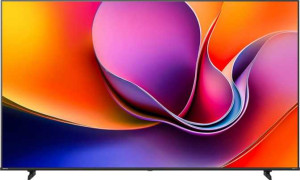
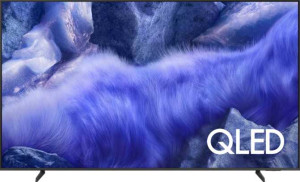
Both the Hisense 55A6Q and the Samsung QN50QEF1AF share a strong display foundation: native 4K (3840 x 2160) resolution, a 10-bit panel capable of rendering over a billion colors, a 60Hz refresh rate, and wide 178° viewing angles in both axes. Anti-reflection coating and ambient light sensors are present on both, meaning neither has an edge in glare management or automatic brightness adaptation.
The most meaningful panel-level distinction is the display technology: the Hisense uses a standard LED-backlit LCD, while the Samsung employs QLED — a quantum dot layer over an LED-backlit LCD. In practice, QLED typically delivers higher color volume and peak brightness, which makes the Samsung's panel better suited to bright rooms and vivid HDR content, even though both sets share the same rated color depth. The Samsung also edges ahead on pixel density at 89 ppi versus the Hisense's 80 ppi, a consequence of fitting the same 4K resolution into a physically smaller 49.5″ panel. Up close, the Samsung will look marginally sharper, though at typical living-room viewing distances the difference is subtle.
The decisive HDR differentiator, however, favors the Hisense: it supports Dolby Vision, while the Samsung does not. Dolby Vision uses dynamic, scene-by-scene metadata to optimize brightness and color, and an expanding library of streaming content is mastered in that format. Both TVs handle HDR10, HDR10+, and HLG equally, but the Hisense's Dolby Vision compatibility gives it broader future-proof HDR coverage. Weighing everything, the Samsung holds a panel-quality edge through QLED and higher pixel density, but the Hisense counters with a larger screen and superior HDR format support — making the Hisense the stronger pick for HDR streaming enthusiasts, and the Samsung more appealing for those prioritizing color richness in a compact form factor.