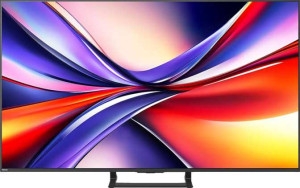
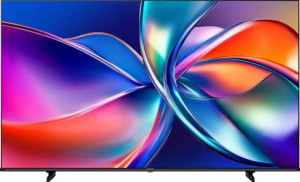
Both the Hisense 55A7Q and Hisense 55E7Q share the same core display foundation: a 55″ QLED, LED-backlit LCD panel running at a native 3840 x 2160 (4K UHD) resolution, delivering 80 ppi pixel density and a 10-bit color pipeline capable of rendering 1.07 billion colors. Their contrast ratio (3800:1), refresh rate (60Hz), response time (8ms), and wide 178º viewing angles on both axes are completely identical, as are their HDR format credentials — both support HDR10, HDR10+, Dolby Vision, and HLG, covering every major standard in use today. In practical terms, these two panels are built from the same architecture and will behave identically across most viewing scenarios.
The only measurable difference between the two lies in typical brightness: the 55A7Q is rated at 400 nits versus the 55E7Q's 320 nits — a gap of roughly 25%. While neither figure is exceptional for HDR performance (premium QLED panels can reach 1000+ nits), that extra 80 nits on the A7Q does carry real-world weight. In moderately lit or bright living rooms, the A7Q will maintain better image pop and resist washout more effectively. For HDR content specifically, higher peak brightness translates to more visible specular highlights and a greater sense of depth, even if both TVs fall within the ″entry HDR″ tier.
The 55A7Q holds a clear edge in this display group, solely due to its higher brightness output. All other display characteristics — panel type, resolution, color depth, HDR support, contrast, and motion performance — are a dead tie. If your room receives significant ambient light, or if HDR brightness fidelity matters to you, the A7Q is the stronger choice here. In a consistently dark viewing environment, the brightness advantage becomes negligible and the two panels are effectively equivalent.