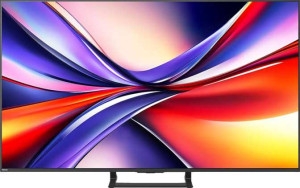
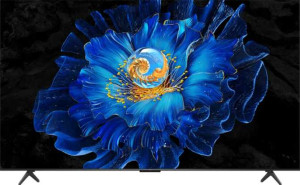
Both televisions share the same foundational display DNA: 4K UHD resolution at 3840 x 2160 px, a 10-bit panel capable of displaying 1.07 billion colors, and full support for every major HDR format — HDR10, HDR10+, Dolby Vision, and HLG. Anti-reflection coating and an ambient light sensor are present on both, as are identical 178º horizontal and vertical viewing angles, meaning neither has a meaningful edge in color-shift or HDR ecosystem compatibility. The screen size difference (55″ vs 54.6″) is cosmetically negligible in practice.
The real divergence lies in two critical specs. First, the TCL 55C6KS uses a Mini-LED backlighting layer on top of its QLED LCD panel, which gives it finer local dimming zone control and translates directly into its higher 5000:1 contrast ratio, versus the Hisense's 3800:1. In real-world viewing, this means the TCL can render deeper blacks and more convincing HDR highlights — a meaningful difference in dark-room movie watching. Second, the TCL operates at a native 120Hz refresh rate compared to the Hisense's 60Hz. For fast-motion content — sports, action films, and gaming — 120Hz delivers noticeably smoother motion and also unlocks lower-latency game modes that 60Hz panels simply cannot match.
The TCL 55C6KS holds a clear advantage in this display group. Its Mini-LED architecture, superior contrast ratio, and doubled refresh rate are not marginal improvements — they represent a fundamentally more capable panel for both cinematic and interactive use cases. The Hisense 55A7Q is a competent display with solid HDR coverage, but on purely display-centric metrics, it trails the TCL on the specs that matter most for picture quality and motion performance.