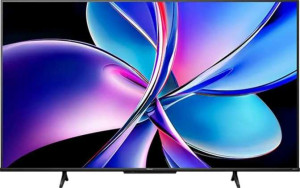
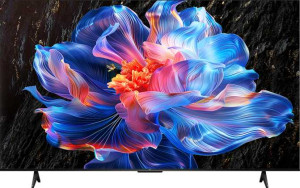
Both TVs share the same 4K (3840 x 2160) resolution, 10-bit color depth, and a rated output of 330 nits of typical brightness, so their baseline picture foundations are identical on paper. The critical divergence starts with the panel technology: the Hisense 55E7Q Pro uses a QLED layer on top of its LED-backlit LCD, which enables a wider color gamut and generally more saturated, accurate colors compared to the standard LED-backlit LCD panel in the TCL 75P6K.
For motion and gaming, the gap widens significantly. The Hisense runs at 144Hz versus the TCL's 60Hz — in practice this means smoother fast-motion content, far less judder during sports, and a substantially better experience for gaming where high frame rates matter. The Hisense also wins on pixel density (80 ppi vs 59 ppi), meaning its 55″ image will appear visibly sharper up close than the TCL's 74.5″ panel at typical viewing distances. On HDR, the Hisense supports HDR10+ and Dolby Vision in addition to HDR10 and HLG, while the TCL is limited to HDR10 and HLG only — this means a large portion of premium streaming content with dynamic metadata will display in its intended form only on the Hisense.
The TCL's sole advantage is its considerably larger 74.5″ screen, which delivers more visual presence and immersion in a big room. However, the Hisense 55E7Q Pro holds a clear overall edge in display quality for this group: superior panel technology, a much higher refresh rate, greater pixel sharpness, and broader HDR format support make it the stronger performer for anyone prioritizing picture fidelity and motion clarity over raw screen size.