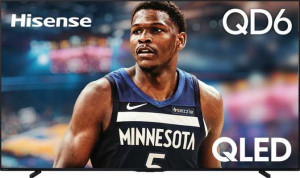
Hisense 55QD6QF 55"
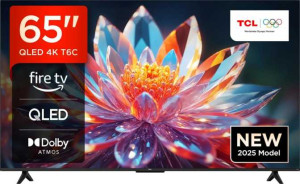
TCL 65T6C-UK 65"

Hisense 55QD6QF 55" TCL 65T6C-UK 65"

Overview

Welcome to our in-depth specification face-off between the Hisense 55QD6QF 55″ and the TCL 65T6C-UK 65″. Both televisions share a strong QLED 4K UHD foundation with Dolby Vision, Dolby Atmos, and HDMI 2.1 connectivity, making this a genuinely close contest. The real battlegrounds emerge around refresh rate and gaming features, screen size, HDR format support, and long-term ownership value — areas where each TV takes a noticeably different stance. Read on to find out which one suits your needs best.

Common Features

  • Both TVs have a 4K UHD resolution of 3840 x 2160 px.
  • Both use a QLED, LED-backlit LCD display type.
  • Both reproduce 1070 million display colors with 10-bit bit depth.
  • HDR10 support is available on both products.
  • Dolby Vision support is available on both products.
  • HLG support is available on both products.
  • Bluetooth 5 is available on both products.
  • Both TVs have 3 HDMI 2.1 ports.
  • Both TVs support Wi-Fi 4 (802.11n) and Wi-Fi 5 (802.11ac).
  • Both TVs have 2 USB ports and 1 RJ45 port.
  • Dolby Digital support is available on both products.
  • Dolby Digital Plus support is available on both products.
  • Dolby Atmos support is available on both products.
  • Dolby Audio support is available on both products.
  • Digital Out support is available on both products.
  • SRS TheaterSound HD is not available on either product.
  • Dolby Virtual support is not available on either product.
  • Stereo speakers are present on both products.
  • Both TVs support VESA mounting.
  • Both TVs share the same operating temperature range of 5 °C to 35 °C.
  • AirPlay support is available on both products.
  • A built-in smart TV platform is present on both products.
  • Alexa compatibility is available on both products.
  • Apple HomeKit and Siri support is not available on either product.
  • Remote smartphone control is supported on both products.
  • Neither TV has a rechargeable remote control.
  • USB recording is supported on both products.
  • Both TVs have a standby power consumption of 0.5W.

Main Differences

  • Screen size is 54.6″ on Hisense 55QD6QF 55″ and 65″ on TCL 65T6C-UK 65″.
  • Pixel density is 81 ppi on Hisense 55QD6QF 55″ and 68 ppi on TCL 65T6C-UK 65″.
  • Refresh rate is 144Hz on Hisense 55QD6QF 55″ and 120Hz on TCL 65T6C-UK 65″.
  • HDR10+ support is present on Hisense 55QD6QF 55″ but not available on TCL 65T6C-UK 65″.
  • Adaptive synchronization (AMD FreeSync and AMD FreeSync Premium) is available on Hisense 55QD6QF 55″ but not present on TCL 65T6C-UK 65″.
  • A 3.5 mm audio jack is available on Hisense 55QD6QF 55″ but not present on TCL 65T6C-UK 65″.
  • Audio output power is 2 x 8W on Hisense 55QD6QF 55″ and 2 x 10W on TCL 65T6C-UK 65″.
  • Width is 1234.4 mm on Hisense 55QD6QF 55″ and 1444 mm on TCL 65T6C-UK 65″.
  • Height is 716.3 mm on Hisense 55QD6QF 55″ and 837 mm on TCL 65T6C-UK 65″.
  • Thickness is 73.7 mm on Hisense 55QD6QF 55″ and 70 mm on TCL 65T6C-UK 65″.
  • Weight is 9480 g on Hisense 55QD6QF 55″ and 16000 g on TCL 65T6C-UK 65″.
  • Volume is 65165.593064 cm³ on Hisense 55QD6QF 55″ and 84603.96 cm³ on TCL 65T6C-UK 65″.
  • Warranty period is 1 year on Hisense 55QD6QF 55″ and 2 years on TCL 65T6C-UK 65″.
Specs Comparison
Hisense 55QD6QF 55"

Hisense 55QD6QF 55"

TCL 65T6C-UK 65"

TCL 65T6C-UK 65"

Display:
display resolution 4K (UHD) 4K (UHD)
Display type QLED, LED-backlit, LCD QLED, LED-backlit, LCD
screen size 54.6" 65"
resolution 3840 x 2160 px 3840 x 2160 px
pixel density 81 ppi 68 ppi
display colors 1070 million 1070 million
bit depth 10-bit 10-bit
refresh rate 144Hz 120Hz
supports HDR10
supports HDR10+
supports Dolby Vision
supports HLG
Adaptive synchronization AMD FreeSync, AMD FreeSync Premium None
has anti-reflection coating
has an ambient light sensor
maximum horizontal viewing angle 178º 178º
maximum vertical viewing angle 178º 178º

Both the Hisense 55QD6QF and the TCL 65T6C-UK share the same fundamental panel technology — QLED, LED-backlit LCD — and identical base image quality credentials: 4K (3840 x 2160) resolution, 10-bit color depth, and 1.07 billion displayable colors. They also match on viewing angles (178º both axes), anti-reflection coating, and ambient light sensor support. For a typical living room viewer, these shared traits mean both screens will look broadly similar in terms of color richness and off-axis usability.

The key differentiators emerge in motion handling and HDR ecosystem. The Hisense runs at 144Hz versus the TCL's 120Hz, which matters most for gaming and fast-motion content — smoother panning, less judder. The Hisense also supports AMD FreeSync Premium adaptive sync, a meaningful advantage for console and PC gamers looking to eliminate screen tearing, while the TCL offers no adaptive sync at all. On the HDR side, the Hisense adds HDR10+ support on top of the standard HDR10, Dolby Vision, and HLG that both share — HDR10+ uses dynamic metadata (like Dolby Vision) to optimize brightness scene-by-scene, giving it a potential edge on compatible content.

Screen size works in the TCL's favor at 65″ versus the Hisense's 54.6″, though that larger panel comes at the cost of a lower pixel density — 68 ppi vs 81 ppi — meaning the TCL's individual pixels are more visible at closer viewing distances. Overall, the Hisense 55QD6QF has a clear display-spec advantage: its higher refresh rate, adaptive sync support, and broader HDR format coverage make it the stronger performer for gaming and high-end HDR content, while the TCL's only display-side win is raw screen real estate.
Connectivity:
Has Bluetooth
HDMI version HDMI 2.1 HDMI 2.1
HDMI ports 3 3
supports Wi-Fi
Wi-Fi version Wi-Fi 4 (802.11n), Wi-Fi 5 (802.11ac) Wi-Fi 4 (802.11n), Wi-Fi 5 (802.11ac)
Bluetooth version 5 5
USB ports 2 2
RJ45 ports 1 1
supports Miracast
has a socket for a 3.5 mm audio jack
has an external memory slot
has a VGA connector
has a DVI connector

Connectivity is essentially a dead heat between these two TVs. Both carry HDMI 2.1 across all three HDMI ports — a genuinely important spec that supports 4K at 120Hz, 8K, and high-bandwidth gaming signals from current-gen consoles and PCs without any bottlenecking. Alongside that, both offer 2 USB ports, a single Ethernet jack, Bluetooth 5, and identical Wi-Fi support spanning Wi-Fi 4 and Wi-Fi 5 — solid for streaming and peripherals, though neither steps up to the faster Wi-Fi 6 standard.

The one meaningful split is the 3.5mm headphone jack: the Hisense 55QD6QF includes one, the TCL 65T6C-UK does not. For users who want to plug in headphones directly for late-night viewing — without pairing a Bluetooth device or routing through an external audio system — this omission on the TCL is a genuine convenience gap. It is a small but practical difference that could matter depending on your setup.

On the whole, the Hisense holds a narrow edge in this category purely by virtue of that headphone jack. Every other connectivity spec is a mirror image between the two — same ports, same wireless standards, same versions. Neither TV is particularly cutting-edge here (Wi-Fi 6 and Bluetooth 5.3+ are absent on both), but for most living room use cases, the shared specs are more than sufficient.

Audio:
supports Dolby Digital
audio output power 2 x 8W 2 x 10W
supports Digital Out
supports Dolby Digital Plus
has SRS TheaterSound HD
has stereo speakers
has Dolby Atmos
has Dolby Audio
supports Dolby Virtual
has a subwoofer
has DTS:X
HDMI ARC / eARC HDMI ARC, HDMI eARC HDMI ARC, HDMI eARC

Audio format support is identical across both TVs — Dolby Atmos, DTS:X, Dolby Digital Plus, and full HDMI ARC/eARC are all present on each. eARC in particular is worth highlighting as a shared strength: it carries enough bandwidth to pass lossless Dolby Atmos and DTS:X audio to a compatible soundbar or AV receiver, meaning neither TV creates a bottleneck for high-end home theater setups.

The only measurable difference between the two is raw speaker output: the TCL 65T6C-UK delivers 2 x 10W versus the Hisense 55QD6QF's 2 x 8W. In practical terms, 4W of additional total power is a modest bump — not a night-and-day difference in perceived loudness — but it does give the TCL slightly more headroom before distortion sets in at higher volumes, which can matter in larger rooms or during dynamic, bass-heavy content.

Given how closely matched the format support is, the TCL holds a slim audio edge on the strength of its higher output wattage. That said, neither TV is likely to satisfy critical listeners on built-in speakers alone — both lack a subwoofer and share the same two-channel stereo configuration. For anyone planning to pair the TV with an external soundbar or audio system, this category is effectively a tie.

Design:
width 1234.4 mm 1444 mm
weight 9480 g 16000 g
thickness 73.7 mm 70 mm
height 716.3 mm 837 mm
volume 65165.593064 cm³ 84603.96 cm³
Supports VESA mount
maximum operating temperature 35 °C 35 °C
lowest potential operating temperature 5 °C 5 °C

Size difference is the dominant story here, and it flows naturally from the screen size gap established in the display category. The TCL 65T6C-UK is physically larger in every dimension — wider, taller, and occupying a notably bigger footprint — which is expected for a 65″ panel versus a 55″ one. What is more striking is the weight disparity: the TCL comes in at 16,000 g compared to the Hisense's 9,480 g, meaning the TCL is nearly 70% heavier. That gap is significant during installation — wall-mounting a 16 kg TV typically requires a second person and more careful attention to wall anchor ratings.

Thickness tells a slightly different story in the Hisense's favor: at 73.7 mm the Hisense is marginally deeper than the TCL's 70 mm, though in practice a 3.7 mm difference is imperceptible on a shelf or wall mount. Both TVs support VESA mounting and share identical operating temperature ranges (5–35 °C), so neither has an environmental advantage for placement flexibility.

For design and handling, the Hisense has a clear practical edge — it is substantially lighter and more compact, making it easier to move, position, and wall-mount solo. The TCL's larger physical footprint is simply the trade-off for its bigger screen, not a design flaw, but buyers with limited space or those planning a single-person installation will find the Hisense considerably more manageable.

Features:
release date April 2025 April 2025
has AirPlay
has built-in smart TV
works with Alexa
works with Siri/Apple HomeKit
supports a remote smartphone
has a rechargeable remote control
supports USB recording
standby power consumption 0.5W 0.5W
has a search browser
has a sleep timer
has a child lock
warranty period 1 years 2 years
has voice commands

Across the full features checklist, these two TVs are remarkably alike. Both run a built-in smart TV platform, support AirPlay, Alexa voice control, smartphone remote, USB recording, and arrive without Apple HomeKit/Siri integration. For most households this shared feature set covers the practical bases well — content casting from Apple devices works via AirPlay, voice assistant control is handled through Alexa, and USB recording adds a useful layer of flexibility for catching live broadcasts without an external recorder.

With virtually every feature ticked identically, the one concrete differentiator is the warranty period: the TCL 65T6C-UK comes with a 2-year warranty versus the Hisense's 1-year warranty. For a large-screen TV — a purchase most people expect to last many years — an extra year of manufacturer coverage is a tangible, real-world benefit. Panel and backlight issues, if they are going to appear, often do so in the first two years of use, meaning the TCL's longer warranty provides meaningfully broader protection rather than just a marginal one.

On features alone, the TCL holds the edge, and solely because of that warranty advantage. There is no functional difference in smart capabilities, ecosystem support, or everyday usability between the two — but when the spec sheets are this evenly matched, longer post-purchase protection is a clear and rational tiebreaker.

Comparison Summary & Verdict

After reviewing every specification, the two TVs serve distinct audiences. The Hisense 55QD6QF 55″ stands out as the stronger choice for gamers and enthusiasts who demand the highest responsiveness: its 144Hz refresh rate, AMD FreeSync Premium adaptive synchronization, HDR10+ support, and higher pixel density of 81 ppi all point to a display engineered for precision and smooth motion. Its lighter build and included 3.5 mm audio jack add practical everyday versatility. The TCL 65T6C-UK 65″, on the other hand, wins on sheer screen presence with its expansive 65-inch panel, slightly more powerful 2 x 10W audio output, and a reassuring 2-year warranty — making it a compelling pick for home cinema setups and buyers who prioritize long-term peace of mind over advanced gaming features.

Hisense 55QD6QF 55
Buy Hisense 55QD6QF 55" if...

Buy the Hisense 55QD6QF 55″ if you are a gamer or motion-conscious viewer who wants a 144Hz refresh rate, AMD FreeSync Premium support, HDR10+ compatibility, and a sharper pixel density in a lighter, more compact set.

TCL 65T6C-UK 65
Buy TCL 65T6C-UK 65" if...

Buy the TCL 65T6C-UK 65″ if you want a larger 65-inch screen for immersive home cinema viewing, slightly higher audio output power, and the added reassurance of a 2-year warranty.