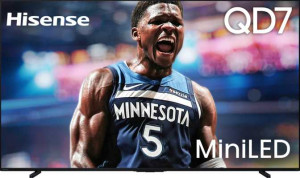
Hisense 55QD7QF 55"
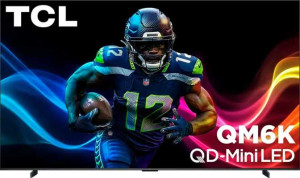
TCL 98QM6K 98"

Hisense 55QD7QF 55" TCL 98QM6K 98"

Overview

Welcome to our in-depth specification comparison between the Hisense 55QD7QF 55″ and the TCL 98QM6K 98″. These two QLED Mini-LED televisions share a strong common foundation, yet they diverge significantly in areas that matter most to buyers, including screen size and refresh rate, connectivity options, and audio capabilities. Whether you are optimizing for a compact living space or craving a truly cinematic large-format experience, this side-by-side breakdown will help you make an informed decision.

Common Features

  • Both TVs have a 4K UHD resolution of 3840 x 2160 px.
  • Both TVs use a QLED, LED-backlit, LCD, Mini-LED display type.
  • Both TVs display 1070 million colors with a 10-bit bit depth.
  • HDR10 support is available on both products.
  • HDR10+ support is available on both products.
  • Dolby Vision support is available on both products.
  • Both TVs include 4 HDMI ports and 2 USB ports.
  • Both TVs include 1 RJ45 Ethernet port.
  • Bluetooth is available on both products.
  • Both TVs support Wi-Fi 4 (802.11n) and Wi-Fi 5 (802.11ac).
  • Miracast support is available on both products.
  • Neither TV has an external memory slot.
  • Dolby Digital support is available on both products.
  • Dolby Digital Plus support is available on both products.
  • Digital Out support is available on both products.
  • Dolby Atmos support is available on both products.
  • Dolby Audio support is available on both products.
  • SRS TheaterSound HD is not available on either product.
  • Dolby Virtual support is not available on either product.
  • Stereo speakers are present on both products.
  • VESA mount support is available on both products.
  • Both TVs operate within the same temperature range of 5 °C to 35 °C.
  • AirPlay support is available on both products.
  • A built-in smart TV platform is present on both products.
  • Google Assistant compatibility is available on both products.
  • Apple HomeKit and Siri compatibility is not available on either product.
  • Remote smartphone control is supported on both products.
  • Neither TV has a rechargeable remote control.
  • USB recording is supported on both products.
  • Both TVs have a standby power consumption of 0.5W.

Main Differences

  • Screen size is 54.6″ on Hisense 55QD7QF 55″ and 97.5″ on TCL 98QM6K 98″.
  • Pixel density is 81 ppi on Hisense 55QD7QF 55″ and 45 ppi on TCL 98QM6K 98″.
  • Refresh rate is 60Hz on Hisense 55QD7QF 55″ and 144Hz on TCL 98QM6K 98″.
  • Adaptive synchronization supports AMD FreeSync and AMD FreeSync Premium on Hisense 55QD7QF 55″, while TCL 98QM6K 98″ additionally includes AMD FreeSync Premium Pro.
  • HDMI version is 2.0 on Hisense 55QD7QF 55″ and 2.1 on TCL 98QM6K 98″.
  • Bluetooth version is 5.0 on Hisense 55QD7QF 55″ and 5.4 on TCL 98QM6K 98″.
  • A 3.5mm audio jack socket is present on Hisense 55QD7QF 55″ but not available on TCL 98QM6K 98″.
  • A built-in subwoofer is present on TCL 98QM6K 98″ but not available on Hisense 55QD7QF 55″.
  • Width is 1226.8 mm on Hisense 55QD7QF 55″ and 2180.1 mm on TCL 98QM6K 98″.
  • Height is 713.7 mm on Hisense 55QD7QF 55″ and 1246.9 mm on TCL 98QM6K 98″.
  • Thickness is 76.2 mm on Hisense 55QD7QF 55″ and 64 mm on TCL 98QM6K 98″.
  • Weight is 13290 g on Hisense 55QD7QF 55″ and 53302 g on TCL 98QM6K 98″.
  • Volume is 66718.22 cm³ on Hisense 55QD7QF 55″ and 173975.47 cm³ on TCL 98QM6K 98″.
  • Alexa compatibility is available on Hisense 55QD7QF 55″ but not on TCL 98QM6K 98″.
Specs Comparison
Hisense 55QD7QF 55"

Hisense 55QD7QF 55"

TCL 98QM6K 98"

TCL 98QM6K 98"

Display:
display resolution 4K (UHD) 4K (UHD)
Display type QLED, LED-backlit, LCD, Mini-LED QLED, LED-backlit, LCD, Mini-LED
screen size 54.6" 97.5"
resolution 3840 x 2160 px 3840 x 2160 px
pixel density 81 ppi 45 ppi
display colors 1070 million 1070 million
bit depth 10-bit 10-bit
refresh rate 60Hz 144Hz
supports HDR10
supports HDR10+
supports Dolby Vision
supports HLG
Adaptive synchronization AMD FreeSync, AMD FreeSync Premium AMD FreeSync, AMD FreeSync Premium, AMD FreeSync Premium Pro
has anti-reflection coating
has an ambient light sensor
maximum horizontal viewing angle 178º 178º
maximum vertical viewing angle 178º 178º

Both the Hisense 55QD7QF and the TCL 98QM6K share the same display technology stack — QLED Mini-LED LCD — and identical native resolution of 3840 x 2160 px (4K UHD), along with full HDR support across all major formats (HDR10, HDR10+, Dolby Vision, and HLG). Their panel characteristics — 10-bit color depth, 1.07 billion colors, and 178° viewing angles in both directions — are essentially equivalent on paper.

Where the two diverge significantly is in screen size and refresh rate. The TCL's 97.5″ panel nearly doubles the Hisense's 54.6″, which has a profound impact on pixel density: the Hisense delivers 81 ppi versus the TCL's 45 ppi. In practice, this means the Hisense produces a noticeably sharper image at typical viewing distances, while the TCL's lower pixel density is more of a non-issue when viewed from the greater distances that a near-100″ screen naturally demands. Meanwhile, the TCL's 144Hz refresh rate is a major advantage over the Hisense's 60Hz panel — smoother motion in fast-action content, sports, and gaming is a tangible, everyday benefit. The TCL also extends its adaptive sync support to include AMD FreeSync Premium Pro, adding low-framerate compensation and HDR support in variable refresh rate scenarios, giving it a clear edge for gamers.

In summary, each TV has a distinct advantage in its own right. The Hisense 55QD7QF wins on pixel sharpness for its size and is the more practical choice for typical room sizes. The TCL 98QM6K holds a clear edge in motion fluidity and gaming performance thanks to its 144Hz panel and expanded FreeSync support — and its cinematic screen size is unmatched if the viewing environment can accommodate it.
Connectivity:
Has Bluetooth
HDMI version HDMI 2.0 HDMI 2.1
HDMI ports 4 4
supports Wi-Fi
Wi-Fi version Wi-Fi 4 (802.11n), Wi-Fi 5 (802.11ac) Wi-Fi 4 (802.11n), Wi-Fi 5 (802.11ac)
Bluetooth version 5 5.4
USB ports 2 2
RJ45 ports 1 1
supports Miracast
has a socket for a 3.5 mm audio jack
has an external memory slot
has a VGA connector
has a DVI connector

The port layout of both TVs is largely identical — 4 HDMI ports, 2 USB ports, a single RJ45 ethernet jack, Wi-Fi, Bluetooth, and Miracast support — making day-to-day connectivity a wash for most users. The shared Wi-Fi 5 (802.11ac) support is adequate for streaming, and the wired ethernet option is a welcome inclusion on both for users who prioritize network stability.

The meaningful differences emerge at the detail level. The TCL 98QM6K's HDMI 2.1 ports are a genuine upgrade over the Hisense's HDMI 2.0, supporting higher bandwidth that enables 4K at 144Hz and advanced gaming features from compatible sources — a natural complement to its high-refresh-rate panel. The TCL also edges ahead with Bluetooth 5.4 versus the Hisense's Bluetooth 5.0; while both versions offer solid range and stability, 5.4 brings improved efficiency and more robust connection handling for wireless peripherals and audio devices. On the flip side, the Hisense retains a 3.5mm audio jack — absent on the TCL — which matters for users who want to connect headphones directly to the TV without an adapter or wireless workaround.

Overall, the TCL 98QM6K holds the connectivity edge, primarily due to its HDMI 2.1 implementation, which unlocks the full potential of its 144Hz display for next-gen gaming sources. The Hisense 55QD7QF counters with a more practical headphone output, but that is a narrow advantage. Users heavily invested in a modern gaming or home theater setup will find the TCL's connectivity suite more future-ready.

Audio:
supports Dolby Digital
supports Digital Out
supports Dolby Digital Plus
has SRS TheaterSound HD
has stereo speakers
has Dolby Atmos
has Dolby Audio
supports Dolby Virtual
has a subwoofer
has DTS:X
HDMI ARC / eARC HDMI ARC, HDMI eARC HDMI ARC, HDMI eARC

From a format support standpoint, these two TVs are essentially identical — both decode Dolby Atmos, Dolby Audio, Dolby Digital Plus, and DTS:X, and both offer the full HDMI ARC and eARC combo for seamless passthrough to external soundbars or AV receivers. For anyone planning to route audio through a dedicated sound system, neither TV holds an advantage here.

The single but meaningful differentiator is the TCL 98QM6K's inclusion of a built-in subwoofer. For users relying on the TV's internal speakers, a dedicated subwoofer adds low-frequency extension that stereo drivers alone cannot reproduce — delivering more impactful bass for action movies, music, and gaming without any external hardware. The Hisense 55QD7QF, with stereo speakers only, will sound comparatively thin in the low end when used standalone.

For out-of-the-box audio performance, the TCL 98QM6K has a clear advantage thanks to its subwoofer. That said, both TVs are well-equipped for users who plan to pair them with an external audio setup, where the internal speaker configuration becomes largely irrelevant.

Design:
width 1226.8 mm 2180.1 mm
weight 13290 g 53302 g
thickness 76.2 mm 64 mm
height 713.7 mm 1246.9 mm
volume 66718.217592 cm³ 173975.46816 cm³
Supports VESA mount
maximum operating temperature 35 °C 35 °C
lowest potential operating temperature 5 °C 5 °C

The size gulf between these two TVs is reflected just as starkly in their physical footprints as it is on screen. The TCL 98QM6K spans 2180.1 mm wide and 1246.9 mm tall, weighing in at 53.3 kg — a genuinely substantial installation that demands significant wall space, a reinforced mount, or a purpose-built stand, and almost certainly requires multiple people to position safely. By contrast, the Hisense 55QD7QF at 1226.8 mm wide and 13.3 kg is manageable for a single person and fits comfortably in a typical living room or bedroom setup.

One design detail worth noting is that the Hisense is actually thicker at 76.2 mm versus the TCL's slimmer 64 mm profile — somewhat counterintuitive given the TCL's overall mass, but relevant for wall-mount installations where depth clearance matters. Both TVs support VESA mounting and share identical operating temperature ranges, so neither has an environmental advantage.

There is no winner here in the traditional sense — the design specs simply reflect two products built for fundamentally different use cases and room sizes. The Hisense 55QD7QF is the practical choice for standard living spaces, while the TCL 98QM6K is a deliberate large-format installation that requires careful planning around space, structural support, and handling logistics.

Features:
release date April 2025 March 2025
has AirPlay
has built-in smart TV
compatible with Google Assistant
works with Alexa
works with Siri/Apple HomeKit
supports a remote smartphone
has a rechargeable remote control
supports USB recording
standby power consumption 0.5W 0.5W
has a search browser
has a sleep timer
has a child lock
warranty period 1 years 1 years
has voice commands

Across most smart features, these two TVs are nearly indistinguishable — both offer a built-in smart platform, AirPlay, Google Assistant, voice commands, smartphone remote support, USB recording, and a matching 0.5W standby power consumption. For the vast majority of users, the day-to-day smart TV experience will feel essentially the same on either set.

The only concrete differentiator in this group is Alexa compatibility, which the Hisense 55QD7QF supports and the TCL 98QM6K does not. This is a meaningful distinction for users already embedded in Amazon's ecosystem — controlling the TV through an Echo device or using Alexa routines alongside other smart home products becomes seamless on the Hisense, while TCL owners would need to rely on Google Assistant exclusively for voice-based smart home integration.

On the whole, the Hisense 55QD7QF holds a narrow edge here purely due to its broader voice assistant compatibility. Neither TV supports Apple HomeKit or Siri, so Apple-centric users are equally limited on both. The features category otherwise presents no meaningful reason to choose one over the other.

Comparison Summary & Verdict

After examining every specification, both TVs prove to be capable QLED Mini-LED displays with full HDR support including Dolby Vision, HDR10, and HDR10+, plus smart platform features like AirPlay and Google Assistant. However, their differences define very distinct audiences. The Hisense 55QD7QF 55″ is the stronger pick for smaller rooms, offering a higher pixel density of 81 ppi, a 3.5mm audio jack, and Alexa compatibility, making it a well-rounded everyday TV. The TCL 98QM6K 98″, on the other hand, is built for enthusiasts who demand scale and performance, delivering a massive 97.5-inch screen, a blazing 144Hz refresh rate, HDMI 2.1 ports, AMD FreeSync Premium Pro for gaming, a built-in subwoofer, and Bluetooth 5.4. Choose the Hisense for a compact, versatile setup, and choose the TCL for an immersive, large-screen home cinema or gaming environment.

Hisense 55QD7QF 55
Buy Hisense 55QD7QF 55" if...

Buy the Hisense 55QD7QF 55″ if you want a higher pixel density display for a smaller room and value the convenience of a 3.5mm audio jack and built-in Alexa compatibility.

TCL 98QM6K 98
Buy TCL 98QM6K 98" if...

Buy the TCL 98QM6K 98″ if you want a massive 97.5-inch screen with a 144Hz refresh rate, HDMI 2.1, AMD FreeSync Premium Pro, and a built-in subwoofer for a premium gaming or home cinema setup.