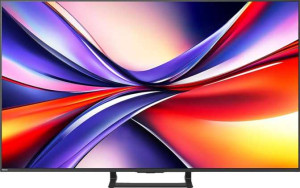
Hisense 75A7Q 75"
TCL 115C7K 115"

Hisense 75A7Q 75" TCL 115C7K 115"

Overview

Welcome to our in-depth specification comparison between the Hisense 75A7Q 75″ and the TCL 115C7K 115″. These two QLED TVs share a strong foundation — 4K UHD resolution, full HDR format support, and Dolby Atmos audio — yet they diverge sharply when it comes to screen size, brightness, and refresh rate. Whether you are weighing up everyday versatility against a cinematic large-format experience, this side-by-side breakdown covers every key specification to help you make the most informed decision possible.

Common Features

  • Both TVs offer 4K UHD resolution at 3840 x 2160 px.
  • Both displays support 1070 million colors at 10-bit depth.
  • HDR10 support is available on both products.
  • HDR10+ support is available on both products.
  • Dolby Vision support is available on both products.
  • HLG support is available on both products.
  • Both TVs use a QLED, LED-backlit LCD display type as a baseline.
  • Both products include HDMI 2.1 ports.
  • Bluetooth is available on both products.
  • Wi-Fi connectivity is supported on both products, including Wi-Fi 4 and Wi-Fi 5.
  • Both TVs include one RJ45 ethernet port.
  • Miracast is supported on both products.
  • A 3.5 mm audio jack socket is present on both products.
  • Neither product includes an external memory slot.
  • Neither product has a VGA connector.
  • Dolby Atmos and Dolby Audio are supported on both products.
  • Dolby Digital and Dolby Digital Plus support is available on both products.
  • Digital Out support is available on both products.
  • Stereo speakers are present on both products.
  • AirPlay is available on both products.
  • Both TVs have a built-in smart TV platform.
  • Google Assistant compatibility is available on both products.
  • Neither product works with Siri or Apple HomeKit.
  • Remote smartphone control is supported on both products.
  • Neither product includes a rechargeable remote control.
  • USB recording is supported on both products.
  • Standby power consumption is 0.5W on both products.
  • Both products support VESA mounting.
  • The maximum operating temperature is 35 °C on both products.
  • The minimum operating temperature is 5 °C on both products.

Main Differences

  • The display technology is QLED LED-backlit LCD on the Hisense 75A7Q 75″ and QLED LED-backlit LCD with Mini-LED on the TCL 115C7K 115″.
  • Screen size is 75″ on the Hisense 75A7Q 75″ and 114.5″ on the TCL 115C7K 115″.
  • Pixel density is 59 ppi on the Hisense 75A7Q 75″ and 38 ppi on the TCL 115C7K 115″.
  • Typical brightness is 400 nits on the Hisense 75A7Q 75″ and 3000 nits on the TCL 115C7K 115″.
  • Contrast ratio is 3800:1 on the Hisense 75A7Q 75″ and 7000:1 on the TCL 115C7K 115″.
  • Refresh rate is 60Hz on the Hisense 75A7Q 75″ and 144Hz on the TCL 115C7K 115″.
  • HDMI port count is 3 on the Hisense 75A7Q 75″ and 4 on the TCL 115C7K 115″.
  • Wi-Fi support extends to Wi-Fi 5 on the Hisense 75A7Q 75″, while the TCL 115C7K 115″ also adds Wi-Fi 6 (802.11ax).
  • Bluetooth version is 5 on the Hisense 75A7Q 75″ and 5.4 on the TCL 115C7K 115″.
  • USB port count is 2 on the Hisense 75A7Q 75″ and 3 on the TCL 115C7K 115″.
  • Width is 1668 mm on the Hisense 75A7Q 75″ and 2566 mm on the TCL 115C7K 115″.
  • Height is 961 mm on the Hisense 75A7Q 75″ and 1471 mm on the TCL 115C7K 115″.
  • Thickness is 86 mm on the Hisense 75A7Q 75″ and 57 mm on the TCL 115C7K 115″.
  • Weight is 28500 g on the Hisense 75A7Q 75″ and 99800 g on the TCL 115C7K 115″.
  • Volume is 137853.528 cm³ on the Hisense 75A7Q 75″ and 215151.402 cm³ on the TCL 115C7K 115″.
  • Alexa support is present on the Hisense 75A7Q 75″ but not available on the TCL 115C7K 115″.
Specs Comparison
Hisense 75A7Q 75"

Hisense 75A7Q 75"

TCL 115C7K 115"

TCL 115C7K 115"

Display:
display resolution 4K (UHD) 4K (UHD)
Display type QLED, LED-backlit, LCD QLED, LED-backlit, LCD, Mini-LED
screen size 75" 114.5"
resolution 3840 x 2160 px 3840 x 2160 px
pixel density 59 ppi 38 ppi
display colors 1070 million 1070 million
bit depth 10-bit 10-bit
brightness (typical) 400 nits 3000 nits
contrast ratio 3800:1 7000:1
refresh rate 60Hz 144Hz
supports HDR10
supports HDR10+
supports Dolby Vision
supports HLG
has anti-reflection coating
has an ambient light sensor
maximum horizontal viewing angle 178º 178º
maximum vertical viewing angle 178º 178º

Both the Hisense 75A7Q and the TCL 115C7K share the same 4K (3840 x 2160) resolution, 10-bit color depth, and full HDR format support — including HDR10+, Dolby Vision, and HLG — making them equally capable on paper when it comes to content compatibility. However, the panel technology diverges meaningfully: the TCL adds Mini-LED backlighting to its QLED LCD stack, which is the root cause of most of its measurable performance advantages over the Hisense's conventional LED-backlit QLED panel.

The most striking gaps are in brightness and contrast. The TCL delivers 3000 nits of typical brightness versus just 400 nits on the Hisense — a 7.5× difference that translates directly into far more impactful HDR highlights, better visibility in bright rooms, and a wider effective dynamic range in practice. Its contrast ratio of 7000:1 also nearly doubles the Hisense's 3800:1, meaning deeper blacks and more separation between shadow detail and bright areas. The TCL's 144Hz refresh rate versus the Hisense's 60Hz is another substantial gap, giving the TCL a major edge in motion clarity for sports, action films, and gaming. On the flip side, the Hisense's smaller 75″ panel yields a pixel density of 59 ppi compared to the TCL's 38 ppi at 114.5″ — meaning individual pixels are more tightly packed and the image will appear sharper at normal viewing distances on the Hisense.

The TCL 115C7K holds a clear display advantage across the most impactful metrics: brightness, contrast, and refresh rate — all driven by its Mini-LED architecture. The Hisense 75A7Q's higher pixel density is a real benefit, but it becomes less relevant at the typical viewing distances a 75″ set implies. For most users prioritizing HDR performance and motion handling, the TCL's panel is the stronger choice; the Hisense is more competitive only if screen size, viewing distance, and image sharpness per inch are the primary concerns.

Connectivity:
Has Bluetooth
HDMI version HDMI 2.1 HDMI 2.1
HDMI ports 3 4
supports Wi-Fi
Wi-Fi version Wi-Fi 4 (802.11n), Wi-Fi 5 (802.11ac) Wi-Fi 4 (802.11n), Wi-Fi 5 (802.11ac), Wi-Fi 6 (802.11ax)
Bluetooth version 5 5.4
USB ports 2 3
RJ45 ports 1 1
supports Miracast
has a socket for a 3.5 mm audio jack
has an external memory slot
has a VGA connector
DVB standards DVB-T, DVB-T2, DVB-C, DVB-S, DVB-S2 DVB-T, DVB-T2, DVB-C, DVB-S, DVB-S2
has a DVI connector

At the foundation, both TVs share a solid common base: HDMI 2.1 ports, a wired RJ45 ethernet port, Miracast wireless casting, a 3.5mm audio jack, and identical DVB tuner support. Neither offers external memory expansion, so local media playback options are limited to what USB ports allow. The meaningful differences emerge when you look at the quantity and quality of those shared connection types.

The TCL 115C7K edges ahead on every expandable interface: it offers 4 HDMI ports versus the Hisense's 3, and 3 USB ports versus 2 — small but practical advantages for users running multiple consoles, streaming sticks, soundbars, and storage drives simultaneously. More significantly, the TCL supports Wi-Fi 6 (802.11ax) in addition to Wi-Fi 4 and 5, while the Hisense tops out at Wi-Fi 5. Wi-Fi 6 delivers higher throughput, lower latency, and better performance in congested network environments — a real-world benefit in households with many connected devices. The TCL also carries a newer Bluetooth 5.4 versus the Hisense's Bluetooth 5.0, which brings improved connection stability and efficiency for wireless audio accessories and peripherals.

The TCL 115C7K holds a clear edge in connectivity. None of the individual upgrades are dramatic in isolation, but together — an extra HDMI port, an extra USB port, Wi-Fi 6, and a more current Bluetooth version — they paint a picture of a more future-ready and flexible hub for a modern home entertainment setup.

Audio:
supports Dolby Digital
supports Digital Out
supports Dolby Digital Plus
has SRS TheaterSound HD
has stereo speakers
has Dolby Atmos
has Dolby Audio
supports Dolby Virtual
has a subwoofer
has DTS:X
HDMI ARC / eARC HDMI ARC, HDMI eARC HDMI ARC, HDMI eARC

Across every audio specification in this group, the Hisense 75A7Q and the TCL 115C7K are an exact match. Both support the full Dolby ecosystem — including Dolby Digital Plus, Dolby Atmos, and Dolby Audio — alongside DTS:X for object-based surround decoding. Both also include a built-in subwoofer, stereo speakers, digital audio output, and full HDMI ARC and eARC support for seamless soundbar or AV receiver integration.

The practical significance of this shared feature set is meaningful. Dolby Atmos and DTS:X support means both TVs can process height-channel audio metadata from streaming services and Blu-ray, even if the ultimate output quality depends on the physical speaker hardware — which these specs do not quantify. The presence of HDMI eARC on both is particularly useful, as it allows lossless, high-bandwidth audio formats like Dolby TrueHD and DTS-HD Master Audio to pass through to a compatible external audio system without compression.

This group is a complete tie. Every audio capability listed is shared identically between the two TVs, so audio feature support plays no role in differentiating them. Buyers prioritizing sound quality beyond the built-in speakers should focus their comparison on external audio system compatibility, where both TVs stand on equal footing.

Design:
width 1668 mm 2566 mm
weight 28500 g 99800 g
thickness 86 mm 57 mm
height 961 mm 1471 mm
volume 137853.528 cm³ 215151.402 cm³
Supports VESA mount
maximum operating temperature 35 °C 35 °C
lowest potential operating temperature 5 °C 5 °C

The size and weight gulf between these two TVs is substantial, and it has direct implications for installation. The TCL 115C7K spans 2566 mm wide and stands 1471 mm tall, weighing in at nearly 100 kg — roughly 3.5 times the mass of the Hisense 75A7Q, which comes in at 28.5 kg across a much more manageable 1668 mm width. At that weight, the TCL is emphatically a multi-person, professional-installation job, and wall-mounting it demands a heavy-duty mount and a structural wall assessment. The Hisense, by contrast, sits within the range a two-person team can handle without specialized equipment.

One area where the Hisense does not lead is panel thickness. Despite being the smaller and lighter set, it measures 86 mm deep compared to the TCL's notably slimmer 57 mm — likely a reflection of the TCL's Mini-LED backlighting engineering, which achieves a thinner profile despite the additional hardware complexity. Both TVs support VESA mounting, and both share identical operating temperature ranges, so neither has an environmental advantage in that regard.

There is no single winner here — the right choice depends entirely on the installation context. The Hisense 75A7Q is far easier to move, position, and mount, making it the practical option for most residential settings. The TCL 115C7K's footprint and weight demand dedicated space and professional handling, but that comes with the territory of a 115″ panel. Buyers should treat the TCL's physical scale as a prerequisite to evaluate before any other factor.

Features:
release date April 2025 March 2025
has AirPlay
has built-in smart TV
compatible with Google Assistant
works with Alexa
works with Siri/Apple HomeKit
supports a remote smartphone
has a rechargeable remote control
supports USB recording
standby power consumption 0.5W 0.5W
has a search browser
has a sleep timer
has a child lock
has voice commands
EU energy label E E

Smart feature parity between these two TVs is remarkably high. Both carry built-in smart TV platforms with voice command support, AirPlay, Google Assistant integration, smartphone remote control, USB recording, and matching utility features like a sleep timer and child lock. Standby power consumption is identical at 0.5W, and both carry an EU energy label of E. For the vast majority of users, the day-to-day smart TV experience will feel nearly indistinguishable.

The only functional differentiator in this group is Amazon Alexa compatibility, which the Hisense 75A7Q supports and the TCL 115C7K does not. In practical terms, this matters primarily to households already embedded in the Amazon smart home ecosystem — users who rely on Alexa routines, Echo devices, or Alexa-controlled smart home gear will find the Hisense integrates more naturally into that environment. Neither TV supports Siri or Apple HomeKit, so Apple-centric users are on equal footing with both.

The Hisense 75A7Q holds a narrow edge in this group solely due to its Alexa support. It is a meaningful advantage only for Amazon ecosystem users; for everyone else, the two TVs are functionally tied on features.

Comparison Summary & Verdict

After examining every specification, these two televisions serve clearly different audiences. The Hisense 75A7Q 75″ is the more practical, living-room-friendly choice: its compact 75-inch footprint, lighter 28.5 kg body, and Alexa compatibility make it an excellent fit for everyday home use where space and smart-home integration matter. The TCL 115C7K 115″, on the other hand, is built for those who demand a premium, immersive experience — its Mini-LED panel, staggering 3000-nit brightness, 7000:1 contrast ratio, and 144Hz refresh rate make it a powerhouse for home cinema enthusiasts and serious gamers alike. If budget and room size allow, the TCL delivers a dramatically more capable display; but for a well-rounded, space-conscious TV with solid smart features including Alexa, the Hisense remains a compelling and competitive option.

Hisense 75A7Q 75
Buy Hisense 75A7Q 75" if...

Buy the Hisense 75A7Q 75″ if you want a space-friendly 75-inch QLED TV with Alexa support and a lighter, more manageable design for everyday home use.

TCL 115C7K 115
Buy TCL 115C7K 115" if...

Buy the TCL 115C7K 115″ if you want a massive 114.5-inch Mini-LED display with exceptional 3000-nit brightness, a 144Hz refresh rate, and a superior 7000:1 contrast ratio for a premium cinema or gaming setup.