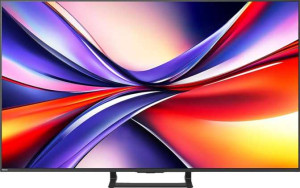
Hisense 75A7Q 75"
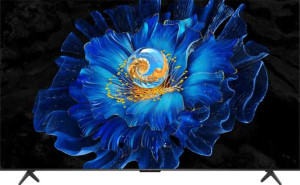
TCL 75C6KS 75"

Hisense 75A7Q 75" TCL 75C6KS 75"

Overview

Welcome to our in-depth specification face-off between the Hisense 75A7Q 75″ and the TCL 75C6KS 75″, two large-screen QLED televisions competing for your living room. Both sets share a strong foundation of 4K UHD resolution, Dolby Vision, and smart TV capabilities, yet they differ in some areas that could meaningfully influence your viewing experience — including refresh rate, contrast performance, and overall physical design. Read on to see how every specification stacks up before making your decision.

Common Features

  • Both TVs have a 4K UHD resolution of 3840 x 2160 px.
  • Both TVs have a pixel density of 59 ppi.
  • Both TVs use QLED, LED-backlit LCD display technology.
  • Both TVs support 1070 million display colors with a 10-bit bit depth.
  • HDR10 support is available on both products.
  • HDR10+ support is available on both products.
  • Dolby Vision support is available on both products.
  • Both TVs include 2 USB ports and 1 RJ45 port.
  • Both TVs support HDMI 2.1.
  • Bluetooth is available on both products.
  • Both TVs support Wi-Fi 4 (802.11n) and Wi-Fi 5 (802.11ac).
  • Miracast support is available on both products.
  • A 3.5 mm audio jack socket is present on both products.
  • Dolby Atmos support is available on both products.
  • Dolby Audio support is available on both products.
  • Dolby Digital and Dolby Digital Plus support is available on both products.
  • Digital Out support is available on both products.
  • SRS TheaterSound HD is not available on either product.
  • Dolby Virtual is not available on either product.
  • Both TVs support VESA mounting and share the same operating temperature range of 5 °C to 35 °C.
  • AirPlay is available on both products.
  • A built-in smart TV platform is present on both products.
  • Google Assistant compatibility is available on both products.
  • Apple HomeKit and Siri support is not available on either product.
  • Smartphone remote control support is available on both products.
  • A rechargeable remote control is not included with either product.
  • USB recording support is available on both products.
  • Both TVs have a standby power consumption of 0.5W.
  • Both TVs feature stereo speakers.
  • Both TVs include HDMI ARC and HDMI eARC.

Main Differences

  • Display type is QLED LED-backlit LCD on Hisense 75A7Q 75″ and QLED LED-backlit LCD with Mini-LED on TCL 75C6KS 75″.
  • Screen size is 75″ on Hisense 75A7Q 75″ and 74.5″ on TCL 75C6KS 75″.
  • Contrast ratio is 3800:1 on Hisense 75A7Q 75″ and 6000:1 on TCL 75C6KS 75″.
  • Refresh rate is 60Hz on Hisense 75A7Q 75″ and 120Hz on TCL 75C6KS 75″.
  • HDMI ports total 3 on Hisense 75A7Q 75″ and 4 on TCL 75C6KS 75″.
  • Bluetooth version is 5 on Hisense 75A7Q 75″ and 5.4 on TCL 75C6KS 75″.
  • Width is 1668 mm on Hisense 75A7Q 75″ and 1670 mm on TCL 75C6KS 75″.
  • Height is 961 mm on Hisense 75A7Q 75″ and 960 mm on TCL 75C6KS 75″.
  • Thickness is 86 mm on Hisense 75A7Q 75″ and 56.7 mm on TCL 75C6KS 75″.
  • Weight is 28500 g on Hisense 75A7Q 75″ and 23500 g on TCL 75C6KS 75″.
  • Volume is 137853.528 cm³ on Hisense 75A7Q 75″ and 90901.44 cm³ on TCL 75C6KS 75″.
Specs Comparison
Hisense 75A7Q 75"

Hisense 75A7Q 75"

TCL 75C6KS 75"

TCL 75C6KS 75"

Display:
display resolution 4K (UHD) 4K (UHD)
Display type QLED, LED-backlit, LCD QLED, LED-backlit, LCD, Mini-LED
screen size 75" 74.5"
resolution 3840 x 2160 px 3840 x 2160 px
pixel density 59 ppi 59 ppi
display colors 1070 million 1070 million
bit depth 10-bit 10-bit
contrast ratio 3800:1 6000:1
refresh rate 60Hz 120Hz
supports HDR10
supports HDR10+
supports Dolby Vision
supports HLG
has anti-reflection coating
has an ambient light sensor
maximum horizontal viewing angle 178º 178º
maximum vertical viewing angle 178º 178º

Both the Hisense 75A7Q and the TCL 75C6KS share the same foundational display DNA: 4K UHD resolution at 3840 x 2160 px, a 59 ppi pixel density, 10-bit color depth rendering 1.07 billion colors, and full HDR format support across HDR10, HDR10+, Dolby Vision, and HLG. Both also feature anti-reflection coatings and ambient light sensors, with identical 178º horizontal and vertical viewing angles. For a buyer focused purely on resolution and color format compatibility, these two panels are effectively tied.

The meaningful gaps emerge in two areas: backlight technology and motion handling. The TCL employs a Mini-LED backlighting layer on top of the QLED LCD stack, which enables its significantly higher 6000:1 contrast ratio versus the Hisense's 3800:1. In practice, Mini-LED allows for more precise local dimming zones, resulting in deeper blacks and brighter highlights without the blooming artifacts common in conventional LED panels — a tangible advantage in dark room viewing and HDR content. Meanwhile, the TCL's native 120Hz refresh rate versus the Hisense's 60Hz is critical for motion clarity: fast-action sports, gaming, and high-frame-rate content will appear noticeably smoother and sharper on the TCL.

The TCL 75C6KS holds a clear display advantage. Its Mini-LED backlight delivers superior contrast, and its 120Hz panel offers a real-world motion performance edge that 60Hz simply cannot match. The Hisense 75A7Q is a capable QLED set with full HDR coverage, but on display hardware specifications alone, the TCL outperforms it in the two dimensions — contrast depth and refresh rate — that most directly affect perceived image quality.
Connectivity:
Has Bluetooth
HDMI version HDMI 2.1 HDMI 2.1
HDMI ports 3 4
supports Wi-Fi
Wi-Fi version Wi-Fi 4 (802.11n), Wi-Fi 5 (802.11ac) Wi-Fi 4 (802.11n), Wi-Fi 5 (802.11ac)
Bluetooth version 5 5.4
USB ports 2 2
RJ45 ports 1 1
supports Miracast
has a socket for a 3.5 mm audio jack
has an external memory slot
has a VGA connector
DVB standards DVB-T, DVB-T2, DVB-C, DVB-S, DVB-S2 DVB-T, DVB-T2, DVB-C, DVB-S, DVB-S2
has a DVI connector

At their core, these two TVs share a solid and nearly identical connectivity foundation: HDMI 2.1 on all ports, dual USB ports, an RJ45 ethernet jack, Wi-Fi 4/5, Miracast screen mirroring, and a 3.5mm audio output. For most users, this common ground covers the essentials comfortably — HDMI 2.1 supports 4K at 120Hz and VRR passthrough, which pairs well with modern consoles and PCs on both sets.

Two specs separate them. The TCL 75C6KS offers 4 HDMI ports versus the Hisense 75A7Q's 3 — a practical difference for living rooms with multiple sources like a soundbar, gaming console, streaming stick, and set-top box running simultaneously. Constantly swapping cables is a real inconvenience, and that extra port removes the need for an HDMI switch for most setups. Additionally, the TCL carries Bluetooth 5.4 compared to the Hisense's Bluetooth 5.0. Version 5.4 brings improvements in connection reliability and lower latency, which matters most when pairing wireless headphones or audio accessories.

The TCL 75C6KS takes a narrow but practical edge in connectivity. The additional HDMI port is the more impactful differentiator for everyday use, while the newer Bluetooth version is a meaningful bonus for wireless audio users. The Hisense is not deficient by any means, but the TCL is simply the more future-ready and flexible option in this category.

Audio:
supports Dolby Digital
supports Digital Out
supports Dolby Digital Plus
has SRS TheaterSound HD
has stereo speakers
has Dolby Atmos
has Dolby Audio
supports Dolby Virtual
has a subwoofer
has DTS:X
HDMI ARC / eARC HDMI ARC, HDMI eARC HDMI eARC, HDMI ARC

Rarely does a spec group tell such a clear story: the audio capabilities of the Hisense 75A7Q and the TCL 75C6KS are, point for point, identical. Both ship with built-in stereo speakers, a subwoofer, and full support for Dolby Atmos, Dolby Audio, Dolby Digital Plus, and DTS:X — covering every major spatial and object-based audio format a streaming service or Blu-ray disc is likely to throw at them. Both also carry HDMI ARC and eARC, meaning either TV can pass high-bandwidth lossless audio formats to a compatible external soundbar or AV receiver without needing a separate optical cable.

This is a genuine dead heat. There is no differentiating spec here — no wattage figures, no channel configuration data, no proprietary processing advantage that belongs to one over the other based on the provided information. Both sets are equally equipped to handle modern audio formats and external audio system integration.

Design:
width 1668 mm 1670 mm
weight 28500 g 23500 g
thickness 86 mm 56.7 mm
height 961 mm 960 mm
volume 137853.528 cm³ 90901.44 cm³
Supports VESA mount
maximum operating temperature 35 °C 35 °C
lowest potential operating temperature 5 °C 5 °C

Footprint-wise, these two 75-inch sets are virtually interchangeable — width and height differ by just 1–2mm, and both support VESA mounting with identical operating temperature ranges. For anyone measuring a wall or entertainment unit, either TV fits the same space. The meaningful design differences lie elsewhere.

Where they diverge significantly is in thickness and weight. The TCL 75C6KS is 56.7mm deep compared to the Hisense 75A7Q's 86mm — a 34% reduction that translates directly to a sleeker wall-mounted profile and easier cabinet clearance. More practically, the TCL weighs 23,500g against the Hisense's 28,500g, a difference of 5kg. That gap is felt during installation: a two-person lift versus a more manageable one, and less stress on wall mounts or furniture.

The TCL 75C6KS has a clear design edge. Its substantially slimmer chassis and lower weight make it easier to install, better suited for flush wall mounting, and less demanding on mounting hardware — practical advantages that matter during setup and in space-conscious environments.

Features:
release date April 2025 March 2025
has AirPlay
has built-in smart TV
compatible with Google Assistant
works with Siri/Apple HomeKit
supports a remote smartphone
has a rechargeable remote control
supports USB recording
standby power consumption 0.5W 0.5W
has a search browser
has a sleep timer
has a child lock
has voice commands

The features category produces the second outright tie in this comparison. Every single spec listed — from AirPlay and Google Assistant compatibility to USB recording, smartphone remote support, voice commands, and a 0.5W standby consumption — is shared identically by both the Hisense 75A7Q and the TCL 75C6KS. Neither supports Apple HomeKit or Siri, and neither ships with a rechargeable remote. There is no feature present on one that is absent from the other.

Worth noting is what both sets do offer: AirPlay enables seamless content mirroring from Apple devices, USB recording allows live TV to be captured directly to an external drive, and the matched 0.5W standby draw means neither set will meaningfully impact an electricity bill when idle. These are genuinely useful capabilities for a wide range of users, and the parity here means the feature set is not a deciding factor in this comparison.

Comparison Summary & Verdict

After reviewing every specification, these two 75-inch QLED TVs share a remarkably similar feature set at their core, yet diverge in ways that matter. The TCL 75C6KS 75″ stands out with its Mini-LED backlighting, superior 6000:1 contrast ratio, and a faster 120Hz refresh rate, making it the stronger choice for cinephiles, sports fans, and gamers who demand deeper blacks and smoother motion. It also benefits from an extra HDMI 2.1 port and a slimmer, lighter build. The Hisense 75A7Q 75″, on the other hand, remains a capable and well-rounded set that covers all the key bases — 4K, Dolby Vision, AirPlay, and Google Assistant — at what is typically a more accessible price point. If picture performance and future-proofing are your top priorities, the TCL is the clear upgrade; if you want a dependable large-screen smart TV without paying a premium for the extras, the Hisense holds its own.

Hisense 75A7Q 75
Buy Hisense 75A7Q 75" if...

Buy the Hisense 75A7Q 75″ if you want a large-screen QLED smart TV with all the essential features — including Dolby Vision, AirPlay, and HDMI 2.1 — at a more budget-friendly price point and are comfortable with a 60Hz refresh rate.

TCL 75C6KS 75
Buy TCL 75C6KS 75" if...

Buy the TCL 75C6KS 75″ if you prioritize superior picture quality thanks to its Mini-LED backlighting, higher 6000:1 contrast ratio, and 120Hz refresh rate, and you value a slimmer design with an additional HDMI 2.1 port.