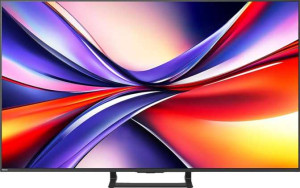
Hisense 75A7Q 75"
TCL 75Q51K 75"

Hisense 75A7Q 75" TCL 75Q51K 75"

Overview

Choosing between two 75-inch QLED televisions can be a tough call, especially when both share a strong common foundation. In this side-by-side comparison of the Hisense 75A7Q 75″ and the TCL 75Q51K 75″, we examine where these sets align and where they part ways across audio performance, connectivity options, physical design, and long-term ownership value to help you make the most informed decision for your home.

Common Features

  • Both TVs have a 4K UHD display resolution of 3840 x 2160 px.
  • Both use a QLED, LED-backlit LCD display type.
  • Both have a pixel density of 59 ppi.
  • Both support 1070 million display colors with a 10-bit color depth.
  • Both have a 60Hz refresh rate.
  • HDR10 support is available on both products.
  • Bluetooth connectivity is available on both products.
  • Both have 3 HDMI ports.
  • Wi-Fi is supported on both products, with Wi-Fi 4 (802.11n) and Wi-Fi 5 (802.11ac).
  • Both include 1 RJ45 port.
  • Miracast support is available on both products.
  • Neither product has an external memory slot.
  • Neither product has a VGA connector.
  • Dolby Digital support is available on both products.
  • Digital Out support is available on both products.
  • Dolby Digital Plus support is available on both products.
  • SRS TheaterSound HD is not available on either product.
  • Stereo speakers are present on both products.
  • Dolby Atmos is available on both products.
  • Dolby Audio is available on both products.
  • Dolby Virtual support is not available on either product.
  • Both TVs support VESA mounting.
  • Both have a maximum operating temperature of 35 °C and a minimum of 5 °C.
  • AirPlay is available on both products.
  • Both have a built-in smart TV platform.
  • Google Assistant compatibility is available on both products.
  • Alexa compatibility is available on both products.
  • Neither product works with Siri/Apple HomeKit.
  • Remote smartphone control is supported on both products.
  • Neither product has a rechargeable remote control.
  • USB recording is supported on both products.

Main Differences

  • Screen size is 75″ on Hisense 75A7Q 75″ and 74.5″ on TCL 75Q51K 75″.
  • HDMI version is 2.1 on Hisense 75A7Q 75″ and 2.0 on TCL 75Q51K 75″.
  • USB ports count is 2 on Hisense 75A7Q 75″ and 1 on TCL 75Q51K 75″.
  • A 3.5 mm audio jack is present on Hisense 75A7Q 75″ but not available on TCL 75Q51K 75″.
  • A built-in subwoofer is present on Hisense 75A7Q 75″ but not available on TCL 75Q51K 75″.
  • Width is 1668 mm on Hisense 75A7Q 75″ and 1666.2 mm on TCL 75Q51K 75″.
  • Weight is 28500 g on Hisense 75A7Q 75″ and 18198 g on TCL 75Q51K 75″.
  • Thickness is 86 mm on Hisense 75A7Q 75″ and 73.7 mm on TCL 75Q51K 75″.
  • Height is 961 mm on Hisense 75A7Q 75″ and 960.1 mm on TCL 75Q51K 75″.
  • Volume is 137853.528 cm³ on Hisense 75A7Q 75″ and 117899.262294 cm³ on TCL 75Q51K 75″.
  • Warranty period is 3 years on Hisense 75A7Q 75″ and 1 year on TCL 75Q51K 75″.
Specs Comparison
Hisense 75A7Q 75"

Hisense 75A7Q 75"

TCL 75Q51K 75"

TCL 75Q51K 75"

Display:
display resolution 4K (UHD) 4K (UHD)
Display type QLED, LED-backlit, LCD QLED, LED-backlit, LCD
screen size 75" 74.5"
resolution 3840 x 2160 px 3840 x 2160 px
pixel density 59 ppi 59 ppi
display colors 1070 million 1070 million
bit depth 10-bit 10-bit
refresh rate 60Hz 60Hz
supports HDR10
supports HDR10+
supports Dolby Vision
supports HLG
has anti-reflection coating
has an ambient light sensor
maximum horizontal viewing angle 178º 178º
maximum vertical viewing angle 178º 178º

In terms of display technology, the Hisense 75A7Q and TCL 75Q51K are remarkably similar. Both use a QLED, LED-backlit LCD panel, deliver a 4K (3840 x 2160) resolution at 59 ppi, and share a 10-bit color depth capable of rendering 1.07 billion colors — enough for smooth gradients and accurate HDR rendering. Their HDR format support is also identical, covering HDR10, HDR10+, Dolby Vision, and HLG, meaning neither has an advantage when it comes to compatibility with streaming or disc-based content. Both also include anti-reflection coating and an ambient light sensor, which help maintain picture quality across different lighting environments.

The only measurable difference in this group is the physical screen size: the Hisense is rated at a full 75″, while the TCL measures 74.5″ — a half-inch gap that is essentially invisible in a real living room setting and has no practical impact on image quality, viewing experience, or pixel density. Both share the same 60Hz native refresh rate and 178° viewing angles horizontally and vertically, so motion handling and off-axis performance are on equal footing.

For this spec group, these two televisions are effectively tied. There is no meaningful display advantage on either side — buyers can confidently make their decision based on other factors such as smart platform, audio, or price, knowing the panel specifications are for all practical purposes identical.

Connectivity:
Has Bluetooth
HDMI version HDMI 2.1 HDMI 2.0
HDMI ports 3 3
supports Wi-Fi
Wi-Fi version Wi-Fi 4 (802.11n), Wi-Fi 5 (802.11ac) Wi-Fi 4 (802.11n), Wi-Fi 5 (802.11ac)
USB ports 2 1
RJ45 ports 1 1
supports Miracast
has a socket for a 3.5 mm audio jack
has an external memory slot
has a VGA connector
has a DVI connector

Two differences stand out immediately when comparing connectivity: HDMI version and USB port count. The Hisense 75A7Q ships with HDMI 2.1, while the TCL 75Q51K is limited to HDMI 2.0. In practice, HDMI 2.1 supports higher bandwidth — relevant for users connecting a PlayStation 5 or Xbox Series X, where features like 4K@120Hz or VRR (Variable Refresh Rate) depend on it. HDMI 2.0 caps out at 4K@60Hz, which matches the panel's native refresh rate but leaves no headroom for future-proofing. The Hisense also offers 2 USB ports versus the TCL's 1, a modest but practical advantage for users who want to connect a USB drive and a peripheral simultaneously without a hub.

The other notable divergence is the 3.5mm audio jack: the Hisense includes one, the TCL does not. For anyone using wired headphones directly from the TV — a common setup for late-night viewing — this is a tangible convenience gap. Everything else aligns closely: both support Wi-Fi 5, Bluetooth, Miracast wireless display, and a single Ethernet port, so day-to-day wireless and wired networking performance should be comparable between the two.

The Hisense 75A7Q holds a clear edge in this category. Its HDMI 2.1 implementation is the most consequential advantage, particularly for gaming households, and the additional USB port and headphone jack add further practical value that the TCL simply does not match.

Audio:
supports Dolby Digital
supports Digital Out
supports Dolby Digital Plus
has SRS TheaterSound HD
has stereo speakers
has Dolby Atmos
has Dolby Audio
supports Dolby Virtual
has a subwoofer
has DTS:X
HDMI ARC / eARC HDMI ARC, HDMI eARC HDMI ARC, HDMI eARC

Across most audio specifications, these two televisions are indistinguishable. Both decode Dolby Atmos, Dolby Audio, Dolby Digital Plus, and DTS:X, and both support HDMI ARC and eARC — the latter being particularly important for users who want to pass high-quality, uncompressed audio to a soundbar or AV receiver without a separate optical cable. Stereo speakers are present on both units, and neither supports Dolby Virtual or SRS TheaterSound HD, so the built-in spatial processing capabilities are on equal footing.

The single differentiating factor in this category is the built-in subwoofer: the Hisense 75A7Q includes one, the TCL 75Q51K does not. A dedicated subwoofer handles low-frequency reproduction — the kind of deep bass that gives movie explosions and music their physical weight. Without one, the TCL relies solely on its main drivers for the full frequency range, which typically means thinner, less impactful bass from the TV's speakers alone. This matters most for users who plan to watch content without an external audio system.

For standalone audio performance, the Hisense 75A7Q has the edge thanks to its integrated subwoofer. That said, if a soundbar or home theater system is already part of the setup, the eARC connection on both TVs levels the playing field entirely, making the subwoofer omission on the TCL essentially irrelevant in that context.

Design:
width 1668 mm 1666.2 mm
weight 28500 g 18198 g
thickness 86 mm 73.7 mm
height 961 mm 960.1 mm
volume 137853.528 cm³ 117899.262294 cm³
Supports VESA mount
maximum operating temperature 35 °C 35 °C
lowest potential operating temperature 5 °C 5 °C

Footprint-wise, these two TVs are nearly twins — width and height differ by less than 2mm, so they will occupy virtually the same wall or stand space. Where they diverge significantly is in weight and thickness. The Hisense 75A7Q tips the scales at 28,500g, while the TCL 75Q51K comes in at 18,198g — a difference of over 10kg. That gap is substantial and directly relevant during installation: a heavier panel is harder to maneuver solo, places greater load on wall mounts, and demands closer attention to the weight rating of the mounting hardware chosen.

The TCL is also meaningfully slimmer at 73.7mm deep versus the Hisense's 86mm, which translates to a lower profile when wall-mounted — a detail that matters in minimalist or space-conscious setups. The lower volume figure on the TCL (roughly 118,000 cm³ versus 138,000 cm³) reflects both the reduced depth and weight, suggesting a leaner internal construction overall. Both televisions support VESA mounting and share identical operating temperature ranges, so environmental suitability is a non-factor.

The TCL 75Q51K holds a clear advantage in this category. Its significantly lower weight makes handling and wall installation considerably more manageable, and its slimmer profile offers a cleaner aesthetic when mounted. For buyers prioritizing ease of installation or a sleek wall-flush look, the TCL is the more practical choice on physical design alone.

Features:
release date April 2025 April 2025
has AirPlay
has built-in smart TV
compatible with Google Assistant
works with Alexa
works with Siri/Apple HomeKit
supports a remote smartphone
has a rechargeable remote control
supports USB recording
standby power consumption 0.5W 0.5W
has a search browser
has a sleep timer
has a child lock
warranty period 3 years 1 years
has voice commands

Across the smart feature set, these two televisions are essentially identical. Both run a built-in smart platform with voice command support via Google Assistant and Alexa, offer AirPlay for Apple device mirroring, support smartphone remote control, and include USB recording — a useful feature for time-shifting live broadcasts without an external recorder. Neither integrates Apple HomeKit or Siri, and both draw a minimal 0.5W in standby, so there is nothing to separate them on day-to-day smart functionality.

The one spec that genuinely sets these two apart in this category is the warranty period. The Hisense 75A7Q is backed by a 3-year warranty, while the TCL 75Q51K offers only 1 year. On a large-screen television — a purchase most buyers expect to last many years — this is a meaningful difference. A longer warranty provides tangible financial protection against panel defects or component failures that may not surface until after the first year of use, and it signals a degree of manufacturer confidence in the product's long-term reliability.

Given the otherwise complete feature parity, the Hisense 75A7Q holds a clear advantage here purely on the strength of its 3-year warranty. For buyers weighing long-term value and peace of mind, that extra coverage is a concrete and practical benefit that the TCL cannot match in this group.

Comparison Summary & Verdict

Both the Hisense 75A7Q 75″ and the TCL 75Q51K 75″ deliver the same 4K QLED picture with 10-bit color, HDR10 support, and a full smart TV experience including AirPlay, Google Assistant, and Alexa. The differences, however, are meaningful. The Hisense pulls ahead on audio with a built-in subwoofer, on connectivity with HDMI 2.1, two USB ports and a 3.5 mm jack, and on long-term value with a 3-year warranty versus just one year on the TCL. It suits buyers who want a more complete, future-ready setup straight out of the box. The TCL counters with a noticeably lighter and slimmer build at 18198 g and 73.7 mm, making it the smarter choice for those prioritizing easier wall mounting and a lower-profile installation without sacrificing picture quality.

Hisense 75A7Q 75
Buy Hisense 75A7Q 75" if...

Buy the Hisense 75A7Q 75″ if you want a richer audio experience with a built-in subwoofer, future-ready HDMI 2.1 connectivity, and the long-term confidence of a 3-year warranty.

TCL 75Q51K 75
Buy TCL 75Q51K 75" if...

Buy the TCL 75Q51K 75″ if a significantly lighter and slimmer design is your priority, making wall mounting and everyday handling far more manageable.