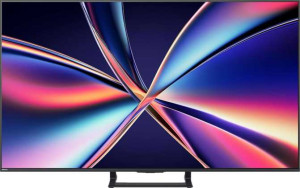
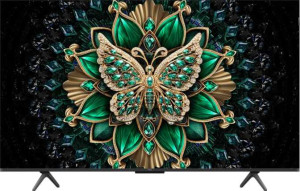
Both TVs share a strong foundation: 4K (3840 x 2160) resolution, 144Hz refresh rate, 10-bit color depth rendering 1.07 billion colors, full HDR format support (HDR10, HDR10+, Dolby Vision, HLG), anti-reflection coating, and an ambient light sensor. These shared traits mean neither has an edge in motion clarity, color volume, or HDR versatility — they are evenly matched on those fronts.
The meaningful differences emerge in panel technology, brightness, and contrast. The TCL 98C6K adds a QLED layer on top of its Mini-LED backlight, which enhances color saturation and peak luminance — reflected directly in its 1000 nits typical brightness versus the Hisense's 500 nits. More strikingly, the TCL's 5000:1 contrast ratio dwarfs the Hisense's 1200:1, meaning blacks appear significantly deeper and highlights more punchy — a night-and-day difference in dark room viewing. The Hisense 75E8Q, while a capable Mini-LED panel, lacks the quantum dot enhancement and trails noticeably in both HDR headroom and dark-scene performance.
The tradeoff is sharpness-per-inch: the Hisense's smaller 75″ screen yields a 59 ppi pixel density, compared to just 45 ppi on the TCL's massive 97.5″ panel. Up close, the Hisense will look crisper, but at typical living-room viewing distances the TCL's lower pixel density is unlikely to be noticeable. Overall, the TCL 98C6K holds a clear display advantage — its dramatically higher contrast ratio and brightness make it the stronger performer for HDR content, bright rooms, and cinematic impact, while the size difference alone makes it a fundamentally different category of screen.