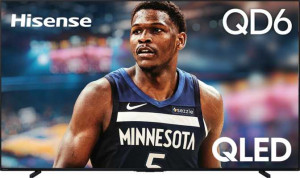
Hisense 75QD6QF 75"
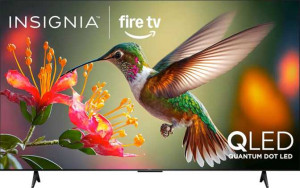
Insignia NS75-UQFL26 75"

Hisense 75QD6QF 75" Insignia NS75-UQFL26 75"

Overview

Choosing between the Hisense 75QD6QF 75″ and the Insignia NS75-UQFL26 75″ is no small task — both are large-screen 4K QLED televisions sharing a remarkably similar foundation. Yet beneath that common ground lie meaningful distinctions, particularly around refresh rate and gaming capabilities, HDR format support, and smart platform integration. This comparison breaks down every key specification to help you determine which 75-inch TV is the right fit for your living room.

Common Features

  • Both TVs have a 4K (UHD) display resolution.
  • Both TVs use a QLED, LED-backlit, LCD display type.
  • Both TVs have a screen size of 74.5″.
  • Both TVs have a resolution of 3840 x 2160 px.
  • Both TVs have a pixel density of 59 ppi.
  • Both TVs support 1070 million display colors.
  • Both TVs have a 10-bit bit depth.
  • HDR10 support is available on both TVs.
  • Bluetooth is available on both TVs.
  • Both TVs have 4 HDMI ports.
  • Wi-Fi support is available on both TVs.
  • Both TVs have Bluetooth version 5.
  • Both TVs have 1 RJ45 port.
  • Miracast support is available on both TVs.
  • A 3.5 mm audio jack socket is present on both TVs.
  • Neither TV has an external memory slot.
  • Both TVs support Dolby Digital.
  • Both TVs have an audio output power of 2 x 15W.
  • Both TVs support Digital Out.
  • Both TVs support Dolby Digital Plus.
  • SRS TheaterSound HD is not available on either TV.
  • Both TVs have stereo speakers.
  • Dolby Atmos is available on both TVs.
  • Dolby Audio is available on both TVs.
  • Both TVs support VESA mounting.
  • AirPlay is available on both TVs.
  • Both TVs have a built-in smart TV platform.
  • Both TVs work with Alexa.
  • Neither TV works with Siri or Apple HomeKit.
  • Remote smartphone control is supported on both TVs.
  • Neither TV has a rechargeable remote control.
  • USB recording is supported on both TVs.
  • Both TVs have a standby power consumption of 0.5W.

Main Differences

  • The refresh rate is 144Hz on Hisense 75QD6QF 75″ and 60Hz on Insignia NS75-UQFL26 75″.
  • HDR10+ support is present on Hisense 75QD6QF 75″ but not available on Insignia NS75-UQFL26 75″.
  • Adaptive synchronization via AMD FreeSync and AMD FreeSync Premium is available on Hisense 75QD6QF 75″, while no adaptive synchronization is present on Insignia NS75-UQFL26 75″.
  • Google Assistant compatibility is present on Hisense 75QD6QF 75″ but not available on Insignia NS75-UQFL26 75″.
  • The number of USB ports is 2 on Hisense 75QD6QF 75″ and 1 on Insignia NS75-UQFL26 75″.
  • The width is 1676.4 mm on Hisense 75QD6QF 75″ and 1666.2 mm on Insignia NS75-UQFL26 75″.
  • The weight is 18824 g on Hisense 75QD6QF 75″ and 18189 g on Insignia NS75-UQFL26 75″.
  • The thickness is 78.7 mm on Hisense 75QD6QF 75″ and 73.7 mm on Insignia NS75-UQFL26 75″.
  • The height is 965.2 mm on Hisense 75QD6QF 75″ and 960.1 mm on Insignia NS75-UQFL26 75″.
  • The volume is 127341.422736 cm³ on Hisense 75QD6QF 75″ and 117899.262294 cm³ on Insignia NS75-UQFL26 75″.
Specs Comparison
Hisense 75QD6QF 75"

Hisense 75QD6QF 75"

Insignia NS75-UQFL26 75"

Insignia NS75-UQFL26 75"

Display:
display resolution 4K (UHD) 4K (UHD)
Display type QLED, LED-backlit, LCD QLED, LED-backlit, LCD
screen size 74.5" 74.5"
resolution 3840 x 2160 px 3840 x 2160 px
pixel density 59 ppi 59 ppi
display colors 1070 million 1070 million
bit depth 10-bit 10-bit
refresh rate 144Hz 60Hz
supports HDR10
supports HDR10+
supports Dolby Vision
supports HLG
Adaptive synchronization AMD FreeSync, AMD FreeSync Premium None
has anti-reflection coating
has an ambient light sensor
maximum horizontal viewing angle 178º 178º
maximum vertical viewing angle 178º 178º

Both the Hisense 75QD6QF and the Insignia NS75-UQFL26 share a strong display foundation: identical QLED, LED-backlit LCD panels at 74.5″, native 4K (3840 x 2160) resolution, 10-bit color depth rendering over 1 billion colors, and wide 178° viewing angles both horizontally and vertically. Both also include anti-reflection coating and an ambient light sensor, meaning neither has an edge in panel construction, color volume, or everyday usability features.

The most meaningful divergence is in motion and HDR capability. The Hisense runs at a native 144Hz refresh rate versus the Insignia's 60Hz — a significant real-world difference for fast-moving content like sports or action films, where higher refresh rates reduce motion blur and judder. Paired with AMD FreeSync Premium adaptive sync support, the Hisense is also notably more capable as a gaming display, eliminating screen tearing when connected to a compatible PC or console. The Insignia offers no adaptive sync at all. On the HDR side, the Hisense adds HDR10+ support on top of the shared HDR10, Dolby Vision, and HLG coverage — HDR10+ uses dynamic metadata (similar to Dolby Vision) to optimize brightness scene-by-scene, which can improve highlight detail on compatible content.

The Hisense 75QD6QF holds a clear display advantage. Its higher refresh rate and adaptive sync make it a substantially better choice for gaming and smooth motion performance, and HDR10+ extends its compatibility with premium streaming content. The Insignia matches it on core image quality specs but falls behind on every performance-oriented differentiator in this group.
Connectivity:
Has Bluetooth
HDMI ports 4 4
supports Wi-Fi
Wi-Fi version Wi-Fi 4 (802.11n), Wi-Fi 5 (802.11ac) Wi-Fi 5 (802.11ac), Wi-Fi 4 (802.11n)
Bluetooth version 5 5
USB ports 2 1
RJ45 ports 1 1
supports Miracast
has a socket for a 3.5 mm audio jack
has an external memory slot
has a VGA connector
has a DVI connector

Wireless connectivity is essentially a draw between these two TVs. Both carry Bluetooth 5.0 and dual-band Wi-Fi covering Wi-Fi 4 and Wi-Fi 5 (802.11ac), which is sufficient for stable 4K streaming and responsive smart TV operation. Miracast screen mirroring is present on both as well, so casting from a mobile device is equally supported on either set.

Where the Hisense pulls ahead is in wired peripheral flexibility. It offers 2 USB ports compared to just 1 on the Insignia — a practical difference if you plan to connect multiple devices simultaneously, such as a USB drive for local media playback alongside a USB-powered accessory. Both models share the same 4 HDMI ports and a single RJ45 ethernet port, so source device capacity and wired network options are identical.

Overall, the Hisense 75QD6QF holds a narrow edge in connectivity, solely due to its extra USB port. For users with multiple USB peripherals or those who frequently play back local content while keeping other devices connected, that additional port adds tangible convenience. For everyone else, the two TVs are functionally equivalent in this category.

Audio:
supports Dolby Digital
audio output power 2 x 15W 2 x 15W
supports Digital Out
supports Dolby Digital Plus
has SRS TheaterSound HD
has stereo speakers
has Dolby Atmos
has Dolby Audio
supports Dolby Virtual
has a subwoofer
HDMI ARC / eARC HDMI ARC, HDMI eARC HDMI ARC, HDMI eARC

Audio is a rare category where these two TVs are in complete lockstep — every single specified feature is identical. Both deliver 2 x 15W stereo output with no subwoofer, which is a fairly typical configuration for large-screen TVs at this tier and adequate for casual viewing, though it won't replace a dedicated soundbar in a larger room.

On the format side, both support the full Dolby audio stack: Dolby Digital, Dolby Digital Plus, Dolby Atmos, and Dolby Audio. Dolby Atmos is worth highlighting — it enables object-based spatial audio on compatible streaming content, which can noticeably enhance immersion even through the TV's built-in speakers. Critically, both also include HDMI ARC and eARC, meaning either TV can pass high-bandwidth audio formats like lossless Atmos to an external soundbar or AV receiver through a single HDMI cable — an important feature for anyone planning a sound system upgrade.

This group is an unambiguous tie. There is no audio specification in the provided data that distinguishes the Hisense 75QD6QF from the Insignia NS75-UQFL26 in any way, so audio performance should not factor into a decision between these two models.

Design:
width 1676.4 mm 1666.2 mm
weight 18824 g 18189 g
thickness 78.7 mm 73.7 mm
height 965.2 mm 960.1 mm
volume 127341.422736 cm³ 117899.262294 cm³
Supports VESA mount

For a 75-inch class TV, the physical differences here are modest but real. The Insignia NS75-UQFL26 is marginally slimmer at 73.7 mm deep versus the Hisense's 78.7 mm, and slightly more compact overall in both width and height. Neither difference is dramatic enough to matter in most living room setups, but the Insignia's reduced depth could be a minor advantage in tighter wall-mount or entertainment unit configurations.

Weight is where the gap is a bit more tangible. The Insignia comes in at 18,189 g compared to the Hisense's 18,824 g — a difference of roughly 635 g. In practical terms, this matters most during installation: a lighter panel is marginally easier to maneuver and wall-mount solo, though at this size both TVs really warrant a two-person install regardless. Both support VESA mounting, so neither has an advantage on compatibility with standard wall brackets.

The Insignia holds a slight edge in design purely on physical footprint and weight — it is consistently the more compact and lighter of the two across every measured dimension. However, the margins are small enough that for most buyers, installation space constraints or personal preference in stand design would be more decisive factors than these numbers alone.

Features:
release date April 2025 February 2025
has AirPlay
has built-in smart TV
compatible with Google Assistant
works with Alexa
works with Siri/Apple HomeKit
supports a remote smartphone
has a rechargeable remote control
supports USB recording
standby power consumption 0.5W 0.5W
has a search browser
has a sleep timer
has a child lock
warranty period 1 years 1 years
has voice commands

The feature sets of these two TVs are nearly identical across the board — both are full smart TVs with AirPlay, Alexa voice control, smartphone remote support, USB recording, and a matched 1-year warranty. The one meaningful distinction is voice assistant breadth: the Hisense 75QD6QF also supports Google Assistant, while the Insignia does not. For households already embedded in the Google ecosystem — using Google Home devices, Android phones, or Chromecast — this adds a genuinely useful layer of integration, allowing voice control over smart home devices, calendar lookups, and other Assistant-native functions directly from the TV.

Everything else is a practical tie. Neither TV includes a rechargeable remote, both share an identical 0.5W standby consumption, and utility features like sleep timer and child lock are present on both. The absence of Siri/Apple HomeKit on either model means Apple-centric smart home users would need to rely on AirPlay for content mirroring but won't get deeper HomeKit device integration from either set.

The Hisense holds a narrow edge here, purely on the strength of its added Google Assistant compatibility. It's not a transformative advantage, but for users who rely on Google's ecosystem daily, it represents a real quality-of-life benefit that the Insignia simply cannot match.

Comparison Summary & Verdict

Both the Hisense 75QD6QF 75″ and the Insignia NS75-UQFL26 75″ deliver a well-rounded 4K QLED experience, sharing strong fundamentals such as Dolby Atmos audio, four HDMI ports, 10-bit color depth, AirPlay, and Alexa compatibility. The differences, however, clearly point each model toward a distinct audience. The Hisense 75QD6QF 75″ is the stronger pick for gamers and demanding home theater enthusiasts, thanks to its 144Hz refresh rate, HDR10+ support, and AMD FreeSync Premium adaptive sync — features entirely absent on the Insignia. It also gains an edge with Google Assistant integration and a second USB port. The Insignia NS75-UQFL26 75″, on the other hand, suits everyday viewers who have no need for advanced gaming or premium HDR features, and who may appreciate its slightly slimmer profile and lighter build for a clean, no-frills 4K viewing experience.

Hisense 75QD6QF 75
Buy Hisense 75QD6QF 75" if...

Buy the Hisense 75QD6QF 75″ if you prioritize gaming performance or premium HDR, as its 144Hz refresh rate, HDR10+ support, and AMD FreeSync Premium set it clearly apart from the competition.

Insignia NS75-UQFL26 75
Buy Insignia NS75-UQFL26 75" if...

Choose the Insignia NS75-UQFL26 75″ if you want a straightforward 4K QLED experience for everyday viewing without advanced gaming features, and prefer a slightly slimmer and lighter design.