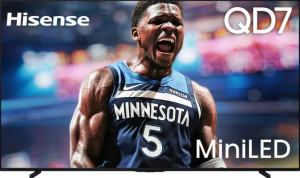
Hisense 75QD7QF 75"
Hisense 75U65QF 75"

Hisense 75QD7QF 75" Hisense 75U65QF 75"

Overview

Welcome to this detailed spec comparison between the Hisense 75QD7QF 75″ and the Hisense 75U65QF 75″. Both are 75-inch 4K Mini-LED televisions sharing a striking amount of common ground, yet they diverge in ways that could meaningfully influence your buying decision. From display technology and wireless connectivity to audio hardware, this side-by-side breakdown will help you identify which model best suits your home entertainment needs.

Common Features

  • Both TVs have a 4K (UHD) display resolution.
  • Both TVs have a screen size of 74.5″.
  • Both TVs have a resolution of 3840 x 2160 px.
  • Both TVs have a pixel density of 59 ppi.
  • Both TVs support 1070 million display colors.
  • Both TVs have a 10-bit bit depth.
  • Both TVs have a 144Hz refresh rate.
  • HDR10 support is available on both TVs.
  • Both TVs use LED-backlit, LCD, Mini-LED panel technology.
  • Bluetooth is available on both TVs.
  • Both TVs have an HDMI version of 2.1.
  • Both TVs have 4 HDMI ports.
  • Wi-Fi support is available on both TVs.
  • Both TVs have 2 USB ports and 1 RJ45 port.
  • Miracast support is available on both TVs.
  • A 3.5 mm audio jack socket is present on both TVs.
  • Dolby Atmos and Dolby Audio support are available on both TVs.
  • Dolby Digital and Dolby Digital Plus support are available on both TVs.
  • Both TVs have stereo speakers.
  • SRS TheaterSound HD is not available on either TV.
  • Dolby Virtual support is not available on either TV.
  • Both TVs share the same physical dimensions: 1668.8 mm wide, 960.1 mm tall, and 76.2 mm thick.
  • Both TVs weigh 29484 g.
  • VESA mount support is available on both TVs.
  • Both TVs operate within the same temperature range of 5 °C to 35 °C.
  • AirPlay support is available on both TVs.
  • A built-in smart TV platform is present on both TVs.
  • Google Assistant compatibility is available on both TVs.
  • Alexa compatibility is available on both TVs.
  • Siri and Apple HomeKit compatibility is not available on either TV.
  • Remote smartphone control is supported on both TVs.
  • Neither TV has a rechargeable remote control.
  • USB recording is supported on both TVs.

Main Differences

  • The display type is QLED, LED-backlit, LCD, Mini-LED on Hisense 75QD7QF 75″ and LED-backlit, LCD, Mini-LED on Hisense 75U65QF 75″.
  • Wi-Fi 6 (802.11ax) support is present on Hisense 75U65QF 75″ but not available on Hisense 75QD7QF 75″, which supports Wi-Fi 4 and Wi-Fi 5 only.
  • The Bluetooth version is 5.2 on Hisense 75U65QF 75″ and 5 on Hisense 75QD7QF 75″.
  • A subwoofer is included on Hisense 75U65QF 75″ but is not present on Hisense 75QD7QF 75″.
Specs Comparison
Hisense 75QD7QF 75"

Hisense 75QD7QF 75"

Hisense 75U65QF 75"

Hisense 75U65QF 75"

Display:
display resolution 4K (UHD) 4K (UHD)
Display type QLED, LED-backlit, LCD, Mini-LED LED-backlit, LCD, Mini-LED
screen size 74.5" 74.5"
resolution 3840 x 2160 px 3840 x 2160 px
pixel density 59 ppi 59 ppi
display colors 1070 million 1070 million
bit depth 10-bit 10-bit
refresh rate 144Hz 144Hz
supports HDR10
supports HDR10+
supports Dolby Vision
supports HLG
Adaptive synchronization AMD FreeSync, AMD FreeSync Premium AMD FreeSync, AMD FreeSync Premium
has anti-reflection coating
has an ambient light sensor
maximum horizontal viewing angle 178º 178º
maximum vertical viewing angle 178º 178º

The Hisense 75QD7QF and Hisense 75U65QF share a remarkably similar display foundation: both are 74.5″ 4K (3840 x 2160) panels with a 59 ppi pixel density, 10-bit color depth, 1070 million colors, and a 144Hz refresh rate. Both support the full suite of HDR formats — HDR10, HDR10+, Dolby Vision, and HLG — and both include AMD FreeSync Premium for adaptive sync, anti-reflection coating, an ambient light sensor, and wide 178°/178° viewing angles. In practice, this means the everyday viewing experience — sharpness, motion fluidity, HDR versatility, and off-axis performance — is essentially identical between the two.

The one meaningful differentiator is the display technology classification. The QD7QF is listed as QLED, LED-backlit, LCD, Mini-LED, while the U65QF is simply LED-backlit, LCD, Mini-LED. The addition of QLED (Quantum Dot) on the QD7QF means its LED backlight passes through a quantum dot filter, which typically expands the color gamut and boosts color volume — resulting in more saturated, accurate colors, especially in bright HDR scenes. Both panels share the same 10-bit depth and 1.07 billion color count on paper, but Quantum Dot technology generally allows those colors to be rendered with greater peak brightness and saturation in real-world conditions.

Overall, the QD7QF holds a display edge strictly based on the provided specs, thanks to its Quantum Dot layer. For users who prioritize color richness and HDR vibrancy, this distinction is relevant. However, given how closely matched every other display parameter is, the practical difference may be subtle depending on content and viewing conditions.

Connectivity:
Has Bluetooth
HDMI version HDMI 2.1 HDMI 2.1
HDMI ports 4 4
supports Wi-Fi
Wi-Fi version Wi-Fi 4 (802.11n), Wi-Fi 5 (802.11ac) Wi-Fi 4 (802.11n), Wi-Fi 5 (802.11ac), Wi-Fi 6 (802.11ax)
Bluetooth version 5 5.2
USB ports 2 2
RJ45 ports 1 1
supports Miracast
has a socket for a 3.5 mm audio jack
has an external memory slot
has a VGA connector
has a DVI connector

Across most connectivity specs, these two TVs are identical: both offer 4x HDMI 2.1 ports, 2x USB ports, an RJ45 ethernet port, Miracast wireless casting, a 3.5mm audio jack, and Wi-Fi with support for both Wi-Fi 4 and Wi-Fi 5. HDMI 2.1 is particularly noteworthy at this screen size, as it supports 4K at 120Hz with full bandwidth — relevant for next-gen gaming consoles and high-frame-rate sources.

Two specs separate them, and both favor the U65QF. First, it adds Wi-Fi 6 (802.11ax) to its wireless stack, whereas the QD7QF tops out at Wi-Fi 5. Wi-Fi 6 delivers meaningfully better performance in congested network environments — higher throughput, lower latency, and improved efficiency when multiple devices share the same router. For a living room with many connected devices, this is a practical advantage. Second, the U65QF features Bluetooth 5.2 versus Bluetooth 5.0 on the QD7QF. Version 5.2 introduces features like LE Audio and improved connection stability, which can matter for wireless headphones or soundbars that support the newer standard.

On connectivity, the U65QF has a clear edge. While neither upgrade is transformative on its own, Wi-Fi 6 support in particular is a future-facing advantage that can make a noticeable difference in real-world network performance — especially as home networks grow more crowded.

Audio:
supports Dolby Digital
supports Digital Out
supports Dolby Digital Plus
has SRS TheaterSound HD
has stereo speakers
has Dolby Atmos
has Dolby Audio
supports Dolby Virtual
has a subwoofer
has DTS:X
HDMI ARC / eARC HDMI ARC, HDMI eARC HDMI ARC, HDMI eARC

From a format support standpoint, both TVs are identically equipped: Dolby Atmos, Dolby Audio, Dolby Digital Plus, DTS:X, and both HDMI ARC and eARC are present on each model. This is a strong shared baseline — eARC in particular enables lossless audio passthrough to a soundbar or AV receiver, and Dolby Atmos plus DTS:X cover the two dominant object-based surround formats for streaming and physical media.

The sole differentiator is that the U65QF includes a built-in subwoofer, while the QD7QF does not. In practice, a dedicated subwoofer handles low-frequency reproduction that stereo TV speakers typically struggle with — adding weight and impact to explosions, music bass lines, and cinematic soundscapes. For viewers who plan to use the TV's internal speakers without an external audio system, this is a tangible advantage in perceived audio depth and fullness.

On audio, the U65QF holds the edge — not because of format support, where both are equally capable, but because the built-in subwoofer offers a richer out-of-the-box listening experience. Users who intend to pair either TV with an external soundbar or receiver will find this distinction largely irrelevant, but for standalone use, the U65QF delivers more complete audio hardware.

Design:
width 1668.8 mm 1668.8 mm
weight 29484 g 29484 g
thickness 76.2 mm 76.2 mm
height 960.1 mm 960.1 mm
volume 122088.773856 cm³ 122088.773856 cm³
Supports VESA mount
maximum operating temperature 35 °C 35 °C
lowest potential operating temperature 5 °C 5 °C

When it comes to design and physical footprint, these two TVs are indistinguishable on paper. Every measured dimension — 1668.8 mm wide, 960.1 mm tall, 76.2 mm thick — is identical, as is the weight at 29,484 g (approximately 29.5 kg). This means installation planning, furniture sizing, and wall-clearance requirements are exactly the same for both models.

Both also support VESA mounting and share the same operating temperature range of 5 °C to 35 °C, so neither has an advantage in terms of placement flexibility or environmental tolerance. At 76.2 mm of depth, the profile is typical for a Mini-LED panel of this size, and the ~29.5 kg weight is standard for a 75-inch TV — manageable with two people for wall mounting or stand placement.

This group is a complete tie. There is no basis in the provided specs to differentiate the two models by design or physical form factor — buyers can make their decision entirely on other criteria without any design trade-offs to consider.

Features:
release date April 2025 April 2025
has AirPlay
has built-in smart TV
compatible with Google Assistant
works with Alexa
works with Siri/Apple HomeKit
supports a remote smartphone
has a rechargeable remote control
supports USB recording
standby power consumption 0.5W 0.5W
has a search browser
has a sleep timer
has a child lock
warranty period 1 years 1 years
has voice commands

Feature parity is total here. Both the QD7QF and the U65QF offer the same smart TV ecosystem: AirPlay, Google Assistant, and Alexa are all present, enabling broad compatibility with Apple, Google, and Amazon smart home setups alike. Neither supports Siri/Apple HomeKit directly, which is a shared limitation worth noting for users deeply embedded in the Apple ecosystem. Smartphone remote control, USB recording, voice commands, and a built-in browser round out an identical feature set.

Practical conveniences like the sleep timer, child lock, and a lean 0.5W standby power consumption are also matched across both models. The 0.5W standby figure is notably efficient — over a year of typical standby use, the difference between this and a less efficient TV can add up on an energy bill. Both carry a 1-year warranty, so post-purchase coverage is equal as well.

With every single feature spec shared between them, this group is an unambiguous tie. No feature gives either model a meaningful advantage, and buyers can set this category aside entirely when weighing their decision.

Comparison Summary & Verdict

Both the Hisense 75QD7QF 75″ and the Hisense 75U65QF 75″ deliver a strong shared foundation: a 144Hz 4K Mini-LED panel, four HDMI 2.1 ports, Dolby Atmos, and a full smart TV experience with AirPlay, Google Assistant, and Alexa. The key distinctions lie in a few targeted areas. The Hisense 75QD7QF 75″ adds a QLED layer to its display, which may appeal to viewers who prioritize color volume and vibrancy. On the other hand, the Hisense 75U65QF 75″ counters with Wi-Fi 6 connectivity, a newer Bluetooth 5.2 radio, and a built-in subwoofer for richer out-of-the-box audio. If picture quality enhancement and display technology are your top priorities, the QD7QF is the stronger pick. If you want future-proof wireless performance and a more complete audio setup without external speakers, the U65QF has the edge.

Hisense 75QD7QF 75
Buy Hisense 75QD7QF 75" if...

Buy the Hisense 75QD7QF 75″ if you prioritize an enhanced color experience through QLED display technology on top of the Mini-LED panel.

Hisense 75U65QF 75
Buy Hisense 75U65QF 75" if...

Buy the Hisense 75U65QF 75″ if you want faster Wi-Fi 6 connectivity, a more modern Bluetooth 5.2 radio, and a built-in subwoofer for richer audio right out of the box.