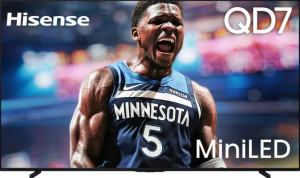
Hisense 75QD7QF 75"
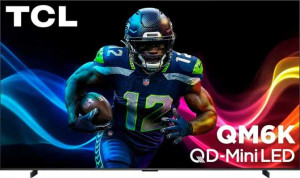
TCL 75QM6K 75"

Hisense 75QD7QF 75" TCL 75QM6K 75"

Overview

Welcome to our in-depth spec comparison of the Hisense 75QD7QF 75″ and the TCL 75QM6K 75″, two 75-inch Mini-LED QLED televisions that share a strong technical foundation yet differ in meaningful ways. Both deliver a stunning 4K 144Hz panel, but the battlegrounds emerge around adaptive sync capabilities, audio hardware, smart platform ecosystems, and physical design — making the choice between them less obvious than it first appears.

Common Features

  • Both TVs have a 4K (UHD) display resolution.
  • Both TVs use a QLED, LED-backlit, LCD, Mini-LED display type.
  • Both TVs have a screen size of 74.5″.
  • Both TVs have a resolution of 3840 x 2160 px.
  • Both TVs have a pixel density of 59 ppi.
  • Both TVs support 1070 million display colors.
  • Both TVs have a 10-bit color depth.
  • Both TVs have a 144Hz refresh rate.
  • Both TVs include Bluetooth connectivity.
  • Both TVs have HDMI 2.1 ports, with 4 ports total.
  • Both TVs support Wi-Fi 4 (802.11n) and Wi-Fi 5 (802.11ac).
  • Both TVs have 2 USB ports and 1 RJ45 port.
  • Miracast is supported on both TVs.
  • Dolby Atmos and Dolby Audio are available on both TVs.
  • Dolby Digital and Dolby Digital Plus support is present on both TVs.
  • Both TVs feature stereo speakers.
  • Dolby Virtual support is not available on either TV.
  • SRS TheaterSound HD is not available on either TV.
  • Both TVs support AirPlay and have a built-in smart TV platform.
  • Google Assistant compatibility is present on both TVs.
  • Apple HomeKit and Siri compatibility is not available on either TV.
  • Both TVs support remote smartphone control and USB recording.
  • Both TVs have a standby power consumption of 0.5W.
  • Both TVs share the same height of 960.1 mm and support VESA mounting.
  • The operating temperature range is identical on both TVs, from 5°C to 35°C.

Main Differences

  • Adaptive sync support includes AMD FreeSync Premium Pro on the TCL 75QM6K 75″, while the Hisense 75QD7QF 75″ only supports AMD FreeSync and AMD FreeSync Premium.
  • Bluetooth version is 5.4 on the TCL 75QM6K 75″ and 5 on the Hisense 75QD7QF 75″.
  • A 3.5mm audio jack is present on the Hisense 75QD7QF 75″ but not available on the TCL 75QM6K 75″.
  • A built-in subwoofer is included on the TCL 75QM6K 75″ but not present on the Hisense 75QD7QF 75″.
  • Width is 1668.8 mm on the Hisense 75QD7QF 75″ and 1671.3 mm on the TCL 75QM6K 75″.
  • Weight is 29484 g on the Hisense 75QD7QF 75″ and 26218 g on the TCL 75QM6K 75″, making the TCL lighter.
  • Thickness is 76.2 mm on the Hisense 75QD7QF 75″ and 55.9 mm on the TCL 75QM6K 75″, making the TCL slimmer.
  • Volume is 122088.77 cm³ on the Hisense 75QD7QF 75″ and 89697.99 cm³ on the TCL 75QM6K 75″.
  • Amazon Alexa compatibility is present on the Hisense 75QD7QF 75″ but not available on the TCL 75QM6K 75″.
Specs Comparison
Hisense 75QD7QF 75"

Hisense 75QD7QF 75"

TCL 75QM6K 75"

TCL 75QM6K 75"

Display:
display resolution 4K (UHD) 4K (UHD)
Display type QLED, LED-backlit, LCD, Mini-LED QLED, LED-backlit, LCD, Mini-LED
screen size 74.5" 74.5"
resolution 3840 x 2160 px 3840 x 2160 px
pixel density 59 ppi 59 ppi
display colors 1070 million 1070 million
bit depth 10-bit 10-bit
refresh rate 144Hz 144Hz
supports HDR10
supports HDR10+
supports Dolby Vision
supports HLG
Adaptive synchronization AMD FreeSync, AMD FreeSync Premium AMD FreeSync, AMD FreeSync Premium, AMD FreeSync Premium Pro
has anti-reflection coating
has an ambient light sensor
maximum horizontal viewing angle 178º 178º
maximum vertical viewing angle 178º 178º

In terms of display fundamentals, the Hisense 75QD7QF and TCL 75QM6K are virtually identical. Both are 74.5″ QLED Mini-LED LCD panels running at a native 4K (3840 x 2160) resolution with a 59 ppi pixel density, a 10-bit color pipeline capable of rendering 1.07 billion colors, and a 144Hz refresh rate. Full HDR format coverage — HDR10, HDR10+, Dolby Vision, and HLG — is present on both, meaning neither TV will be caught off-guard by streaming, disc, or broadcast content. Wide 178° viewing angles in both axes, anti-reflection coatings, and ambient light sensors round out a feature set that is, in these respects, a complete tie.

The sole differentiator in this category is adaptive sync support. The Hisense covers AMD FreeSync and FreeSync Premium, while the TCL adds AMD FreeSync Premium Pro on top of those two tiers. FreeSync Premium Pro layers in Low Framerate Compensation (LFC) alongside HDR support within the variable refresh rate window — a meaningful upgrade for gamers who connect a compatible GPU and want tear-free, HDR-accurate gameplay even when frame rates dip below the panel's minimum sync threshold.

For non-gamers or console users, this distinction is irrelevant and the two TVs are evenly matched on display specs. For PC gamers with an AMD GPU seeking the most complete variable refresh rate experience — particularly under HDR — the TCL 75QM6K holds a narrow but genuine edge in this group, solely by virtue of its FreeSync Premium Pro certification.
Connectivity:
Has Bluetooth
HDMI version HDMI 2.1 HDMI 2.1
HDMI ports 4 4
supports Wi-Fi
Wi-Fi version Wi-Fi 4 (802.11n), Wi-Fi 5 (802.11ac) Wi-Fi 4 (802.11n), Wi-Fi 5 (802.11ac)
Bluetooth version 5 5.4
USB ports 2 2
RJ45 ports 1 1
supports Miracast
has a socket for a 3.5 mm audio jack
has an external memory slot
has a VGA connector
has a DVI connector

The wired connectivity lineup is a clean tie: both TVs offer 4x HDMI 2.1 ports, 2x USB, and a dedicated RJ45 ethernet jack. Four HDMI 2.1 ports is a generous allocation — enough to run a console, soundbar, streaming stick, and PC simultaneously without ever swapping cables, and the 2.1 standard ensures full bandwidth for 4K/144Hz sources. Wireless is equally matched, with both supporting Wi-Fi 5 (802.11ac) and Bluetooth 5 as their baseline.

Two differences are worth calling out. On Bluetooth, the TCL carries version 5.4 versus the Hisense's 5.0. The newer revision brings improvements to connection reliability and power efficiency, which matters most for peripherals like wireless headphones or keyboards kept paired long-term — a modest but real advantage. On the analog side, the situation flips: the Hisense includes a 3.5mm headphone jack while the TCL omits it entirely. For users who rely on wired headphones or need a direct analog audio output for a secondary device, this absence on the TCL is a genuine limitation.

Neither TV holds a sweeping advantage here, but the trade-off is clear. The TCL 75QM6K edges ahead on Bluetooth modernity, while the Hisense 75QD7QF is the better pick for anyone who needs a headphone jack. Users who prioritize wireless peripheral performance lean toward the TCL; those wanting flexible analog audio output should favor the Hisense.

Audio:
supports Dolby Digital
supports Digital Out
supports Dolby Digital Plus
has SRS TheaterSound HD
has stereo speakers
has Dolby Atmos
has Dolby Audio
supports Dolby Virtual
has a subwoofer
has DTS:X
HDMI ARC / eARC HDMI ARC, HDMI eARC HDMI ARC, HDMI eARC

Audio format support is a complete match between these two TVs. Both decode Dolby Atmos, Dolby Audio, Dolby Digital Plus, and DTS:X, and both output via HDMI ARC and eARC — meaning either set can pass high-quality audio to a compatible soundbar or AV receiver without any format compromises. For users routing audio externally, this parity is all that matters.

Where the two diverge is in built-in speaker hardware. The TCL 75QM6K includes a built-in subwoofer alongside its stereo speakers, while the Hisense 75QD7QF relies on stereo speakers alone. A dedicated subwoofer handles low-frequency reproduction — bass in music, rumble in action scenes, weight in dialogue-heavy drama — that stereo drivers in a slim TV chassis typically struggle to reproduce convincingly. For viewers watching without an external sound system, this is a tangible difference in out-of-the-box audio depth.

The TCL 75QM6K holds a clear edge in this group for anyone who plans to use the TV's internal speakers as their primary audio source. The Hisense is fully competitive on format decoding and external audio output, but if living-room audio without a soundbar matters, the TCL's subwoofer integration gives it a meaningful structural advantage.

Design:
width 1668.8 mm 1671.3 mm
weight 29484 g 26218 g
thickness 76.2 mm 55.9 mm
height 960.1 mm 960.1 mm
volume 122088.773856 cm³ 89697.985767 cm³
Supports VESA mount
maximum operating temperature 35 °C 35 °C
lowest potential operating temperature 5 °C 5 °C

At 75 inches, both TVs occupy nearly identical footprints — width and height are within 2.5mm of each other — so shelf or wall space requirements are effectively the same. The divergence shows up in depth and mass. The TCL 75QM6K measures 55.9mm thick against the Hisense 75QD7QF's 76.2mm, a difference of over 20mm that is clearly noticeable when mounted flush to a wall or placed on a stand against a surface. The TCL's slimmer profile translates to a substantially smaller overall volume — roughly 89,700 cm³ versus the Hisense's 122,100 cm³ — making it the more visually unobtrusive option in a room.

Weight compounds this distinction. The Hisense tips the scales at 29,484g (~29.5kg) while the TCL comes in at 26,218g (~26.2kg) — a gap of roughly 3.3kg. For a single person handling installation, that difference is felt immediately, and it can influence the hardware requirements for wall mounting. Both TVs support VESA mounting and share identical operating temperature ranges, so neither holds any advantage on those fronts.

On design and physical form, the TCL 75QM6K has a clear edge — it is meaningfully thinner, lighter, and more compact despite being dimensionally the same size. For wall-mount installations where depth matters aesthetically, or for anyone managing the setup with limited help, the TCL is the more practical choice in this category.

Features:
release date April 2025 March 2025
has AirPlay
has built-in smart TV
compatible with Google Assistant
works with Alexa
works with Siri/Apple HomeKit
supports a remote smartphone
has a rechargeable remote control
supports USB recording
standby power consumption 0.5W 0.5W
has a search browser
has a sleep timer
has a child lock
warranty period 1 years 1 years
has voice commands

Smart platform capabilities are broadly aligned across both TVs. Built-in smart TV functionality, AirPlay, Google Assistant, voice commands, smartphone remote support, USB recording, and a standard 1-year warranty are all shared features — a solid, modern baseline that covers the most common smart home and usability expectations.

The single differentiator in this group is voice assistant breadth. The Hisense 75QD7QF supports Amazon Alexa in addition to Google Assistant, while the TCL 75QM6K supports Google Assistant only. For households already invested in the Alexa ecosystem — smart lights, plugs, routines, and other Alexa-compatible devices — the Hisense can act as a voice hub directly from the TV without a separate Echo device. Notably, neither TV supports Siri or Apple HomeKit, so Apple-centric smart home users will find the same limitation on both.

This is a narrow but practical distinction. The Hisense 75QD7QF holds a modest edge here, purely because its dual assistant support makes it more flexible across mixed smart home ecosystems. For households running exclusively on Google Assistant or without any dedicated smart home setup, the gap is irrelevant and the two TVs are functionally equivalent in this category.

Comparison Summary & Verdict

After a thorough side-by-side analysis, both TVs prove to be highly capable 75-inch Mini-LED QLED displays with identical 4K resolution, 144Hz refresh rates, and a rich shared feature set. The key differentiators come down to use-case priorities. The Hisense 75QD7QF 75″ stands out with its Amazon Alexa compatibility, a 3.5mm audio jack for wired headphones, and a slimmer ecosystem of gaming sync options — but it is heavier and bulkier. The TCL 75QM6K 75″ pulls ahead for dedicated gamers thanks to AMD FreeSync Premium Pro support, and it wins on audio immersion with a built-in subwoofer and newer Bluetooth 5.4. It is also notably lighter and slimmer. Choose the Hisense if your smart home revolves around Alexa or you need a headphone jack; choose the TCL if gaming performance and richer sound matter most.

Hisense 75QD7QF 75
Buy Hisense 75QD7QF 75" if...

Buy the Hisense 75QD7QF 75″ if your smart home setup relies on Amazon Alexa or you need a 3.5mm audio jack for wired headphones.

TCL 75QM6K 75
Buy TCL 75QM6K 75" if...

Buy the TCL 75QM6K 75″ if you want AMD FreeSync Premium Pro for smoother gaming, richer sound from a built-in subwoofer, or prefer a lighter and slimmer design.