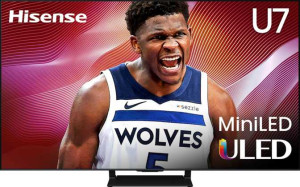
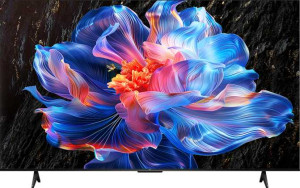
Both TVs share the same physical canvas — a 74.5″ 4K (3840 x 2160) panel with identical pixel density, 10-bit color depth, and 1.07 billion colors — so out of the box they are evenly matched on resolution and color volume. They also both carry anti-reflection coatings and ambient light sensors, meaning neither has an edge in glare management or automatic brightness adaptation.
The gaps open up quickly once you look beyond resolution. The Hisense 75U75QG uses a QLED Mini-LED panel, a fundamentally more advanced backlighting architecture that delivers tighter local dimming zones, higher peak brightness, and better contrast compared to the TCL 75P6K's conventional LED-backlit LCD. On top of that, the Hisense runs at a 165Hz refresh rate versus the TCL's 60Hz — a difference that is transformative for fast-motion content, gaming, and sports, where 60Hz can show noticeable blur or judder. For HDR, the Hisense supports the full suite: HDR10, HDR10+, Dolby Vision, and HLG, while the TCL covers only HDR10 and HLG, missing out on the dynamic metadata formats (HDR10+ and Dolby Vision) that optimize tone-mapping scene by scene for a visibly richer picture on compatible content.
The Hisense 75U75QG has a clear and substantial display advantage. Its superior panel technology, dramatically higher refresh rate, and broader HDR ecosystem make it the stronger choice for virtually every viewing scenario, from cinematic HDR content to high-frame-rate gaming. The TCL 75P6K covers the basics competently but cannot match the Hisense on any of the key differentiating display specs provided.