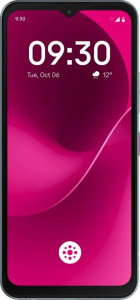
Wireless connectivity splits in an interesting way. The Honor 400 5G supports Wi-Fi 6 (802.11ax) in addition to Wi-Fi 4 and 5, while the T-Mobile T Phone 3 tops out at Wi-Fi 5. On a Wi-Fi 6 router, the Honor benefits from lower latency, better performance in congested environments, and improved efficiency — advantages that become tangible in busy households or offices with many connected devices. On cellular, the Honor's peak download speed of 5000 Mbps significantly outpaces the T Phone 3's 2900 Mbps, though the T Phone 3 counters with a notably higher upload ceiling of 1600 Mbps versus the Honor's 160 Mbps — a reversal that could matter for users who frequently upload large files or stream live video. Bluetooth also favors the Honor, with version 5.4 versus 5.1, offering incremental improvements in connection stability and efficiency.
On SIM flexibility, the two devices take different approaches. The Honor supports two physical SIM cards, while the T Phone 3 offers one physical SIM plus an eSIM — a modern alternative that allows carrier switching without a physical card. The T Phone 3 also includes an external memory slot for expandable storage, a meaningful perk given its base 128 GB capacity. The Honor, with no expansion option, relies entirely on its larger built-in 512 GB. Two unique hardware features stand apart: the Honor carries an infrared sensor, enabling it to function as a universal remote for home appliances — a niche but genuinely useful convenience entirely absent on the T Phone 3.
A shared foundation of 5G, NFC, GPS, USB Type-C, and fingerprint scanning means neither device is lacking in everyday connectivity essentials. On balance, the Honor 400 5G holds the broader connectivity edge — Wi-Fi 6, newer Bluetooth, and faster downloads pull ahead — but the T Phone 3's expandable storage, eSIM, and higher upload speeds give it targeted advantages that specific users will value.