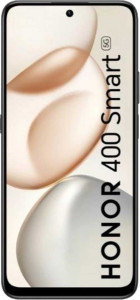
The panel technology gap here is substantial. The Honor 400 Lite uses an OLED/AMOLED display, which delivers true blacks, higher contrast, and more vivid colors by lighting each pixel individually. The Honor 400 Smart 5G, by contrast, relies on an LCD IPS panel — a fundamentally older technology that depends on a backlight, resulting in less deep blacks and generally lower contrast ratios. For everyday tasks like browsing or messaging the difference is tolerable, but for media consumption, dark-mode interfaces, or outdoor visibility, OLED holds a meaningful real-world advantage.
Pixel density compounds that gap further. Despite both screens being similarly sized — 6.7″ vs 6.77″ — the Lite packs a 394 ppi resolution of 1080 x 2412 px, while the Smart 5G offers just 261 ppi at 720 x 1610 px. That 133 ppi difference is clearly visible to the naked eye: text and fine detail will appear noticeably sharper on the Lite, and the HD+ resolution of the Smart 5G is increasingly rare at this screen size, placing it closer to budget-tier clarity. The Lite also supports an Always-On Display, a convenience feature absent on the Smart 5G, enabled by OLED's ability to power individual pixels without lighting the full screen.
Both phones match on refresh rate at 120Hz and neither supports HDR10, HDR10+, or Dolby Vision, so those shared traits are a wash. The conclusion, however, is not close: the Honor 400 Lite holds a commanding display advantage, with a superior panel technology, significantly higher pixel density, and Always-On Display support — making it the clear winner in this category by a wide margin.