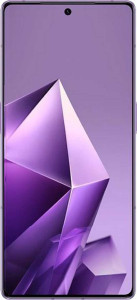
Both phones share the same storage configuration (256GB internal, 12GB RAM) and are built on identical 6 nm fabrication processes, but the silicon underneath tells quite different stories. The Honor 400 Lite's Dimensity 7025 outscores the Infinix Note 50 Pro 4G's Helio G100 in AnTuTu benchmarks — 465,629 vs 438,000 — a roughly 6% lead that reflects a measurably snappier experience in multitasking, app launches, and sustained workloads.
Digging deeper, the architectural advantages of the Dimensity 7025 compound further. Its memory subsystem operates on DDR5 with a maximum bandwidth of 51.2 GB/s, compared to the Helio G100's DDR4 at just 17.1 GB/s — a three-fold difference that directly benefits memory-intensive tasks like gaming texture streaming, image processing, and heavy multitasking. The Honor also supports up to 16GB of RAM (vs 12GB on the Infinix), giving it more headroom for future configurations. On the GPU side, the Infinix's Mali G57 runs at a slightly higher clock speed, but the Honor's GPU supports DirectX 12 versus the Infinix's DirectX 11, indicating a more modern graphics architecture overall.
The Honor 400 Lite takes a clear performance win. The Infinix's faster RAM clock speed (4266 MHz) is a genuine spec on paper, but it cannot compensate for the Honor's superior benchmark scores, three-times-greater memory bandwidth, newer DDR generation, and more capable GPU API support. For users who care about future-proofing and sustained performance, the Honor 400 Lite holds a meaningful and multi-dimensional edge.