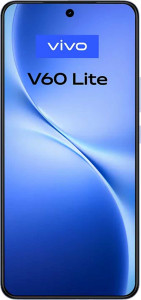
The rear camera systems look similar on the surface — both lead with a 50MP primary sensor — but the secondary lens reveals a gap. The Vivo V60 Lite pairs its main shooter with an 8MP secondary camera, while the Honor 400 Smart settles for a 2MP companion lens. A 2MP secondary is typically limited to depth-sensing duties only, offering minimal real-world versatility, whereas 8MP can meaningfully contribute to ultrawide or macro shots depending on implementation. The Vivo's primary lens also has a slightly wider aperture at f/2.2 versus the Honor's f/2.4, which in theory admits a touch more light in low-light conditions.
The most dramatic split, however, is on the front. The Vivo V60 Lite sports a 32MP selfie camera, compared to just 5MP on the Honor 400 Smart. This is not a marginal difference — it represents a fundamentally different class of selfie capability, with far more detail, better cropping flexibility, and significantly improved quality for video calls or portrait shots. Notably, the Honor's front aperture of f/2.2 is wider than the Vivo's f/2.5, so it lets in more light per pixel, but that advantage cannot compensate for the enormous resolution gap. On the flip side, the Honor 400 Smart supports slow-motion video and timelapse recording, two creative modes the Vivo V60 Lite lacks entirely.
Overall, the Vivo V60 Lite holds the stronger camera profile for most users, driven almost entirely by its vastly superior 32MP front camera and more capable secondary rear lens. The Honor 400 Smart carves out a niche for video enthusiasts who value slow-motion and timelapse, but for everyday photography — especially selfies — the Vivo is the clear winner in this category.