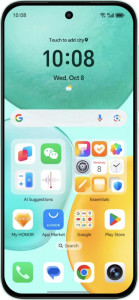
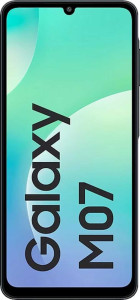
Most of the connectivity fundamentals are identical across these two phones — dual SIM, Wi-Fi 5, USB Type-C (USB 2.0), NFC, expandable storage, GPS with Galileo support, and a fingerprint scanner are all present on both. Neither supports 5G, which is consistent with their market positioning. The shared NFC support is worth highlighting as a genuine everyday utility, enabling contactless payments and quick pairing without any advantage to either side.
Three specs break the tie, and they all favor the Galaxy M07. Its Bluetooth 5.3 is a step ahead of the X6c's 5.1 — the newer version brings improvements to connection stability, interference handling, and energy efficiency, which collectively translate into more reliable wireless audio and peripheral pairing. More strikingly, the M07 supports significantly faster cellular speeds: 650 Mbits/s download and 150 Mbits/s upload, compared to the X6c's 300 Mbits/s and 100 Mbits/s. In strong network conditions, this means the M07 can pull data more than twice as fast — a real advantage for heavy streamers, large file transfers, or users in congested urban environments.
The Samsung Galaxy M07 takes this category on the strength of its newer Bluetooth version and substantially higher cellular throughput. The X6c matches it on every other front, but the M07's connectivity ceiling is meaningfully higher for users who push their mobile network connection regularly.