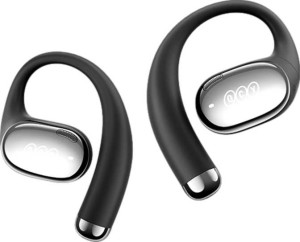
Huawei FreeArc
QCY Crossky R70

Huawei FreeArc QCY Crossky R70

Overview

Welcome to this in-depth specification comparison between the Huawei FreeArc and the QCY Crossky R70, two open-ear wireless earbuds designed for active, on-the-go listeners. Both models share a cable-free, open-ear form factor with wingtips and stereo sound, yet they diverge in meaningful ways across battery endurance, water resistance, and connectivity features. Read on to discover which of these earbuds best fits your lifestyle and listening needs.

Common Features

  • Both products have an open-ear fit.
  • Neither product has wires or cables.
  • Neither product is a neckband earbud design.
  • Both products include wingtips.
  • Neither product has RGB lighting.
  • Both products feature stereo speakers.
  • Neither product has a UV light.
  • Neither product has a display.
  • Neither product has active noise cancellation.
  • Neither product has passive noise reduction.
  • Both products have a lowest frequency of 20 Hz and a highest frequency of 20000 Hz.
  • Spatial audio is not supported on either product.
  • Neither product has wireless charging.
  • Neither product has a solar power battery.
  • Both products have a battery level indicator.
  • Both products have a rechargeable battery.
  • Neither product supports fast pairing.
  • Both products have a USB Type-C port.
  • Neither product supports LDAC on the Huawei FreeArc, though this is a difference — see differences.
  • Both products support multipoint connection with 2 devices.
  • Neither product can read notifications.
  • Both products have a mute function.
  • Both products can be used as a headset.
  • Both products have a control panel placed on the device.
  • Both products have voice prompts.
  • Both products have a noise-canceling microphone.
  • Both products support fast charging.

Main Differences

  • Ingress Protection rating is IP57 on Huawei FreeArc and IPX5 on QCY Crossky R70.
  • Water resistance is waterproof on Huawei FreeArc and water resistant on QCY Crossky R70.
  • Battery life is 7 hours on Huawei FreeArc and 13 hours on QCY Crossky R70.
  • Battery life of the charging case is 21 hours on Huawei FreeArc and 49 hours on QCY Crossky R70.
  • Charge time is 1 hour on Huawei FreeArc and 2 hours on QCY Crossky R70.
  • Bluetooth version is 5.2 on Huawei FreeArc and 6 on QCY Crossky R70.
  • LDAC support is present on QCY Crossky R70 but not available on Huawei FreeArc.
  • In/on-ear detection is present on Huawei FreeArc but not available on QCY Crossky R70.
Specs Comparison
Huawei FreeArc

Huawei FreeArc

QCY Crossky R70

QCY Crossky R70

Design:
Fit Open-ear Open-ear
Ingress Protection (IP) rating IP57 IPX5
water resistance Waterproof Water resistant
has no wires or cables
are neckband earbuds
wingtips included
has RGB lighting
has stereo speakers
has UV light
Has a display

Both the Huawei FreeArc and the QCY Crossky R70 share the same fundamental design philosophy: open-ear, truly wireless earbuds with wingtips for secure fit and stereo audio — making them directly comparable in form factor. Neither features RGB lighting or a display, keeping the focus purely on functional wearability.

The most meaningful differentiator in this group is water resistance. The FreeArc carries an IP57 rating, meaning it is fully dustproof and can be submerged in up to 1 meter of water for 30 minutes — qualifying it as genuinely waterproof. The Crossky R70, rated IPX5, offers only water resistance against low-pressure jets from any direction, with no dust protection and no submersion capability. In real-world terms, the FreeArc is the safer choice for intense workouts, rain, or accidental drops in water, while the R70 handles sweat and light rain but little more.

Overall, the Huawei FreeArc holds a clear edge in this design group, driven entirely by its superior ingress protection. For users who prioritize durability in demanding or outdoor environments, the IP57 rating is a significant practical advantage over the R70′s IPX5.

Sound quality:
has active noise cancellation (ANC)
has passive noise reduction
lowest frequency 20 Hz 20 Hz
highest frequency 20000 Hz 20000 Hz
supports spatial audio
has Dolby Atmos
has Dirac Virtuo
has a neodymium magnet

Across every sound quality spec provided, the Huawei FreeArc and QCY Crossky R70 are in complete lockstep. Both cover the standard 20 Hz–20,000 Hz frequency range — the full extent of human hearing — and neither supports ANC, passive noise reduction, spatial audio, Dolby Atmos, or Dirac Virtuo.

It is worth noting that the absence of noise cancellation is expected and largely unavoidable in open-ear designs, since the form factor by nature lets in ambient sound. The shared frequency range is a baseline specification and does not reveal differences in driver quality, tuning, or actual acoustic performance — factors that simply are not captured in the provided data.

This group is a complete tie. There is no basis in the supplied specs to give either product an audio advantage over the other. Buyers seeking differentiation in sound quality between these two will need to look beyond spec sheets to real-world listening tests.

Power:
Battery life 7 hours 13 hours
Battery life of charging case 21 hours 49 hours
charge time 1 hours 2 hours
has wireless charging
Has a solar power battery
has a battery level indicator
has a rechargeable battery

Battery endurance is where these two products diverge most sharply. The QCY Crossky R70 delivers 13 hours of playtime per charge versus the Huawei FreeArc's 7 hours — nearly double. Combined with their respective cases, the gap widens further: the R70 offers a total of 49 hours of combined battery life compared to the FreeArc's 21 hours. In practical terms, the R70 can comfortably last through multiple full days of use before needing a case top-up, while the FreeArc will require more frequent charging cycles.

The FreeArc does recover some ground with its charge time: it refills in just 1 hour, half the 2 hours the R70 requires. For users who tend to charge overnight or in predictable windows, this difference is negligible — but for someone topping up quickly before heading out, the FreeArc's faster turnaround is a genuine convenience. Neither model supports wireless charging, so both require a cable regardless.

The QCY Crossky R70 holds a clear and substantial advantage in this category. Unless charging speed is a top priority, the R70's dramatically longer per-earbud and total system battery life makes it the stronger choice for users who value extended use between charges.

Connectivity:
has fast pairing
Has USB Type-C
Bluetooth version 5.2 6
has LDAC
has LDHC
has Bluetooth LE Audio
has aptX Adaptive
has aptX Low Latency
has aptX HD
has aptX
has aptX Lossless
has aptX Voice
has Auracast
maximum Bluetooth range 10 m 10 m
supports Bluetooth pairing using NFC
Can be used wirelessly
has AAC

Two meaningful differences separate these earbuds on connectivity. The QCY Crossky R70 runs on Bluetooth 6, the latest generation, while the Huawei FreeArc uses Bluetooth 5.2. A newer Bluetooth version generally brings improvements in connection stability, power efficiency, and interference handling — advantages that are subtle in day-to-day use but meaningful in congested wireless environments like offices or public transit.

The more practical differentiator is codec support. The R70 adds LDAC on top of the shared AAC baseline. LDAC transmits audio at up to three times the bitrate of standard Bluetooth codecs, which can yield noticeably higher audio fidelity when paired with a compatible Android source device. The FreeArc is limited to AAC, which is well-suited for Apple devices but offers no comparable high-resolution option on Android. For listeners who stream high-quality audio and own an LDAC-compatible device, this is a tangible advantage for the R70.

The QCY Crossky R70 takes a clear edge in connectivity, combining a more modern Bluetooth version with superior codec flexibility. The FreeArc is not deficient by any means, but the R70 offers a more future-ready and higher-fidelity wireless foundation.

Features:
release date February 2025 April 2025
has ambient sound mode
has in/on-ear detection
Supports fast charging
multipoint count 2 2
can read notifications
has a mute function
can be used as a headset
control panel placed on a device
Has voice prompts
travel bag is included
Has an in-line control panel
Has a temperature sensor
Has a built-in camera remote control function

For the most part, these two earbuds are evenly matched on features. Both support multipoint connection to two devices simultaneously, fast charging, mute, on-device controls, voice prompts, headset use, and even include a travel bag — a solid and nearly identical feature set for the category.

The single differentiator is in/on-ear detection, which the Huawei FreeArc has and the QCY Crossky R70 lacks. This sensor automatically pauses playback when an earbud is removed and resumes when it is put back in — a small but genuinely convenient quality-of-life feature that reduces the need to manually interact with your source device during brief interruptions.

The Huawei FreeArc holds a narrow edge here solely due to in/on-ear detection. It is not a decisive advantage, but for users who frequently take their earbuds in and out throughout the day, it adds a layer of everyday convenience that the R70 simply does not offer.

Microphone:
has a noise-canceling microphone

Both the Huawei FreeArc and the QCY Crossky R70 include a noise-canceling microphone, which is the only data point available for this group. This means both are equipped to filter out background noise during calls — a practical necessity for open-ear earbuds, which by design do not isolate the wearer from their environment and can otherwise pick up significant ambient sound.

This group is a complete tie. With only a single shared spec on record, there is no basis to distinguish one product from the other on microphone capability.

Comparison Summary & Verdict

After examining every specification, the Huawei FreeArc and QCY Crossky R70 each carve out a distinct niche. The FreeArc stands out with its superior IP57 waterproof rating and in/on-ear detection, making it the stronger companion for intense workouts or rainy-day runs where full waterproofing and smart wear-detection matter. It also charges faster at just one hour. The QCY Crossky R70, on the other hand, dominates on battery life — offering 13 hours of playback and up to 49 hours with its case — and benefits from Bluetooth 6 connectivity and LDAC audio support for higher-quality wireless sound. Choose the Huawei FreeArc if durability and smart detection are priorities; choose the QCY Crossky R70 if you need longer-lasting power and premium audio codec support.

Huawei FreeArc
Buy Huawei FreeArc if...

Buy the Huawei FreeArc if you need a fully waterproof open-ear earbud with in/on-ear detection and a faster one-hour charge time.

QCY Crossky R70
Buy QCY Crossky R70 if...

Buy the QCY Crossky R70 if long battery life, Bluetooth 6, and LDAC support for higher-quality audio are your top priorities.