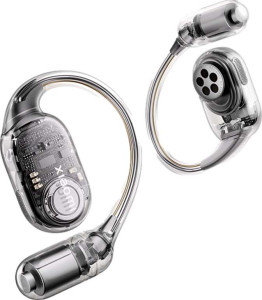
Huawei FreeArc
Xiaomi OpenWear Stereo Pro

Huawei FreeArc Xiaomi OpenWear Stereo Pro

Overview

Welcome to our detailed spec breakdown of the Huawei FreeArc versus the Xiaomi OpenWear Stereo Pro — two open-ear wireless earbuds competing for your attention. Both share a cable-free design with stereo speakers and fast charging support, but key battlegrounds emerge around water resistance, battery endurance, and audio frequency range. Read on to see which one comes out on top for your lifestyle.

Common Features

  • Both products have an open-ear fit.
  • Neither product has wires or cables.
  • Neither product is a neckband earbud design.
  • Both products include wingtips.
  • Neither product has RGB lighting.
  • Both products feature stereo speakers.
  • Neither product has a UV light.
  • Neither product has a display.
  • Neither product has active noise cancellation.
  • Neither product has passive noise reduction.
  • Both products have a lowest frequency of 20 Hz.
  • Neither product supports spatial audio.
  • Neither product has Dolby Atmos.
  • Neither product has a neodymium magnet.
  • Neither product supports wireless charging.
  • Both products have a battery level indicator.
  • Both products have a rechargeable battery.
  • Both products have USB Type-C charging.
  • Neither product has Bluetooth LE Audio.
  • Neither product has LDAC, aptX Adaptive, aptX Low Latency, aptX HD, or aptX support.
  • Neither product has an ambient sound mode.
  • Both products support fast charging.
  • Neither product can read notifications.
  • Both products have a mute function.
  • Both products can be used as a headset.
  • Both products have a control panel placed on the device.
  • Both products have voice prompts.
  • A travel bag is included with both products.
  • Both products have a noise-canceling microphone.
  • Neither product has fast pairing.

Main Differences

  • Ingress Protection rating is IP57 on Huawei FreeArc and IP54 on Xiaomi OpenWear Stereo Pro.
  • The Huawei FreeArc is waterproof, while the Xiaomi OpenWear Stereo Pro is only sweat resistant.
  • The highest frequency reaches 20000 Hz on Huawei FreeArc and 40000 Hz on Xiaomi OpenWear Stereo Pro.
  • Battery life is 7 hours on Huawei FreeArc and 7.5 hours on Xiaomi OpenWear Stereo Pro.
  • Battery life of the charging case is 21 hours on Huawei FreeArc and 31 hours on Xiaomi OpenWear Stereo Pro.
  • Charge time is 1 hour on Huawei FreeArc and 1.5 hours on Xiaomi OpenWear Stereo Pro.
  • Battery power is 55 mAh on Huawei FreeArc and 60 mAh on Xiaomi OpenWear Stereo Pro.
  • Charging case battery power is 510 mAh on Huawei FreeArc and 780 mAh on Xiaomi OpenWear Stereo Pro.
  • Bluetooth version is 5.2 on Huawei FreeArc and 5.3 on Xiaomi OpenWear Stereo Pro.
  • LDHC support is present on Xiaomi OpenWear Stereo Pro but not available on Huawei FreeArc.
  • In/on-ear detection is present on Huawei FreeArc but not available on Xiaomi OpenWear Stereo Pro.
Specs Comparison
Huawei FreeArc

Huawei FreeArc

Xiaomi OpenWear Stereo Pro

Xiaomi OpenWear Stereo Pro

Design:
Fit Open-ear Open-ear
Ingress Protection (IP) rating IP57 IP54
water resistance Waterproof Sweat resistant
has no wires or cables
are neckband earbuds
wingtips included
has RGB lighting
has stereo speakers
has UV light
Has a display

Both the Huawei FreeArc and the Xiaomi OpenWear Stereo Pro share a broadly similar design philosophy: open-ear, fully wireless form factors with wingtips for secure fit and stereo speaker output. Neither adds visual flair through RGB lighting or a display, keeping the focus squarely on audio utility and wearability.

The most meaningful differentiator in this group is water resistance. The FreeArc carries an IP57 rating, meaning it is fully dustproof and can withstand immersion in up to 1 meter of water for 30 minutes — qualifying it as genuinely waterproof. The OpenWear Stereo Pro, rated IP54, offers only partial dust protection and splash/sweat resistance, making it suitable for workouts but not submersion. For users who plan to wear these in rain, near pools, or during intense outdoor activity, this is a practical distinction that goes beyond marketing language.

Overall, the Huawei FreeArc holds a clear design edge in this group, driven entirely by its superior ingress protection. Everything else — fit style, wireless design, wingtips, stereo output — is functionally equivalent between the two.

Sound quality:
has active noise cancellation (ANC)
has passive noise reduction
lowest frequency 20 Hz 20 Hz
highest frequency 20000 Hz 40000 Hz
supports spatial audio
has Dolby Atmos
has Dirac Virtuo
has a neodymium magnet

Noise isolation is a non-factor for both headphones — neither ANC nor passive noise reduction is present in either model, which is expected for open-ear designs that are built to maintain environmental awareness rather than block it out.

Where the two diverge is at the top of the frequency range. The FreeArc reproduces audio up to 20,000 Hz, covering the full standard range of human hearing. The Xiaomi OpenWear Stereo Pro extends to 40,000 Hz, reaching into the ultrasonic territory associated with hi-res audio formats. In practice, most listeners cannot perceive frequencies above 20 kHz, so this difference is unlikely to translate into an audible improvement for the average user — but it does signal a driver capable of handling high-resolution source material with less roll-off near the audible ceiling.

On balance, this group is close to a tie for most real-world listening scenarios. The Xiaomi OpenWear Stereo Pro holds a narrow technical edge on paper due to its wider frequency ceiling, but the practical benefit depends heavily on source quality and individual hearing sensitivity. Neither product offers spatial audio or premium audio processing features, so buyers prioritizing those capabilities will need to look elsewhere regardless of which model they choose.

Power:
Battery life 7 hours 7.5 hours
Battery life of charging case 21 hours 31 hours
charge time 1 hours 1.5 hours
battery power 55 mAh 60 mAh
battery power (charging case) 510mAh 780mAh
has wireless charging
Has a solar power battery
has a battery level indicator
has a rechargeable battery

Earbud battery life is nearly identical at a glance — 7 hours for the FreeArc versus 7.5 hours for the Xiaomi OpenWear Stereo Pro — a gap small enough that most users will never notice it in daily use. The more telling difference emerges when you factor in the charging case. The OpenWear Stereo Pro's case holds 780 mAh, delivering a combined total of 31 hours, while the FreeArc's 510 mAh case tops out at 21 hours total. That 10-hour gap is meaningful for travelers or users who go multiple days without access to a charger.

Charge time tilts back toward the FreeArc: it refills in 1 hour versus 1.5 hours for the OpenWear Stereo Pro. A 30-minute faster charge cycle is a practical convenience, particularly if you need a quick top-up before heading out. Neither model supports wireless charging, so both require a cable regardless.

Taking the full picture into account, the Xiaomi OpenWear Stereo Pro has a clear endurance advantage thanks to its substantially larger case capacity, making it the stronger choice for extended use away from power sources. The FreeArc counters with faster charging, but that advantage is secondary when the total available runtime is this far apart.

Connectivity:
has fast pairing
Has USB Type-C
Bluetooth version 5.2 5.3
has LDAC
has LDHC
has Bluetooth LE Audio
has aptX Adaptive
has aptX Low Latency
has aptX HD
has aptX
has aptX Lossless
has aptX Voice
has Auracast
maximum Bluetooth range 10 m 10 m
supports Bluetooth pairing using NFC
Can be used wirelessly
has AAC

The connectivity foundations are largely shared: both headphones operate over the same 10 m Bluetooth range, support AAC as their common high-quality codec, use USB-C for charging, and lack fast pairing or NFC. For the majority of users pairing with a smartphone for everyday listening, these shared traits mean a very similar out-of-box wireless experience.

Two differences are worth examining. First, the Xiaomi OpenWear Stereo Pro runs Bluetooth 5.3 versus the FreeArc's 5.2 — a minor generational step that brings incremental improvements in connection stability and power efficiency, though the practical gap in real-world use is small. More meaningfully, the OpenWear Stereo Pro adds LDHC support, a high-resolution wireless codec capable of transmitting up to 900 kbps — well above AAC's ceiling. For users with LDHC-compatible source devices, this opens the door to higher-fidelity wireless audio transmission that AAC simply cannot match.

The Xiaomi OpenWear Stereo Pro earns the edge in this group. The newer Bluetooth version is a minor bonus, but LDHC support is the substantive differentiator — it gives audio-conscious users a meaningful codec upgrade path that the FreeArc, limited to AAC, cannot offer.

Features:
release date February 2025 September 2025
has ambient sound mode
has in/on-ear detection
Supports fast charging
can read notifications
has a mute function
can be used as a headset
control panel placed on a device
Has voice prompts
travel bag is included
Has an in-line control panel
Has a temperature sensor
Has a built-in camera remote control function

Across most practical features, these two headphones are mirror images of each other — both support fast charging, offer on-device controls, include a travel bag, have voice prompts, support mute, and can function as a headset for calls. For day-to-day usability, that shared baseline is solid and covers the features most users will actually reach for.

The single differentiator in this group is in/on-ear detection, which the Huawei FreeArc supports and the Xiaomi OpenWear Stereo Pro does not. This sensor automatically pauses playback when the earbuds are removed and resumes when they are put back on — a convenience feature that also helps conserve battery during unplanned interruptions. Its absence on the OpenWear Stereo Pro is a minor but noticeable omission for users who frequently take their earbuds on and off throughout the day.

The Huawei FreeArc takes a narrow edge here solely on the strength of ear detection. It is not a decisive advantage, but in a group where everything else is equal, it represents a tangible quality-of-life improvement that the OpenWear Stereo Pro simply does not offer.

Microphone:
has a noise-canceling microphone

Microphone capability is a dead heat: both the Huawei FreeArc and the Xiaomi OpenWear Stereo Pro include a noise-canceling microphone. For open-ear headphones — which by design allow ambient sound to bleed in freely — microphone noise cancellation is particularly valuable, as it helps isolate the caller's voice from the surrounding environment during calls or voice assistant use.

This group offers no basis for differentiation. The two products are fully tied on the only available microphone specification, and neither holds an advantage over the other here.

Comparison Summary & Verdict

After reviewing all specifications, both the Huawei FreeArc and the Xiaomi OpenWear Stereo Pro prove to be capable open-ear earbuds with strong shared foundations. However, their differences point to distinct audiences. The Huawei FreeArc stands out with its superior IP57 waterproof rating, faster 1-hour charge time, and in/on-ear detection, making it the smarter pick for active users who need reliable water protection and smart wear detection. The Xiaomi OpenWear Stereo Pro, on the other hand, excels with a higher 40000 Hz frequency ceiling, longer 31-hour case battery life, a larger 780 mAh case battery, Bluetooth 5.3, and LDHC support, appealing to audio enthusiasts who prioritize sound range and extended wireless endurance between charges.

Huawei FreeArc
Buy Huawei FreeArc if...

Buy the Huawei FreeArc if you need a fully waterproof open-ear earbud with faster charging and in/on-ear detection for an active, on-the-go lifestyle.

Xiaomi OpenWear Stereo Pro
Buy Xiaomi OpenWear Stereo Pro if...

Buy the Xiaomi OpenWear Stereo Pro if you prioritize a wider audio frequency range, longer total battery life, and advanced connectivity features like LDHC and Bluetooth 5.3.