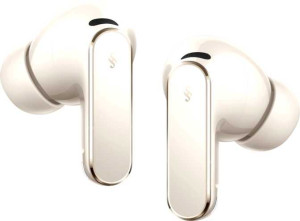
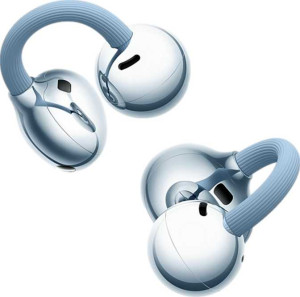
Noise cancellation is where these two products diverge most sharply. The FreeBuds Pro 5 offers both active noise cancellation (ANC) and passive noise reduction — a combination that, paired with its in-ear seal, makes it genuinely capable of blocking out commute noise, office chatter, and ambient distractions. The FreeClip 2 has neither, which is a direct consequence of its open-ear design: there is no ear canal seal to build passive isolation upon, and ANC on an open-ear form factor is technically impractical. This is not a flaw so much as an inherent trade-off of the open-ear philosophy, but users seeking a quieter listening environment should weigh this carefully.
Frequency response tells a similar story of asymmetry. The FreeBuds Pro 5 spans 10 Hz to 48,000 Hz, extending well below the threshold of human hearing on the low end and reaching into high-resolution audio territory on the top. The FreeClip 2 covers the standard 20 Hz to 20,000 Hz range — precisely the boundaries of typical human hearing. In practice, the ultra-low and ultra-high extensions of the FreeBuds Pro 5 may contribute to a fuller, more textured sound reproduction, particularly in bass presence and high-frequency air, even if the extremes are not consciously perceived.
Neither product supports spatial audio, Dolby Atmos, or Dirac Virtuo, so neither holds an edge in immersive audio processing. Overall, the FreeBuds Pro 5 holds a clear advantage in this category — broader frequency range and active noise cancellation together represent a substantially more capable sound quality toolkit, especially for focused or commute listening scenarios.