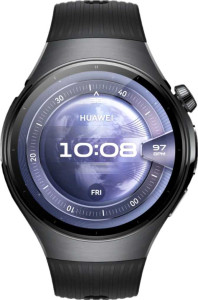
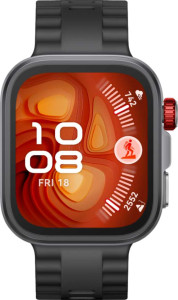
Both watches share a strong design foundation: OLED/AMOLED displays, sapphire glass, always-on display support, replaceable bands, and identical 5 ATM / IP68 water resistance. However, the real-world design experience diverges significantly. The Huawei Watch 5 adopts a larger, chunkier profile — 46.7 × 46 mm with an 11.3 mm thickness and a substantial 63 g weight — giving it a bold, traditional smartwatch presence on the wrist. The Watch Fit 4 Pro, by contrast, is notably slimmer at 9.3 mm and dramatically lighter at just 30.4 g, nearly half the mass. For all-day and overnight wear, that weight difference is felt immediately and consistently.
What makes the Fit 4 Pro's lightness even more striking is that it achieves it while carrying a larger 1.82″ screen compared to the Watch 5's 1.5″ panel. Combined with a higher 347 ppi pixel density versus 310 ppi, the Fit 4 Pro delivers a sharper, roomier display in a physically smaller and lighter chassis — a genuine engineering trade-off win. The Watch 5's narrower 22 mm band versus the Fit 4 Pro's 20 mm band is a minor distinction, though it does align with the Watch 5's more classically styled case shape.
One area where the Watch 5 holds a meaningful edge is thermal resilience: its maximum operating temperature of 55 °C versus the Fit 4 Pro's 45 °C makes it better suited for extreme heat environments such as saunas or hot outdoor conditions. The Fit 4 Pro, however, offers a slightly deeper waterproof rating of 50 m versus 40 m. On balance, the Huawei Watch Fit 4 Pro has a clear design advantage for users who prioritize everyday comfort and display quality, while the Watch 5 suits those who prefer a more substantial, traditional watch aesthetic and need higher heat tolerance.