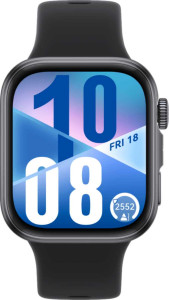
Huawei Watch Fit 4
Redmi Watch 5

Huawei Watch Fit 4 Redmi Watch 5

Overview

When comparing the Huawei Watch Fit 4 and the Redmi Watch 5, two capable fitness-focused smartwatches come face to face across a range of key battlegrounds. From design and portability to sensor variety, connectivity features, and battery endurance, each device takes a notably different approach to delivering value. Whether you prioritize a compact, feature-rich wrist companion or a larger display with extended battery life, this side-by-side breakdown will help you decide which watch best fits your lifestyle.

Common Features

  • Both watches feature an OLED/AMOLED display.
  • Both watches have a 5 ATM water resistance rating.
  • Both watches carry an IP68 ingress protection rating with a waterproof depth of 50 m.
  • Always-On Display is available on both watches.
  • The watch band is replaceable on both models.
  • Neither watch features branded damage-resistant glass.
  • Blood oxygenation level monitoring is available on both watches.
  • A heart rate monitor is present on both watches.
  • GPS is available on both watches.
  • Both watches include an accelerometer, a compass, and a gyroscope.
  • Neither watch includes a temperature sensor or perspiration monitoring.
  • Both watches track sleep, distance, steps, pace, and elevation, and provide sleep reports.
  • Automatic activity detection and a route tracker are available on both watches.
  • Neither watch has a cellular module or Wi-Fi support.
  • Both watches are compatible with iOS and Android, and support Galileo.
  • Both watches have a rechargeable battery with no solar power or removable battery option.
  • Both watches can be used to answer calls, have call control, notifications, a silent alarm, and vibrating alerts.
  • ECG technology is not available on either watch.
  • Both watches measure resting heart rate and can locate your phone.
  • Activity reports, inactivity alerts, calorie tracking, goal setting, achievements, an exercise diary, and coaching are available on both watches through a free app.
  • A battery level indicator is present on both watches.
  • Both watches are compatible with external heart rate monitors.
  • Neither watch is compatible with Windows or Mac OS X, has an external memory slot, or a 3.5 mm audio jack socket.

Main Differences

  • Screen size is 1.82″ on the Huawei Watch Fit 4 and 2.07″ on the Redmi Watch 5.
  • The Huawei Watch Fit 4 is rated as waterproof, while the Redmi Watch 5 is rated as water resistant.
  • Pixel density is 347 ppi on the Huawei Watch Fit 4 and 324 ppi on the Redmi Watch 5.
  • Resolution is 408 x 480 px on the Huawei Watch Fit 4 and 432 x 514 px on the Redmi Watch 5.
  • Thickness is 9.5 mm on the Huawei Watch Fit 4 and 11.3 mm on the Redmi Watch 5.
  • Weight is 27 g on the Huawei Watch Fit 4 and 33.5 g on the Redmi Watch 5.
  • Height is 43 mm on the Huawei Watch Fit 4 and 47.5 mm on the Redmi Watch 5.
  • Width is 38 mm on the Huawei Watch Fit 4 and 41.1 mm on the Redmi Watch 5.
  • Volume is 15.523 cm³ on the Huawei Watch Fit 4 and 22.060425 cm³ on the Redmi Watch 5.
  • A barometer is present on the Huawei Watch Fit 4 but not available on the Redmi Watch 5.
  • A cadence sensor is present on the Huawei Watch Fit 4 but not available on the Redmi Watch 5.
  • Bluetooth version is 5.2 on the Huawei Watch Fit 4 and 5.3 on the Redmi Watch 5.
  • NFC is present on the Huawei Watch Fit 4 but not available on the Redmi Watch 5.
  • Battery life is 10 days on the Huawei Watch Fit 4 and 24 days on the Redmi Watch 5.
  • Battery power is 400 mAh on the Huawei Watch Fit 4 and 550 mAh on the Redmi Watch 5.
  • Wireless charging is available on the Huawei Watch Fit 4 but not on the Redmi Watch 5.
  • Irregular heart rate warnings are available on the Huawei Watch Fit 4 but not on the Redmi Watch 5.
  • Voice commands are available on the Redmi Watch 5 but not on the Huawei Watch Fit 4.
  • Internal storage is 4 GB on the Huawei Watch Fit 4 and 0.164 GB on the Redmi Watch 5.
  • The Huawei Watch Fit 4 has 1 microphone, while the Redmi Watch 5 has 2 microphones.
  • A passcode feature is available on the Huawei Watch Fit 4 but not on the Redmi Watch 5.
Specs Comparison
Huawei Watch Fit 4

Huawei Watch Fit 4

Redmi Watch 5

Redmi Watch 5

Design:
screen size 1.82" 2.07"
Display type OLED/AMOLED OLED/AMOLED
water resistance Waterproof Water resistant
ATM rating 5 ATM 5 ATM
Ingress Protection (IP) rating IP68 IP68
waterproof depth rating 50 m 50 m
Always-On Display
pixel density 347 ppi 324 ppi
resolution 408 x 480 px 432 x 514 px
Watch band is replaceable
has branded damage-resistant glass
thickness 9.5 mm 11.3 mm
weight 27 g 33.5 g
height 43 mm 47.5 mm
width 38 mm 41.1 mm
Has a display
has a touch screen
Has sapphire glass display
volume 15.523 cm³ 22.060425 cm³
is designed for kids

Both watches share the same core display technology — OLED/AMOLED panels with Always-On Display, identical 5 ATM / IP68 water protection rated to 50 m, replaceable bands, and touchscreens without sapphire or branded damage-resistant glass. These are the baseline expectations met by both, so the real story is in the physical form factor and screen characteristics.

The Redmi Watch 5 offers a noticeably larger 2.07″ display at 432 x 514 px, which translates to more screen real estate for reading notifications, workouts, or maps at a glance. However, this comes at a physical cost: it is 11.3 mm thick and weighs 33.5 g, with a volume of roughly 22.06 cm³. The Huawei Watch Fit 4, by contrast, packs a 1.82″ screen into a slimmer 9.5 mm chassis weighing just 27 g — nearly 20% lighter — and its volume of 15.52 cm³ makes it significantly more compact on the wrist. Crucially, despite the smaller screen, the Huawei delivers a sharper image at 347 ppi versus 324 ppi, meaning individual pixels are less discernible in everyday use.

The edge here depends on the user's priority. For all-day wearability and wrist comfort — especially during sleep tracking or extended workouts — the Huawei Watch Fit 4 holds a clear advantage through its lighter weight, slimmer profile, and higher pixel density. The Redmi Watch 5 wins on raw screen size, which benefits users who prioritize readability or frequently interact with the display, but they trade compactness and sharpness to get it.

Sensors:
Monitors blood oxygenation levels
Has a heart rate monitor
has GPS
has an accelerometer
Has a temperature sensor
has a compass
Has a barometer
has a gyroscope
Has a cadence sensor
Monitors perspiration

The sensor foundations are largely identical between the two watches: both carry GPS, heart rate monitoring, blood oxygen tracking, an accelerometer, a gyroscope, and a compass. For the average fitness user, this shared core covers the essentials — location tracking for outdoor runs, continuous health monitoring, and motion detection for activity recognition.

Where they diverge is meaningful for more active users. The Huawei Watch Fit 4 adds a barometer and a cadence sensor — two omissions on the Redmi Watch 5. A barometer enables altitude tracking and elevation gain calculations, which are valuable for hikers, cyclists, and trail runners who want accurate climb data rather than GPS-estimated elevation. A cadence sensor directly measures steps per minute or pedal strokes, giving runners and cyclists actionable feedback on their form and efficiency — something the Redmi simply cannot provide.

The Huawei Watch Fit 4 holds a clear edge in this category. Neither watch includes a temperature sensor or perspiration monitor, so that parity is a non-factor — but the barometer and cadence sensor together make the Huawei meaningfully more capable for sport-focused users who want deeper performance data from their workouts.

Activity tracking:
Tracks your sleep
Tracks distance
Tracks steps taken
Measures pace
Provides sleep reports
Detects activities automatically
Has a route tracker
Tracks elevation
Has multi-sport mode
Has exercise tagging
Has a stroke counter for swimming
Tracks calorie intake
Designed for diving
Designed for golf

Across every single activity tracking specification provided, the Huawei Watch Fit 4 and Redmi Watch 5 are in complete parity. Both cover the full spectrum of everyday fitness needs: sleep tracking with reports, step and distance counting, pace measurement, route tracking, elevation monitoring, and automatic activity detection. For the typical user switching between walking, running, and gym sessions, neither watch has a gap to fill.

The more sport-specific features are equally matched. Both include multi-sport mode, exercise tagging, a stroke counter for swimming, and even calorie intake tracking — which goes beyond passive burn estimates and lets users log consumption directly. Neither is designed for diving or golf, so those niches are off the table for both.

This group is a clear tie. Activity tracking capability alone gives no reason to choose one over the other — the decision will hinge on differentiators found in other spec groups, such as sensors, performance, or design.

Connectivity:
has a cellular module
Is compatible with iOS
Is compatible with Android
Bluetooth version 5.2 5.3
supports Wi-Fi
has NFC
supports Galileo

Neither watch supports cellular or Wi-Fi, and both are compatible with Android and iOS while supporting Galileo satellite navigation — so the meaningful differences come down to two specific features: Bluetooth version and NFC.

The Redmi Watch 5 edges ahead with Bluetooth 5.3 versus the Huawei's Bluetooth 5.2. In practice, the gap between these two versions is minor — users are unlikely to notice a tangible difference in connection stability or range during daily use. The Huawei Watch Fit 4, however, counters with NFC, which the Redmi Watch 5 lacks entirely. NFC enables contactless payments directly from the wrist, a genuinely practical convenience for users who want to leave their phone or wallet behind during runs or commutes.

On balance, the Huawei Watch Fit 4 holds the connectivity edge that matters more in everyday scenarios. The Redmi's marginally newer Bluetooth version offers negligible real-world benefit, while NFC represents a tangible, daily-use feature that the Redmi simply cannot replicate.

Battery:
battery life 10 days 24 days
battery power 400 mAh 550 mAh
has wireless charging
has a rechargeable battery
Has a solar power battery
has a removable battery

Battery life is where these two watches diverge most dramatically. The Redmi Watch 5 claims 24 days on a single charge backed by a 550 mAh cell, compared to the Huawei Watch Fit 4's 10 days from a 400 mAh battery. For users who dislike frequent charging — or who wear their watch through multi-day trips, hikes, or travel where charging access is limited — the Redmi's endurance is a significant practical advantage. Charging a watch every 10 days versus every 24 days means over twice as many charging cycles per month with the Huawei.

The Huawei fights back with wireless charging, a convenience the Redmi Watch 5 lacks. Wireless charging removes the friction of fumbling with proprietary cables and makes topping up the watch as easy as setting it on a pad — a small but genuinely appreciated quality-of-life feature for daily users. The Redmi, by contrast, requires a wired connection every time.

Ultimately, the Redmi Watch 5 holds the stronger hand in this category for most users. More than doubling the battery life outweighs the convenience of wireless charging for the majority of use cases — the less often you need to charge, the less the charging method matters. The Huawei's wireless charging is a worthy perk, but it cannot compensate for needing to be used more than twice as frequently.

Features:
release date May 2025 January 2025
measures resting heart rate
Can be used to answer calls
Locates your phone
Has call control
Has notifications
has irregular heart rate warnings
Has ECG technology
Has silent alarm
Has vibrating alerts
has fall detection
Has a stopwatch
Has smart alarm
has voice commands
internal storage 4GB 0.164GB
Has a built-in camera remote control function
warranty period 1 years 1 years
number of microphones 1 2

The shared feature set here is substantial — both watches support call answering, call control, notifications, phone locating, a stopwatch, camera remote, and vibrating alerts, making them functionally similar as everyday smartwatch companions. Neither includes ECG, fall detection, or a smart alarm, so those absences are a wash.

The divergences, however, are pointed. The Huawei Watch Fit 4 stands out with irregular heart rate warnings, a health-safety feature the Redmi Watch 5 omits — for users who want passive cardiac monitoring beyond simple resting heart rate tracking, this is a meaningful differentiator. On the other side, the Redmi counters with voice commands and 2 microphones compared to the Huawei's single microphone and no voice command support, making it more capable for hands-free interaction and potentially clearer call audio. The storage gap is the starkest contrast of all: the Huawei carries 4 GB of internal storage against the Redmi's 0.164 GB — roughly 24 times more — which opens the door to storing music or other local content directly on the watch, a feature the Redmi's negligible storage effectively rules out.

This category does not have a single clear winner — it splits by user priority. Health-conscious users will lean toward the Huawei Watch Fit 4 for its irregular heart rate warnings and vastly superior internal storage. Users who value voice interaction and call quality will find the Redmi Watch 5's dual microphones and voice commands more compelling. Neither advantage cancels the other out.

App & Software:
Provides activity reports
Has inactivity alerts
Counts how many calories you've burned
Has goal setting
Has achievements
Free app
Has exercise diary
Has coaching
Has temperature tracking
Has period notifications
Supports routes
Has music playback
Displays fertile window notifications
Predicts ovulation
Predicts start date
Supports widgets
Can be personalised
Has barcode scanner on app
Tracks water intake
Has weight tracking

Remarkably, the app and software category produces an identical feature sheet for both watches across all twenty data points. From fitness essentials like activity reports, calorie tracking, goal setting, and an exercise diary, to more nuanced tools like water intake tracking, weight tracking, and coaching — both platforms deliver the same capabilities without exception.

Worth highlighting is the depth of shared functionality beyond basic fitness: both apps include a full reproductive health suite with period notifications, fertile window display, ovulation prediction, and cycle start date forecasting. Both also support music playback, route support, widgets, and personalization, rounding out a genuinely comprehensive software experience on each device. Neither includes temperature tracking or a barcode scanner, and both apps are free — again, identical.

This is an unambiguous tie. Software and app capability offer zero differentiation between the two watches based on the provided data, and users should weight other spec groups — design, sensors, battery, or connectivity — when making their decision.

Miscellaneous:
has a battery level indicator
Has passcode
Compatible with external heart rate monitors
Is compatible with Windows
has an external memory slot
Is compatible with Mac OS X
has a socket for a 3.5 mm audio jack

Most of this category is shared ground: both watches include a battery level indicator, support external heart rate monitors, and lack an external memory slot, a 3.5 mm audio jack, and compatibility with Windows or Mac OS X. None of these shared absences are surprising for watches in this category, and the external heart rate monitor compatibility is a minor plus for users who already own chest strap sensors for more precise workout data.

The sole differentiator here is passcode protection, which only the Huawei Watch Fit 4 supports. For most fitness-focused users this may seem minor, but it carries real relevance for anyone using the watch for NFC payments — without a passcode, a lost or removed watch could potentially be used for unauthorized transactions. Given that the Huawei also has NFC (as established in its connectivity specs), the passcode becomes a meaningful security layer rather than a cosmetic feature.

The Huawei Watch Fit 4 takes a narrow but practical edge here. The Redmi Watch 5's lack of passcode support is a more notable omission when considered alongside its broader feature set, though for users not relying on any payment or sensitive features, the real-world impact remains limited.

Comparison Summary & Verdict

After examining every specification, it is clear that both watches serve distinct audiences. The Huawei Watch Fit 4 stands out for users who value a lighter, slimmer design at just 27 g and 9.5 mm thick, along with richer sensor coverage including a barometer and cadence sensor, NFC payments, wireless charging, irregular heart rate warnings, a passcode lock, and a generous 4 GB of internal storage. It is the stronger pick for fitness enthusiasts and security-conscious users who want a compact, well-equipped device. The Redmi Watch 5, on the other hand, wins decisively on battery life at 24 days, offers a larger 2.07″ screen, dual microphones, voice command support, and the latest Bluetooth 5.3 — making it the better choice for users who prioritize long-lasting endurance and hands-free convenience over a longer charge cycle.

Huawei Watch Fit 4
Buy Huawei Watch Fit 4 if...

Buy the Huawei Watch Fit 4 if you want a lightweight, slim smartwatch with NFC payments, wireless charging, a barometer, a cadence sensor, irregular heart rate warnings, and ample internal storage.

Redmi Watch 5
Buy Redmi Watch 5 if...

Buy the Redmi Watch 5 if you prioritize an exceptionally long battery life of up to 24 days, a larger display, dual microphones, and voice command support.