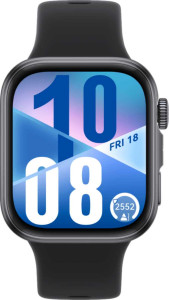
Huawei Watch Fit 4
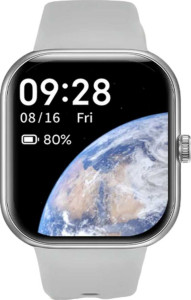
Xiaomi Redmi Watch Move

Huawei Watch Fit 4 Xiaomi Redmi Watch Move

Overview

When choosing between the Huawei Watch Fit 4 and the Xiaomi Redmi Watch Move, shoppers face a genuinely interesting dilemma. Both smartwatches share a solid OLED display, IP68 waterproofing, wireless charging, and a broad set of fitness and notification features — yet they diverge significantly when it comes to sensor richness, sports tracking capabilities, and overall battery endurance. Read on to see how these two contenders stack up across design, connectivity, and activity tracking.

Common Features

  • Both watches feature an OLED/AMOLED display type.
  • Both watches are waterproof with an IP68 ingress protection rating.
  • Always-On Display is available on both watches.
  • Watch bands are replaceable on both watches.
  • Neither watch features branded damage-resistant glass.
  • Both watches have a touchscreen display.
  • Blood oxygenation level monitoring is available on both watches.
  • A heart rate monitor is present on both watches.
  • An accelerometer is included in both watches.
  • Neither watch has a temperature sensor.
  • Neither watch monitors perspiration.
  • Sleep tracking is available on both watches.
  • Step counting is supported on both watches.
  • Sleep reports are provided by both watches.
  • Both watches detect activities automatically.
  • Exercise tagging is supported on both watches.
  • Calorie intake tracking is available on both watches.
  • Neither watch is designed for diving or golf.
  • Neither watch has a cellular module.
  • Both watches are compatible with iOS and Android.
  • Neither watch supports Wi-Fi or ANT+.
  • Wireless charging is supported on both watches.
  • Neither watch has a solar power battery or a removable battery.
  • Resting heart rate measurement is available on both watches.
  • Both watches can be used to answer calls and have call control.
  • Phone location functionality is available on both watches.
  • Notifications are supported on both watches.
  • Neither watch has ECG technology.
  • A silent alarm and vibrating alerts are present on both watches.
  • Activity reports, inactivity alerts, and calorie burn counting are available on both watches.
  • Goal setting, achievements, an exercise diary, and coaching features are present in both watches.
  • The companion app is free for both watches.
  • A battery level indicator is present on both watches.
  • Both watches are compatible with external heart rate monitors.
  • Neither watch is compatible with Windows or Mac OS X.
  • Neither watch has an external memory slot or a 3.5 mm audio jack socket.

Main Differences

  • Screen size is 1.82″ on the Huawei Watch Fit 4 and 1.85″ on the Xiaomi Redmi Watch Move.
  • Waterproof depth rating is 50 m on the Huawei Watch Fit 4 and only 1.5 m on the Xiaomi Redmi Watch Move.
  • Pixel density is 347 ppi on the Huawei Watch Fit 4 and 322 ppi on the Xiaomi Redmi Watch Move.
  • Resolution is 408 x 480 px on the Huawei Watch Fit 4 and 390 x 450 px on the Xiaomi Redmi Watch Move.
  • Thickness is 9.5 mm on the Huawei Watch Fit 4 and 10.8 mm on the Xiaomi Redmi Watch Move.
  • Weight is 27 g on the Huawei Watch Fit 4 and 25 g on the Xiaomi Redmi Watch Move.
  • Height is 43 mm on the Huawei Watch Fit 4 and 45.5 mm on the Xiaomi Redmi Watch Move.
  • Width is 38 mm on the Huawei Watch Fit 4 and 38.9 mm on the Xiaomi Redmi Watch Move.
  • Volume is 15.523 cm³ on the Huawei Watch Fit 4 and 19.11546 cm³ on the Xiaomi Redmi Watch Move.
  • GPS is present on the Huawei Watch Fit 4 but not available on the Xiaomi Redmi Watch Move.
  • A compass is present on the Huawei Watch Fit 4 but not available on the Xiaomi Redmi Watch Move.
  • A barometer is present on the Huawei Watch Fit 4 but not available on the Xiaomi Redmi Watch Move.
  • A gyroscope is present on the Huawei Watch Fit 4 but not available on the Xiaomi Redmi Watch Move.
  • A cadence sensor is present on the Huawei Watch Fit 4 but not available on the Xiaomi Redmi Watch Move.
  • Distance tracking is available on the Huawei Watch Fit 4 but not on the Xiaomi Redmi Watch Move.
  • Pace measurement is available on the Huawei Watch Fit 4 but not on the Xiaomi Redmi Watch Move.
  • A route tracker is present on the Huawei Watch Fit 4 but not on the Xiaomi Redmi Watch Move.
  • Elevation tracking is available on the Huawei Watch Fit 4 but not on the Xiaomi Redmi Watch Move.
  • Multi-sport mode is supported on the Huawei Watch Fit 4 but not on the Xiaomi Redmi Watch Move.
  • A stroke counter for swimming is available on the Huawei Watch Fit 4 but not on the Xiaomi Redmi Watch Move.
  • Bluetooth version is 5.2 on the Huawei Watch Fit 4 and 5.3 on the Xiaomi Redmi Watch Move.
  • NFC is present on the Huawei Watch Fit 4 but not available on the Xiaomi Redmi Watch Move.
  • Galileo satellite support is present on the Huawei Watch Fit 4 but not on the Xiaomi Redmi Watch Move.
  • Battery life is 10 days on the Huawei Watch Fit 4 and 14 days on the Xiaomi Redmi Watch Move.
  • Battery power is 400 mAh on the Huawei Watch Fit 4 and 300 mAh on the Xiaomi Redmi Watch Move.
  • Irregular heart rate warnings are available on the Huawei Watch Fit 4 but not on the Xiaomi Redmi Watch Move.
  • A passcode feature is present on the Huawei Watch Fit 4 but not available on the Xiaomi Redmi Watch Move.
Specs Comparison
Huawei Watch Fit 4

Huawei Watch Fit 4

Xiaomi Redmi Watch Move

Xiaomi Redmi Watch Move

Design:
screen size 1.82" 1.85"
Display type OLED/AMOLED OLED/AMOLED
water resistance Waterproof Waterproof
Ingress Protection (IP) rating IP68 IP68
waterproof depth rating 50 m 1.5 m
Always-On Display
pixel density 347 ppi 322 ppi
resolution 408 x 480 px 390 x 450 px
Watch band is replaceable
has branded damage-resistant glass
thickness 9.5 mm 10.8 mm
weight 27 g 25 g
height 43 mm 45.5 mm
width 38 mm 38.9 mm
Has a display
has a touch screen
Has sapphire glass display
volume 15.523 cm³ 19.11546 cm³
is designed for kids

Both watches share the same display technology (OLED/AMOLED), support Always-On Display, and have replaceable bands — so the fundamentals are level. Where they diverge is in display sharpness and physical form factor. The Huawei Watch Fit 4 packs a higher pixel density (347 ppi vs 322 ppi) into a slightly smaller screen (1.82″ vs 1.85″), which translates to noticeably crisper text and icons in daily use — a meaningful advantage for readability on a small wearable display.

On physical dimensions, the picture is more nuanced. The Fit 4 is considerably slimmer (9.5 mm vs 10.8 mm thick) and has a significantly smaller volume (15.5 cm³ vs 19.1 cm³), making it a more compact presence on the wrist. The Redmi Watch Move, however, is marginally lighter (25 g vs 27 g), though a 2-gram difference is unlikely to be perceptible in real-world wear.

The most decisive differentiator in this group is water resistance. Both carry an IP68 rating, but the depth ratings are worlds apart: the Fit 4 is rated to 50 m, while the Redmi Watch Move only reaches 1.5 m. For casual splashes or hand-washing, both are fine — but for swimming laps or water sports, only the Fit 4 offers genuine protection. Combined with its sharper display and slimmer build, the Huawei Watch Fit 4 holds a clear design edge overall.

Sensors:
Monitors blood oxygenation levels
Has a heart rate monitor
has GPS
has an accelerometer
Has a temperature sensor
has a compass
Has a barometer
has a gyroscope
Has a cadence sensor
Monitors perspiration

The sensor gap between these two watches is substantial. The Huawei Watch Fit 4 goes well beyond the basics, adding GPS, a barometer, a compass, a gyroscope, and a cadence sensor on top of the heart rate and SpO2 monitors that both watches share. The Redmi Watch Move, by contrast, pairs its heart rate and blood oxygen tracking with only an accelerometer — a setup typical of entry-level fitness bands rather than a full-featured smartwatch.

The practical consequences are significant for active users. Built-in GPS means the Fit 4 can track outdoor routes — runs, hikes, bike rides — without needing a paired smartphone nearby. The barometer adds altitude awareness and weather trend detection, while the gyroscope enables more accurate motion tracking and broader workout recognition. The cadence sensor is a particular asset for runners, directly measuring stride rate to improve form and training efficiency. None of these capabilities are available on the Redmi Watch Move.

The Huawei Watch Fit 4 holds a decisive and unambiguous advantage in this category. For users who do any form of outdoor or structured athletic activity, the Redmi Watch Move's sensor set is too limited to compete — it covers basic wellness monitoring, but little more.

Activity tracking:
Tracks your sleep
Tracks distance
Tracks steps taken
Measures pace
Provides sleep reports
Detects activities automatically
Has a route tracker
Tracks elevation
Has multi-sport mode
Has exercise tagging
Has a stroke counter for swimming
Tracks calorie intake
Designed for diving
Designed for golf

A shared foundation exists here — both watches track steps, sleep with reports, auto-detect activities, tag exercises, and monitor calorie intake. For a casual user whose goals are basic daily movement and rest monitoring, either device covers the essentials reasonably well. Beyond that baseline, though, the two diverge sharply.

The Huawei Watch Fit 4 adds a layer of athletic depth that the Redmi Watch Move simply cannot match. Distance tracking, pace measurement, elevation tracking, a route tracker, multi-sport mode, and even a stroke counter for swimming are all present on the Fit 4 and entirely absent on the Redmi. In practice, this means a runner using the Fit 4 gets a full picture of their workout — how far, how fast, and over what terrain — while the same runner on the Redmi Watch Move gets little more than a step count. The multi-sport mode is particularly telling: without it, the Redmi cannot meaningfully differentiate or log structured sessions across different disciplines.

For anyone with fitness goals beyond general wellness, the Huawei Watch Fit 4 is the clear winner in this category. The Redmi Watch Move is adequate for sedentary-to-lightly-active users tracking daily habits, but it lacks the activity tracking depth required to support training of any real structure or variety.

Connectivity:
has a cellular module
Is compatible with iOS
Is compatible with Android
Bluetooth version 5.2 5.3
supports Wi-Fi
supports ANT+
has NFC
supports Galileo

Neither watch supports cellular, Wi-Fi, or ANT+, and both are compatible with iOS and Android — so the connectivity baseline is identical. The Bluetooth versions are close: the Redmi Watch Move uses Bluetooth 5.3 versus the Fit 4's 5.2, a marginal generational step that offers negligibly better efficiency in theory, but is unlikely to produce any perceptible difference in everyday pairing or stability.

The more meaningful split comes down to NFC and Galileo support. The Huawei Watch Fit 4 includes NFC, enabling contactless payments directly from the wrist — a genuinely useful real-world convenience that the Redmi Watch Move lacks entirely. The Fit 4 also supports the Galileo satellite navigation system, which expands the pool of positioning satellites available during GPS-based tracking and can improve location accuracy, particularly in dense urban environments or areas with weaker GPS signal.

On balance, the Huawei Watch Fit 4 edges ahead in this category. The Redmi's marginal Bluetooth version advantage is too minor to carry practical weight, while NFC payments and broader satellite support represent tangible, everyday benefits that tilt the connectivity verdict in the Fit 4's favor.

Battery:
battery life 10 days 14 days
battery power 400 mAh 300 mAh
has wireless charging
has a rechargeable battery
Has a solar power battery
has a removable battery

At first glance, the battery specs here seem contradictory: the Huawei Watch Fit 4 carries a larger 400 mAh cell, yet the Xiaomi Redmi Watch Move claims a longer rated battery life of 14 days versus 10 days. This apparent paradox is explained by the Fit 4's significantly richer feature set — GPS, a barometer, a gyroscope, and more active sensors all draw power continuously, meaning a bigger battery still yields fewer days on a charge. The Redmi's simpler hardware simply demands less from its smaller 300 mAh pack.

Both watches support wireless charging and have non-removable, rechargeable batteries — so the charging experience is on equal footing. The four-day difference in rated longevity is meaningful in practice: a 14-day watch can comfortably outlast a two-week trip without a charger, while a 10-day watch requires more disciplined charging habits for the same scenario.

For users who prioritize minimal charging interruptions above all else, the Redmi Watch Move holds the edge in this category. That said, the Fit 4's shorter runtime is a direct consequence of its more capable hardware — buyers choosing it for GPS and advanced tracking are effectively trading some battery endurance for those features, which is a reasonable and expected tradeoff.

Features:
release date May 2025 April 2025
measures resting heart rate
Can be used to answer calls
Locates your phone
Has call control
Has notifications
has irregular heart rate warnings
Has ECG technology
Has silent alarm
Has vibrating alerts
has fall detection
Has a stopwatch
Has smart alarm
has voice commands
Has a built-in camera remote control function
warranty period 1 years 1 years
number of microphones 1 1
has a front camera

This is the closest category of the comparison so far. Both watches support call answering and control, notifications, a stopwatch, silent and vibrating alerts, phone locating, a camera remote, and resting heart rate measurement — all backed by a single microphone and a one-year warranty. For everyday smartwatch utility, the feature parity is essentially complete.

The sole differentiator in this group is irregular heart rate warnings, present on the Huawei Watch Fit 4 and absent on the Redmi Watch Move. This feature continuously monitors heart rhythm and alerts the user when unusual patterns are detected — a passive but potentially meaningful health safety net, particularly for older users or those with a history of cardiac irregularities.

Given how closely matched these two devices are across this entire feature set, the Huawei Watch Fit 4 takes a narrow edge purely on the strength of that one health-monitoring addition. It is not a sweeping advantage, but for users who place value on proactive heart health alerts, it is the only meaningful distinction this category offers.

App & Software:
Provides activity reports
Has inactivity alerts
Counts how many calories you've burned
Has goal setting
Has achievements
Free app
Has exercise diary
Has coaching
Has period notifications
Supports routes
Has music playback
Displays fertile window notifications
Predicts ovulation
Predicts start date
Supports widgets
Can be personalised
Has barcode scanner on app
Tracks water intake
Has weight tracking

Across every single data point in this category — from activity reports and calorie tracking to coaching, goal setting, and music playback — the Huawei Watch Fit 4 and the Xiaomi Redmi Watch Move are in complete lockstep. Both companion apps are free, support widgets and personalisation, include a full suite of women's health features (period notifications, fertile window display, ovulation and start date prediction), and cover lifestyle tracking staples like water intake and weight monitoring.

This level of parity is notable. It means that regardless of which device a user chooses, they land in essentially the same software ecosystem in terms of documented feature breadth — the app experience, at least on paper, will not be a deciding factor between the two.

This category is a complete tie. With no differentiating data points present, neither watch holds any advantage here, and buyers should look to other categories — sensors, activity tracking, and design — to inform their decision.

Miscellaneous:
has a battery level indicator
Has passcode
Compatible with external heart rate monitors
Is compatible with Windows
has an external memory slot
Is compatible with Mac OS X
has a socket for a 3.5 mm audio jack

Most of this category is shared ground. Both watches display battery levels, support external heart rate monitors, and lack external memory slots, desktop OS compatibility, or a 3.5 mm audio jack — none of which are surprising omissions for modern wearables in this segment.

The only point of divergence is passcode protection, which the Huawei Watch Fit 4 supports and the Redmi Watch Move does not. On a device that handles notifications, call access, and NFC payments, a passcode adds a meaningful layer of security — particularly if the watch is lost or removed from the wrist. Its absence on the Redmi is a minor but genuine limitation for privacy-conscious users.

The Huawei Watch Fit 4 takes a narrow win here on the strength of passcode support alone. It is not a category that dramatically shifts the overall comparison, but the security implication is real enough — especially given the Fit 4's NFC payment capability — to count in its favor.

Comparison Summary & Verdict

After examining every specification, a clear picture emerges for each buyer. The Huawei Watch Fit 4 is the stronger choice for active and outdoor-focused users: it brings built-in GPS, a barometer, a gyroscope, a compass, and a cadence sensor, along with route tracking, elevation monitoring, multi-sport mode, and even a stroke counter for swimming — features completely absent on its rival. It also offers NFC for contactless payments and a deeper waterproof rating of 50 m. The Xiaomi Redmi Watch Move, on the other hand, appeals to everyday users who prioritize longer battery life — 14 days versus 10 — in a slightly lighter 25 g body, and benefits from the newest Bluetooth 5.3 standard. If you simply need a reliable daily companion for sleep, steps, and notifications without demanding sport-specific tools, the Redmi Watch Move delivers solid value at a simpler feature set.

Huawei Watch Fit 4
Buy Huawei Watch Fit 4 if...

Buy the Huawei Watch Fit 4 if you need a feature-rich sports watch with built-in GPS, multi-sport tracking, route and elevation monitoring, NFC, and a 50 m waterproof rating for serious outdoor and fitness use.

Xiaomi Redmi Watch Move
Buy Xiaomi Redmi Watch Move if...

Buy the Xiaomi Redmi Watch Move if you want a lightweight everyday smartwatch with a longer 14-day battery life and core health and notification features without the need for advanced sport sensors.