Huawei Watch GT 6
Huawei Watch Ultimate 2

Huawei Watch GT 6 Huawei Watch Ultimate 2

Overview

Welcome to our in-depth comparison of the Huawei Watch GT 6 and the Huawei Watch Ultimate 2. Both smartwatches share a strong foundation of health and fitness features, yet they diverge significantly when it comes to battery endurance, advanced sensors, and overall build. Whether you are looking for an everyday companion or a high-performance sports watch, understanding where these two models align and where they part ways will help you make the right choice.

Common Features

  • Both watches feature an OLED/AMOLED display.
  • Both watches are waterproof.
  • Always-On Display is available on both watches.
  • Both watches share the same resolution of 466 x 466 px.
  • The watch band is replaceable on both watches.
  • Branded damage-resistant glass is not available on either watch.
  • Both watches have a touchscreen display.
  • Blood oxygenation level monitoring is available on both watches.
  • A heart rate monitor is present on both watches.
  • GPS is available on both watches.
  • An accelerometer is present on both watches.
  • A temperature sensor is available on both watches.
  • A compass is present on both watches.
  • A barometer is present on both watches.
  • A gyroscope is present on both watches.
  • Sleep tracking is available on both watches.
  • Both watches track distance, steps taken, pace, and elevation.
  • Automatic activity detection is available on both watches.
  • A route tracker is present on both watches.
  • Sleep reports are provided on both watches.
  • Neither watch has a cellular module.
  • Both watches are compatible with iOS and Android.
  • ANT+ support is not available on either watch.
  • NFC is present on both watches.
  • Galileo satellite system support is available on both watches.
  • Both watches have an 867 mAh battery.
  • Wireless charging is supported on both watches.
  • Neither watch has a solar power battery.
  • Neither watch has a removable battery.
  • HRV tracking is available on both watches.
  • VO2 max measurement is available on both watches.
  • Resting heart rate measurement is present on both watches.
  • Fast and slow heart rate notifications are available on both watches.
  • Readiness level tracking is shown on both watches.
  • Both watches can be used to answer calls and have call control.
  • Phone locating functionality is present on both watches.
  • Activity reports are provided on both watches.
  • Inactivity alerts are available on both watches.
  • Calorie burn counting is available on both watches.
  • Goal setting and achievements are supported on both watches.
  • The companion app is free and ad-free on both watches.
  • An exercise diary is available on both watches.
  • A battery level indicator is present on both watches.
  • Auto pause is available on both watches.
  • Passcode protection is supported on both watches.
  • Both watches are compatible with smart scales and external heart rate monitors.
  • Neither watch is compatible with Windows or Mac OS X.
  • Neither watch has an external memory slot.

Main Differences

  • Screen size is 1.47″ on the Huawei Watch GT 6 and 1.5″ on the Huawei Watch Ultimate 2.
  • ATM rating is 5 ATM on the Huawei Watch GT 6 and 10 ATM on the Huawei Watch Ultimate 2.
  • Ingress Protection rating is IP69 on the Huawei Watch GT 6 and IP68 on the Huawei Watch Ultimate 2.
  • Pixel density is 317 ppi on the Huawei Watch GT 6 and 311 ppi on the Huawei Watch Ultimate 2.
  • Thickness is 11 mm on the Huawei Watch GT 6 and 12.9 mm on the Huawei Watch Ultimate 2.
  • Weight is 51.3 g on the Huawei Watch GT 6 and 80.5 g on the Huawei Watch Ultimate 2.
  • Height is 46 mm on the Huawei Watch GT 6 and 48.5 mm on the Huawei Watch Ultimate 2.
  • Width is 46 mm on the Huawei Watch GT 6 and 48.5 mm on the Huawei Watch Ultimate 2.
  • Volume is 23.276 cm³ on the Huawei Watch GT 6 and 30.344025 cm³ on the Huawei Watch Ultimate 2.
  • A cadence sensor is present on the Huawei Watch Ultimate 2 but not available on the Huawei Watch GT 6.
  • A stroke counter for swimming is present on the Huawei Watch Ultimate 2 but not available on the Huawei Watch GT 6.
  • Golf-specific design features are present on the Huawei Watch Ultimate 2 but not available on the Huawei Watch GT 6.
  • Bluetooth version is 6 on the Huawei Watch GT 6 and 5.2 on the Huawei Watch Ultimate 2.
  • Wi-Fi support is present on the Huawei Watch Ultimate 2 but not available on the Huawei Watch GT 6.
  • Battery life in training mode is 40 hours on the Huawei Watch GT 6 and 192 hours on the Huawei Watch Ultimate 2.
  • ECG technology is present on the Huawei Watch Ultimate 2 but not available on the Huawei Watch GT 6.
  • Faster GPS acquisition is available on the Huawei Watch Ultimate 2 but not on the Huawei Watch GT 6.
Specs Comparison
Huawei Watch GT 6

Huawei Watch GT 6

Huawei Watch Ultimate 2

Huawei Watch Ultimate 2

Design:
screen size 1.47" 1.5"
Display type OLED/AMOLED OLED/AMOLED
water resistance Waterproof Waterproof
ATM rating 5 ATM 10 ATM
Ingress Protection (IP) rating IP69 IP68
Always-On Display
pixel density 317 ppi 311 ppi
resolution 466 x 466 px 466 x 466 px
Watch band is replaceable
has branded damage-resistant glass
thickness 11 mm 12.9 mm
weight 51.3 g 80.5 g
height 46 mm 48.5 mm
width 46 mm 48.5 mm
Has a display
has a touch screen
Has sapphire glass display
volume 23.276 cm³ 30.344025 cm³
is designed for kids

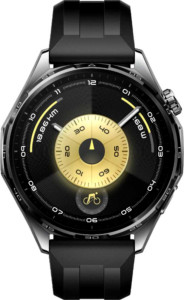
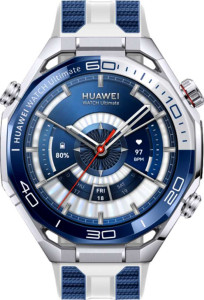
Both watches share a strong design foundation: OLED/AMOLED displays, sapphire glass, Always-On Display, replaceable bands, and identical 466 × 466 px resolutions. The key divergence lies in physical scale and water resistance. The Watch Ultimate 2 is larger at 48.5 × 48.5 mm with a 1.5″ screen, while the Watch GT 6 measures 46 × 46 mm with a 1.47″ panel — a modest size difference that nonetheless results in the GT 6 being noticeably sharper at 317 ppi versus 311 ppi on the Ultimate 2.

The weight gap is the most consequential real-world differentiator: the GT 6 weighs just 51.3 g compared to the Ultimate 2′s 80.5 g — over 57% heavier. Combined with the Ultimate 2′s greater thickness (12.9 mm vs. 11 mm), this means the Ultimate 2 has a substantially more noticeable presence on the wrist, which some users will appreciate as a premium, tool-watch feel, while others may find fatiguing during extended wear or sleep tracking. The GT 6′s slimmer, lighter profile makes it the more wearable daily companion by these numbers.

On water resistance, the two watches take different approaches: the Ultimate 2 carries a 10 ATM rating (suitable for recreational diving and serious water sports), while the GT 6 is rated 5 ATM but pairs it with an IP69 certification — meaning it withstands high-pressure, high-temperature water jets, a scenario the IP68-rated Ultimate 2 is not explicitly rated for. For most users, both are more than sufficient for swimming and showering, but the Ultimate 2 holds a clear edge for dedicated water activities. Overall, the GT 6 has the advantage for everyday comfort, while the Ultimate 2 edges ahead for rugged, water-intensive use cases and those who prefer a larger, heftier build.
Sensors:
Monitors blood oxygenation levels
Has a heart rate monitor
has GPS
has an accelerometer
Has a temperature sensor
has a compass
Has a barometer
has a gyroscope
Has a cadence sensor

The sensor suites of these two watches are nearly identical across the board — both pack heart rate monitoring, SpO2 (blood oxygen), GPS, accelerometer, gyroscope, compass, barometer, and temperature sensor. For the vast majority of health and fitness use cases, this shared foundation is comprehensive and competitive with top-tier smartwatches in the segment.

The sole differentiator is the cadence sensor, present on the Watch Ultimate 2 but absent on the GT 6. In practical terms, a dedicated cadence sensor directly measures step or pedal cycles per minute — a metric valued by runners tracking stride rate and, particularly, cyclists seeking accurate pedaling efficiency without relying on GPS-derived estimates. For casual users this gap is largely invisible, but for cyclists and performance-oriented runners, it represents a meaningful data quality advantage on the Ultimate 2.

The Watch Ultimate 2 holds a narrow but real edge in this category strictly due to the cadence sensor addition. The GT 6 is not lacking for everyday health and fitness tracking, but users who prioritize precise cadence data for cycling or structured run training will find the Ultimate 2 better equipped out of the box.

Activity tracking:
Tracks your sleep
Tracks distance
Tracks steps taken
Measures pace
Provides sleep reports
Detects activities automatically
Has a route tracker
Tracks elevation
Has multi-sport mode
Has exercise tagging
Has a stroke counter for swimming
Tracks calorie intake
Designed for diving
Designed for golf

Activity tracking coverage is impressively broad on both watches, with a shared feature set that covers sleep monitoring, distance, pace, elevation, route tracking, automatic activity detection, calorie tracking, multi-sport mode, exercise tagging, and even diving support. For the overwhelming majority of athletes and casual fitness users, either watch delivers a complete tracking experience without notable gaps.

Where the Watch Ultimate 2 pulls ahead is in two specific disciplines: golf and swimming stroke counting. Golf mode is a niche but dedicated feature that typically provides course mapping, shot tracking, and distance-to-pin data — entirely absent on the GT 6. The stroke counter for swimming is similarly targeted: it automatically tallies strokes per length, enabling swimmers to monitor technique and workload in a way that raw distance and pace data alone cannot capture. The GT 6 lacks both of these.

For general-purpose fitness tracking the two watches are effectively tied, but the Watch Ultimate 2 holds a clear advantage for users who swim seriously or play golf. These are not minor omissions on the GT 6 — for those specific activities, the Ultimate 2 offers meaningfully richer tracking data that directly informs performance and technique.

Connectivity:
has a cellular module
Is compatible with iOS
Is compatible with Android
Bluetooth version 6 5.2
supports Wi-Fi
supports ANT+
has NFC
supports Galileo

Connectivity on both watches shares a solid common ground: dual compatibility with iOS and Android, NFC for contactless payments, Galileo satellite support, and no cellular module on either — meaning both require a paired phone for calls and data. For most daily smartwatch users, this shared baseline is entirely sufficient.

The two meaningful differentiators cut in opposite directions. The Watch GT 6 features Bluetooth 6, a newer standard than the Bluetooth 5.2 found on the Ultimate 2. In practical terms, Bluetooth 6 brings improved connection stability, lower latency, and more efficient energy use — benefits that are most noticeable when the watch is used at the edge of pairing range or with wireless audio accessories. Conversely, the Watch Ultimate 2 includes Wi-Fi support, which the GT 6 lacks entirely. Wi-Fi enables faster firmware updates, potential music or data syncing without Bluetooth, and connectivity in environments where a phone may not be nearby but a network is available.

These two advantages effectively trade off against each other depending on use case. Users who prioritize a more future-proof, stable wireless link to their phone will lean toward the GT 6, while those who value the flexibility of direct network access for syncing and updates will find the Ultimate 2 more capable. On balance, neither watch has a decisive overall edge in connectivity — the winner depends entirely on which feature matters more to the individual user.

Battery:
battery power 867 mAh 867 mAh
battery life in training mode 40 hours 192 hours
has wireless charging
has a rechargeable battery
Has a solar power battery
has a removable battery

On paper, both watches start from an identical hardware baseline: an 867 mAh battery, wireless charging, and no removable or solar-assist option. Given the same cell capacity, one might expect comparable endurance — but the real-world numbers tell a strikingly different story.

In training mode, the Watch Ultimate 2 delivers an extraordinary 192 hours of battery life versus just 40 hours on the Watch GT 6 — nearly five times longer from the exact same battery size. This gap cannot be explained by hardware capacity alone and points directly to significant differences in power management, processor efficiency, or how aggressively each watch throttles GPS and sensor polling during workouts. For endurance athletes — ultramarathon runners, long-distance cyclists, or multi-day hikers — the Ultimate 2's stamina is a practical game-changer, eliminating mid-activity charging concerns that would be very real with the GT 6.

The Watch Ultimate 2 has a commanding advantage in this category. Sharing identical battery hardware yet achieving nearly 5× the training endurance makes the Ultimate 2 the clear choice for any user where extended activity tracking without recharging is a priority. The GT 6's 40-hour training ceiling is respectable for everyday workouts, but it is simply outclassed here.

Features:
release date September 2025 September 2025
has HRV tracking
measures VO2 max
measures resting heart rate
has fast/slow heart rate notifications
shows readiness level
Can be used to answer calls
Locates your phone
Has call control
Has notifications
has irregular heart rate warnings
Has ECG technology
Has silent alarm
Has vibrating alerts
Has a stopwatch
has voice commands
Has a built-in camera remote control function
Acquires GPS faster
warranty period 1 years 1 years

Feature parity between these two watches is remarkably high. Both offer a comprehensive smartwatch toolkit — call answering and control, notifications, HRV tracking, VO2 max, resting heart rate, readiness scores, irregular heart rate warnings, voice commands, camera remote, silent and vibrating alarms, and a stopwatch. Warranty is identical at one year. For the vast majority of daily smartwatch use cases, neither watch leaves the user wanting.

Two features tip the scales toward the Watch Ultimate 2. First, ECG technology — absent on the GT 6 — enables on-demand electrocardiogram readings, a clinically meaningful capability that can help detect atrial fibrillation and other rhythm anomalies that passive heart rate monitoring alone may miss. This is a substantive health monitoring advantage, not a minor checkbox. Second, faster GPS acquisition on the Ultimate 2 means less standing-around time waiting for a satellite lock before a run or ride — a small but genuinely appreciated quality-of-life improvement for outdoor athletes who train on a schedule.

The Watch Ultimate 2 holds a clear edge in this category. The GT 6 is thoroughly capable and falls short only on these two points, but ECG in particular is a meaningful differentiator for health-conscious users — it elevates cardiac monitoring from passive alerts to active, on-demand diagnostics that the GT 6 simply cannot match.

App & Software:
Provides activity reports
Has inactivity alerts
Counts how many calories you've burned
Has goal setting
Has achievements
Free app
Has exercise diary
Ad-free
Has coaching
Has temperature tracking
Has period notifications
Supports routes
Has voice feedback
Has music playback
Displays fertile window notifications
Includes maps
Predicts ovulation
Predicts start date
Supports widgets
Can be personalised
Has barcode scanner on app
Tracks water intake
Has weight tracking
Has live tracking
Tracks BMI

Across every single app and software feature in this category, the Huawei Watch GT 6 and Watch Ultimate 2 are in complete lockstep. Both run a free, ad-free companion app that covers the full spectrum of health and fitness management — activity reports, exercise diary, coaching, live tracking, route and map support, voice feedback, music playback, and comprehensive body metrics including calorie burn, BMI, water intake, and weight tracking.

The software experience extends meaningfully into wellness territory as well, with both watches supporting period notifications, fertile window alerts, ovulation prediction, and cycle start date forecasting — a notably thorough reproductive health feature set. Personalization options, widget support, temperature tracking, and inactivity alerts round out an ecosystem that covers casual users and dedicated athletes equally well. The only shared gap is the absence of a barcode scanner on the app, which is a minor omission for users who track nutrition.

This category is a complete tie. There is no software or app feature that distinguishes one watch from the other based on the provided data. A buyer's decision here should rest entirely on the hardware and performance differences covered in other categories — the app experience itself will be identical regardless of which model is chosen.

Miscellaneous:
has a battery level indicator
Has auto pause
Has passcode
Compatible with smart scales
Compatible with external heart rate monitors
Is compatible with Windows
has an external memory slot
Is compatible with Mac OS X
has a socket for a 3.5 mm audio jack

The miscellaneous feature set for both watches is identical in every respect. Both include a battery level indicator, auto pause, and passcode security, alongside compatibility with smart scales and external heart rate monitors — the latter being useful for athletes who prefer chest-strap accuracy over wrist-based optical readings during high-intensity sessions.

Shared limitations are equally consistent: no Windows or Mac OS X compatibility, no external memory slot, and no 3.5 mm audio jack. The absence of desktop OS compatibility is worth noting for users who prefer to manage health data directly from a computer rather than exclusively through a smartphone app, though this is a common constraint across the smartwatch category. The lack of a memory slot means neither watch can independently store significant amounts of data or media beyond what the onboard storage allows.

Much like the App and Software category, this is an unambiguous complete tie. Not a single miscellaneous spec differentiates the two watches. Buyers should weight this category as neutral in their decision-making and focus on the meaningful distinctions found in design, battery endurance, features, and activity tracking.

Comparison Summary & Verdict

After examining every specification, a clear picture emerges for each device. The Huawei Watch GT 6 stands out as the lighter, slimmer option at just 51.3 g and 11 mm thick, making it an excellent daily wearable for users who value comfort and a higher Bluetooth version. The Huawei Watch Ultimate 2, on the other hand, is built for serious athletes and outdoor enthusiasts, offering an extraordinary 192-hour training battery life, a 10 ATM water resistance rating, Wi-Fi connectivity, ECG technology, a cadence sensor, golf-specific features, and a stroke counter for swimming. If you want a refined, lightweight smartwatch for general wellness tracking, the GT 6 delivers. If you demand a rugged, feature-packed performance watch with unmatched endurance, the Huawei Watch Ultimate 2 is the clear fit.

Huawei Watch GT 6
Buy Huawei Watch GT 6 if...

Buy the Huawei Watch GT 6 if you prefer a lighter, slimmer watch for everyday use and want the latest Bluetooth 6 connectivity without paying a premium for advanced sports-specific features.

Huawei Watch Ultimate 2
Buy Huawei Watch Ultimate 2 if...

Buy the Huawei Watch Ultimate 2 if you need a rugged, high-endurance watch with 192 hours of training battery life, Wi-Fi, ECG, 10 ATM water resistance, and dedicated tools for swimming, cycling, and golf.