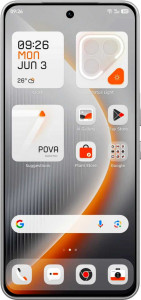
Infinix GT 30 Pro
Tecno Pova 7 Pro 5G

Infinix GT 30 Pro Tecno Pova 7 Pro 5G

Overview

When choosing between the Infinix GT 30 Pro and the Tecno Pova 7 Pro 5G, two mid-range 5G contenders emerge with surprisingly different priorities. Both share a sharp 6.78″ OLED display, 144Hz refresh rate, and 45W fast charging, yet they diverge sharply when it comes to raw processing power, camera capabilities, battery size, and everyday connectivity features. Which one is the right fit for you? Read on to find out.

Common Features

  • Both phones are water resistant with an IP64 ingress protection rating.
  • Neither phone has a rugged build.
  • Neither phone can be folded.
  • Both phones feature a 6.78″ OLED/AMOLED display.
  • Both phones have a pixel density of 440 ppi with a resolution of 1224 x 2720 px.
  • Both phones support a 144Hz refresh rate.
  • HDR10 support is not available on either phone.
  • HDR10+ support is not available on either phone.
  • Always-On Display is available on both phones.
  • Both phones come with 12GB of RAM and are built on a 4 nm semiconductor process.
  • Both phones support 64-bit processing and use big.LITTLE technology with 8 CPU threads.
  • Both phones have integrated LTE and integrated graphics, and support DirectX 12.
  • Both phones run Android 15 and support theme customization.
  • App tracking can be blocked on both phones, and both provide camera/microphone and location privacy options.
  • Both phones have a dual-lens main camera and a 13MP front camera.
  • Neither phone has built-in optical image stabilization or a BSI sensor.
  • Both phones support continuous autofocus and phase-detection autofocus when recording.
  • Both phones support 45W fast charging and 30W wireless charging, and neither has a removable battery.
  • Both phones have stereo speakers, and none of aptX, LDAC, aptX HD, aptX Adaptive, aptX Lossless are supported on either device.
  • Both phones support 5G, dual SIM, NFC, USB Type-C (USB 2.0), and have a fingerprint scanner.
  • Neither phone has an external memory slot or emergency SOS via satellite.
  • Both phones have a video light, and neither has a sapphire glass display, curved display, or e-paper display.

Main Differences

  • Weight is 189 g on Infinix GT 30 Pro and 195 g on Tecno Pova 7 Pro 5G.
  • Thickness is 8 mm on Infinix GT 30 Pro and 8.2 mm on Tecno Pova 7 Pro 5G.
  • Volume is 99.27 cm³ on Infinix GT 30 Pro and 101.76 cm³ on Tecno Pova 7 Pro 5G.
  • Damage-resistant glass is present on Infinix GT 30 Pro but not available on Tecno Pova 7 Pro 5G.
  • Internal storage is 512GB on Infinix GT 30 Pro and 256GB on Tecno Pova 7 Pro 5G.
  • The chipset is MediaTek Dimensity 8350 on Infinix GT 30 Pro and MediaTek Dimensity 7300 on Tecno Pova 7 Pro 5G.
  • AnTuTu benchmark score is 1,450,000 on Infinix GT 30 Pro and 676,261 on Tecno Pova 7 Pro 5G.
  • Geekbench 6 multi-core score is 4700 on Infinix GT 30 Pro and 2932 on Tecno Pova 7 Pro 5G.
  • Geekbench 6 single-core score is 1536 on Infinix GT 30 Pro and 1026 on Tecno Pova 7 Pro 5G.
  • The GPU is Mali G615 MC6 on Infinix GT 30 Pro and Mali G615 MC2 on Tecno Pova 7 Pro 5G.
  • GPU clock speed is 1400 MHz on Infinix GT 30 Pro and 1047 MHz on Tecno Pova 7 Pro 5G.
  • RAM speed is 8533 MHz on Infinix GT 30 Pro and 6400 MHz on Tecno Pova 7 Pro 5G.
  • Maximum memory amount is 24GB on Infinix GT 30 Pro and 16GB on Tecno Pova 7 Pro 5G.
  • Main camera resolution is 108 & 8 MP on Infinix GT 30 Pro and 64 & 8 MP on Tecno Pova 7 Pro 5G.
  • Dual-tone LED flash is present on Infinix GT 30 Pro but not available on Tecno Pova 7 Pro 5G.
  • Laser autofocus is present on Infinix GT 30 Pro but not available on Tecno Pova 7 Pro 5G.
  • RAW shooting is supported on Infinix GT 30 Pro but not on Tecno Pova 7 Pro 5G.
  • Battery capacity is 5500 mAh on Infinix GT 30 Pro and 6000 mAh on Tecno Pova 7 Pro 5G.
  • Reverse wireless charging is available on Infinix GT 30 Pro but not on Tecno Pova 7 Pro 5G.
  • A 3.5 mm audio jack is present on Tecno Pova 7 Pro 5G but not available on Infinix GT 30 Pro.
  • A built-in radio is present on Infinix GT 30 Pro but not available on Tecno Pova 7 Pro 5G.
  • An infrared sensor is present on Infinix GT 30 Pro but not available on Tecno Pova 7 Pro 5G.
Specs Comparison
Infinix GT 30 Pro

Infinix GT 30 Pro

Tecno Pova 7 Pro 5G

Tecno Pova 7 Pro 5G

Design:
water resistance Water resistant Water resistant
weight 189 g 195 g
thickness 8 mm 8.2 mm
width 75.8 mm 75.9 mm
height 163.7 mm 163.5 mm
volume 99.26768 cm³ 101.75913 cm³
Ingress Protection (IP) rating IP64 IP64
has a rugged build
can be folded

In terms of overall form factor, the Infinix GT 30 Pro and Tecno Pova 7 Pro 5G are remarkably close siblings. Their footprints are nearly indistinguishable — a difference of just 0.1 mm in width and 0.2 mm in height means that in practice, both phones occupy virtually the same amount of pocket or palm space.

Where a small but real distinction emerges is in density and mass. The GT 30 Pro is 6 g lighter (189 g vs. 195 g) and 0.2 mm thinner (8 mm vs. 8.2 mm), which translates to a slightly more compact internal volume of 99.27 cm³ compared to the Pova 7 Pro's 101.76 cm³. While neither difference is dramatic, over a long day of use that marginal reduction in weight and thickness can contribute to a subtly less fatiguing one-handed grip — an edge worth noting for users sensitive to ergonomics.

On protection, both devices are evenly matched: each carries an IP64 rating, meaning they resist dust ingress and can handle water splashes from any direction, but neither is rated for submersion. Neither phone offers a rugged build or a foldable form. Overall, the GT 30 Pro holds a slight design edge by being marginally lighter and slimmer, but prospective buyers should consider this a near-tie — the real differentiators between these two phones lie elsewhere.

Display:
Display type OLED/AMOLED OLED/AMOLED
screen size 6.78" 6.78"
pixel density 440 ppi 440 ppi
resolution 1224 x 2720 px 1224 x 2720 px
refresh rate 144Hz 144Hz
has branded damage-resistant glass
supports HDR10
supports HDR10+
Always-On Display
supports Dolby Vision
Has a secondary screen
has a touch screen

The display hardware on these two phones is, for all practical purposes, a carbon copy: both feature a 6.78″ OLED/AMOLED panel running at 1224 x 2720 px, a sharp 440 ppi pixel density, and a smooth 144Hz refresh rate. AMOLED technology brings genuine blacks, vivid colors, and power-efficient rendering of dark content, while 144Hz ensures fluid scrolling and responsive gaming — a meaningful perk for the gaming-oriented audience both phones target. Always-On Display is supported on both, adding ambient glanceability without a full screen wake.

With the panels themselves being identical, the single differentiator in this group is screen durability. The GT 30 Pro ships with branded damage-resistant glass, while the Pova 7 Pro 5G does not. In day-to-day use, this matters: rated scratch- and shatter-resistant glass meaningfully reduces the risk of surface damage from keys, drops, and minor impacts, potentially saving on costly screen repairs over the device's lifetime.

The GT 30 Pro earns a clear edge in this category. Since every measurable display metric is identical, that added layer of screen protection is the deciding factor — and it is a practical one that will be felt over months of real use rather than just on a spec sheet.

Performance:
internal storage 512GB 256GB
RAM 12GB 12GB
AnTuTu benchmark score 1450000 676261
Chipset (SoC) name MediaTek Dimensity 8350 MediaTek Dimensity 7300
GPU name Mali G615 MC6 Mali G615 MC2
CPU speed 1 x 3.35 & 3 x 3.2 & 4 x 2.2 GHz 4 x 2.5 & 4 x 2 GHz
Geekbench 6 result (multi) 4700 2932
Geekbench 6 result (single) 1536 1026
GPU clock speed 1400 MHz 1047 MHz
Has integrated LTE
RAM speed 8533 MHz 6400 MHz
semiconductor size 4 nm 4 nm
Supports 64-bit
DirectX version DirectX 12 DirectX 12
Has integrated graphics
Uses big.LITTLE technology
CPU threads 8 threads 8 threads
Uses HMP
maximum memory amount 24GB 16GB
DDR memory version 5 5

This is where the two phones diverge most dramatically. The GT 30 Pro is powered by the MediaTek Dimensity 8350, while the Pova 7 Pro 5G runs on the MediaTek Dimensity 7300 — and the benchmark data makes the performance gap impossible to ignore. The GT 30 Pro's AnTuTu score of 1,450,000 is more than double the Pova 7 Pro's 676,261, a difference that is not merely theoretical. In real-world terms, this translates to noticeably faster app launches, smoother multitasking, and the ability to handle demanding 3D titles at higher settings without throttling.

The GPU story reinforces this gap. Both phones use a Mali G615 variant, but the GT 30 Pro's MC6 configuration — six cores clocked at 1400 MHz — dwarfs the Pova 7 Pro's MC2 variant running at 1047 MHz. That is three times the GPU cores at a significantly higher clock, which directly impacts frame rates in graphically intensive games. The CPU advantage is similarly pronounced: Geekbench 6 multi-core scores of 4700 vs. 2932 and single-core scores of 1536 vs. 1026 confirm the Dimensity 8350 outpaces the 7300 across both sustained workloads and snappy single-threaded tasks. The GT 30 Pro also benefits from faster 8533 MHz RAM versus 6400 MHz, reducing memory bottlenecks under load.

Storage and memory headroom further separate the two: the GT 30 Pro offers 512 GB of internal storage and supports up to 24 GB of maximum memory, compared to 256 GB and a 16 GB ceiling on the Pova 7 Pro. The GT 30 Pro holds an overwhelming performance advantage in this category across every measurable dimension — chipset, GPU, CPU throughput, RAM speed, and storage capacity.

Cameras:
megapixels (main camera) 108 & 8 MP 64 & 8 MP
Has a dual-lens (or multi-lens) main camera
megapixels (front camera) 13MP 13MP
has built-in optical image stabilization
Has a dual-tone LED flash
number of flash LEDs 2 2
has a BSI sensor
has a CMOS sensor
has continuous autofocus when recording movies
Has phase-detection autofocus for photos
supports slow-motion video recording
has a built-in HDR mode
has manual exposure
has a flash
optical zoom 0x 0x
has manual ISO
has a serial shot mode
has manual focus
has a front camera
Has laser autofocus
Shoots 360° panorama
has manual white balance
shoots raw
has touch autofocus
has manual shutter speed
can create panoramas in-camera
Has timelapse function
Has a front-facing LED flash
has a dual-lens (or multi-lens) front camera
supports HDR10 recording
supports Dolby Vision recording
has a front-facing camera under the display
Has a RGB LED flash
has 3D photo/video recording capabilities

Both phones ship with a dual-lens rear system, but the primary sensor resolution tells an immediate story: the GT 30 Pro leads with a 108 MP main shooter versus the Pova 7 Pro's 64 MP. Higher megapixel counts allow for more detail retention when cropping and can improve the quality of downsampled output — a tangible advantage for users who frequently zoom into shots or print at larger sizes. The secondary 8 MP lens is shared by both, and front-facing cameras are identical at 13 MP, so the differentiation is squarely on the main sensor.

Beyond resolution, the GT 30 Pro holds two additional hardware advantages. It includes laser autofocus, which supplements phase-detection AF for faster, more reliable lock-on — especially useful in low-light or fast-moving scenarios where contrast-based systems can hunt. It also features a dual-tone LED flash, which helps produce more natural-looking skin tones under artificial lighting by blending warm and cool light. The Pova 7 Pro lacks both. Perhaps more significantly for enthusiasts, the GT 30 Pro supports RAW shooting, enabling uncompressed image capture for post-processing flexibility — a capability the Pova 7 Pro does not offer at all.

The GT 30 Pro takes a clear and well-rounded camera edge in this category. Its advantages — higher main sensor resolution, laser autofocus, dual-tone flash, and RAW capture — compound into a meaningfully more capable imaging system, particularly for users who push beyond the default auto mode.

Operating system:
Android version Android 15 Android 15
has clipboard warnings
has location privacy options
has camera/microphone privacy options
has Mail Privacy Protection
has theme customization
can block app tracking
blocks cross-site tracking
has on-device machine learning
has notification permissions
has media picker
Can play games while they download
has dark mode
has Wi-Fi password sharing
has battery health check
has an extra dim mode
has focus modes
has dynamic theming
can offload apps
Has customizable notifications
has Live Text
has full-page screenshots
supports split screen
gets direct OS updates
has PiP
Can be used as a PC
Has sharing intents
has a child lock
Supports widgets
Is free and open source
Has offline voice recognition
has voice commands
Tracks the current position of a mobile device
is a multi-user system
has Quick Start

Rarely does a spec group tell such a definitive story: the Infinix GT 30 Pro and Tecno Pova 7 Pro 5G run identical software profiles across every single data point provided. Both ship with Android 15, and their feature sets — from privacy controls and dynamic theming to split-screen multitasking, Picture-in-Picture, and offline voice recognition — are a perfect match. Neither receives direct OS updates, and neither supports Quick Start or cross-site tracking blocks.

The breadth of shared features is still worth acknowledging for buyers coming from older devices or competing platforms. Both phones offer a solid privacy toolkit including camera and microphone access controls, app tracking blocks, and location privacy options. Productivity staples like split-screen support, widget customization, and full-page screenshots are present on both, as is on-device machine learning for tasks like Live Text. These are meaningful capabilities that improve daily usability, and both phones deliver them equally.

This category is an unambiguous tie. With no divergence across any spec in this group, the operating system experience offers zero basis for choosing one phone over the other — buyers should weigh this alongside the meaningful differences found in other categories.

Battery:
battery power 5500 mAh 6000 mAh
has wireless charging
Supports fast charging
charging speed 45W 45W
wireless charging speed 30W 30W
has reverse wireless charging
has a removable battery
has a battery level indicator
has a rechargeable battery

Charging infrastructure is identical across both phones — 45W wired fast charging and 30W wireless charging ensure that neither has an advantage in how quickly power is replenished. The more interesting split is in capacity and flexibility. The Pova 7 Pro 5G packs a larger 6000 mAh battery against the GT 30 Pro's 5500 mAh, a 500 mAh difference that, all else being equal, translates to a proportionally longer time between charges — potentially meaningful for heavy users who push through a full day and into the evening.

However, the GT 30 Pro counters with reverse wireless charging, a feature the Pova 7 Pro entirely lacks. This allows the GT 30 Pro to act as a wireless charging pad for other compatible devices — earbuds, smartwatches, or a friend's phone — turning the handset into a portable power source without any cables. For users embedded in a wireless charging ecosystem, this is a genuinely useful convenience that adds utility beyond the phone itself.

The battery category produces a split verdict. Users who prioritize raw endurance and the reassurance of a larger reservoir will favor the Pova 7 Pro 5G. Those who value charging versatility and the ability to top up other devices wirelessly will find the GT 30 Pro's feature set more compelling. Neither phone dominates outright — the decision hinges on which capability matters more in a given user's daily routine.

Audio:
has a socket for a 3.5 mm audio jack
has stereo speakers
has aptX
has LDAC
has aptX HD
has aptX Adaptive
has aptX Lossless
Has a radio

Stereo speakers are the one shared audio highlight here — both phones deliver them, which means spatial sound for media and gaming without needing headphones. Beyond that common ground, the two phones make opposing trade-offs that cater to distinctly different listener preferences. The Pova 7 Pro 5G retains a 3.5 mm headphone jack, while the GT 30 Pro omits it entirely. For users with a collection of wired headphones or earphones, this is a practical daily convenience — no dongles, no Bluetooth pairing, no charging a wireless accessory before a commute.

The GT 30 Pro's counterpoint is a built-in FM radio tuner, absent on the Pova 7 Pro. While radio may seem like a legacy feature, it remains genuinely useful in areas with strong terrestrial broadcasts, during emergencies when data networks are congested, or simply for battery-efficient background listening that does not consume mobile data. Neither phone supports high-resolution Bluetooth codecs such as aptX or LDAC, so wireless audio quality is on equal footing for both.

This category is a trade-off draw rather than a clear winner. The Pova 7 Pro 5G edges ahead for wired audio users who value plug-and-play headphone compatibility, while the GT 30 Pro appeals to those who prioritize broadcast radio access. The right choice depends entirely on which of these two features aligns with the user's listening habits.

Connectivity & Features:
release date May 2025 June 2025
has 5G support
SIM cards 2 SIM 2 SIM
has an external memory slot
Has USB Type-C
USB version 2 2
has NFC
Has a fingerprint scanner
has emergency SOS via satellite
has crash detection
is DLNA-certified
has a gyroscope
supports ANT+
Has a heart rate monitor
has GPS
has a compass
supports Wi-Fi
Has an infrared sensor
has an accelerometer
has a cellular module
Has a barometer
has an HDMI output
Uses 3D facial recognition
Has an iris scanner
Stylus included
supports Galileo
Has motion tracking
Has optical tracking
Has a built-in projector

Across the broad connectivity checklist — 5G, dual SIM, NFC, USB Type-C, Wi-Fi, GPS with Galileo support, fingerprint scanner, gyroscope, and accelerometer — these two phones are in complete lockstep. The shared presence of NFC is worth highlighting for buyers in this segment, as it enables contactless payments and quick device pairing, a feature not guaranteed at every price point. Dual-band positioning with Galileo support alongside GPS improves location accuracy, and both phones deliver this equally.

Scan the full list and one solitary difference surfaces: the GT 30 Pro includes an infrared (IR) blaster, while the Pova 7 Pro does not. An IR blaster turns the phone into a universal remote control for televisions, air conditioners, set-top boxes, and a wide range of home appliances — a feature that sounds niche but proves surprisingly useful in daily life, especially in households with multiple IR-controlled devices. It costs nothing in terms of complexity or battery, but its absence on the Pova 7 Pro is a permanent hardware limitation.

The GT 30 Pro takes a narrow but clear edge in this category. With every other connectivity and sensor spec being identical, the IR blaster is the sole differentiator — and for users who would actually use it, it adds tangible everyday convenience that the Pova 7 Pro simply cannot replicate.

Miscellaneous:
has a video light
Has sapphire glass display
Has a curved display
Has an e-paper display

The miscellaneous spec group is a clean sweep of shared traits: both the GT 30 Pro and Pova 7 Pro 5G include a video light, and neither features a sapphire glass display, a curved screen, or an e-paper panel. The presence of a video light on both is a small but practical note — it provides continuous illumination for video recording in low-light settings, complementing the standard camera flash.

This category is a complete tie with no differentiating data points. Buyers should look to the more substantive spec groups — performance, cameras, and battery — to drive their decision.

Comparison Summary & Verdict

After a thorough look at the specs, both phones offer a compelling package, but each shines for a different type of user. The Infinix GT 30 Pro is the clear choice for performance enthusiasts: its MediaTek Dimensity 8350 chipset, dramatically higher AnTuTu score of 1,450,000, 512GB storage, laser autofocus, RAW shooting, and reverse wireless charging make it a feature-rich powerhouse. The Tecno Pova 7 Pro 5G, on the other hand, appeals to users who value endurance and everyday practicality, thanks to its larger 6000 mAh battery, 3.5mm headphone jack, and a more accessible price point implied by its modest chipset. Both phones run Android 15, support NFC and dual SIM, and share the same stunning display. Your decision ultimately comes down to whether you prioritize speed and storage or battery longevity and audio versatility.

Infinix GT 30 Pro
Buy Infinix GT 30 Pro if...

Buy the Infinix GT 30 Pro if you want top-tier performance, more storage, and a richer camera feature set including RAW shooting and laser autofocus.

Tecno Pova 7 Pro 5G
Buy Tecno Pova 7 Pro 5G if...

Buy the Tecno Pova 7 Pro 5G if you prioritize a larger battery for all-day use and want a headphone jack for wired audio convenience.